Technical-tactical performance of Spanish female basketball players in first division (2013–2022): effects of match outcome, location, and playing position
Gómez-Carmona, Carlos D. (Universidad de Zaragoza) ; Gómez-Ramos, Elena ; Piñar, María I. ; Contreras, José M. ; Ibáñez, Sergio J.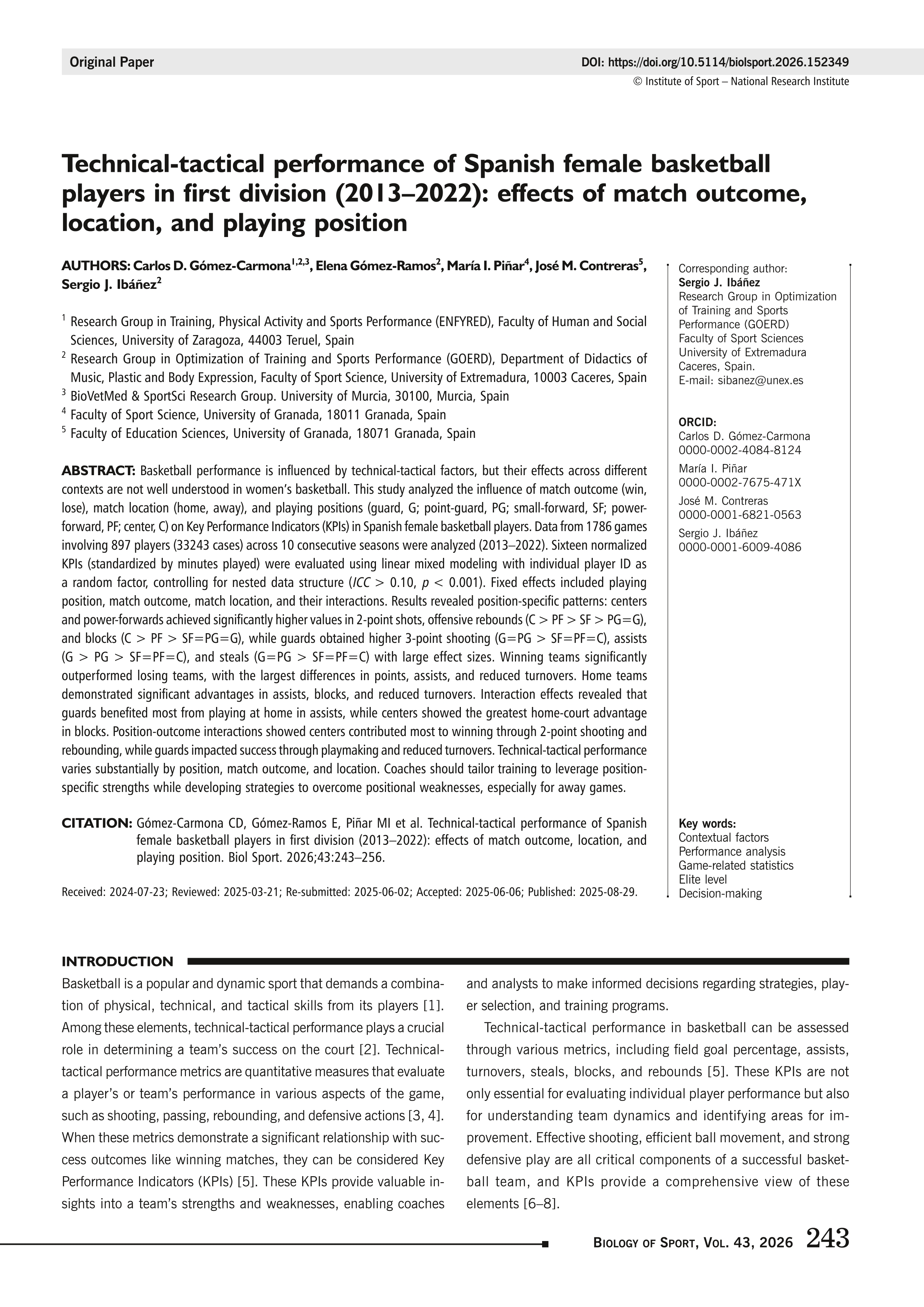
Resumen: Basketball performance is influenced by technical-tactical factors, but their effects across different contexts are not well understood in women’s basketball. This study analyzed the influence of match outcome (win, lose), match location (home, away), and playing positions (guard, G; point-guard, PG; small-forward, SF; power forward, PF; center, C) on Key Performance Indicators (KPIs) in Spanish female basketball players. Data from 1786 games involving 897 players (33243 cases) across 10 consecutive seasons were analyzed (2013–2022). Sixteen normalized KPIs (standardized by minutes played) were evaluated using linear mixed modeling with individual player ID as a random factor, controlling for nested data structure (ICC > 0.10, p < 0.001). Fixed effects included playing position, match outcome, match location, and their interactions. Results revealed position-specific patterns: centers and power-forwards achieved significantly higher values in 2-point shots, offensive rebounds (C > PF > SF > PG=G), and blocks (C > PF > SF=PG=G), while guards obtained higher 3-point shooting (G=PG > SF=PF=C), assists (G > PG > SF=PF=C), and steals (G=PG > SF=PF=C) with large effect sizes. Winning teams significantly outperformed losing teams, with the largest differences in points, assists, and reduced turnovers. Home teams demonstrated significant advantages in assists, blocks, and reduced turnovers. Interaction effects revealed that guards benefited most from playing at home in assists, while centers showed the greatest home-court advantage in blocks. Position-outcome interactions showed centers contributed most to winning through 2-point shooting and rebounding, while guards impacted success through playmaking and reduced turnovers. Technical-tactical performance varies substantially by position, match outcome, and location. Coaches should tailor training to leverage positionspecific strengths while developing strategies to overcome positional weaknesses, especially for away games.
Idioma: Inglés
DOI: 10.5114/biolsport.2026.152349
Año: 2026
Publicado en: BIOLOGY OF SPORT 43 (2026), 243-256
ISSN: 0860-021X
Tipo y forma: Artículo (Versión definitiva)
Área (Departamento): Área Didáctica Expres.Corporal (Dpto. Expres.Music.Plást.Corp.)
 Debe reconocer adecuadamente la autoría, proporcionar un enlace a la licencia e indicar si se han realizado cambios. Puede hacerlo de cualquier manera razonable, pero no de una manera que sugiera que tiene el apoyo del licenciador o lo recibe por el uso que hace.
Exportado de SIDERAL (2025-11-07-10:25:15)
Visitas y descargas
Idioma: Inglés
DOI: 10.5114/biolsport.2026.152349
Año: 2026
Publicado en: BIOLOGY OF SPORT 43 (2026), 243-256
ISSN: 0860-021X
Tipo y forma: Artículo (Versión definitiva)
Área (Departamento): Área Didáctica Expres.Corporal (Dpto. Expres.Music.Plást.Corp.)
Debe reconocer adecuadamente la autoría, proporcionar un enlace a la licencia e indicar si se han realizado cambios. Puede hacerlo de cualquier manera razonable, pero no de una manera que sugiera que tiene el apoyo del licenciador o lo recibe por el uso que hace. Exportado de SIDERAL (2025-11-07-10:25:15)
Enlace permanente:
Visitas y descargas
Este artículo se encuentra en las siguientes colecciones:
Artículos > Artículos por área > Didáctica de la Expresión Corporal
Registro creado el 2025-11-07, última modificación el 2025-11-07