Latent class analysis of women with borderline personality disorder: the role of adverse childhood experiences in impulsivity, emotional dysregulation, and neurocognitive profiles
Laffite, Horus ; Díaz-Garrido, J. A. ; Ordóñez-Carrasco, J. L. (Universidad de Zaragoza) ; Hernández-Fleta, J. L. ; Martínez-Loredo, V.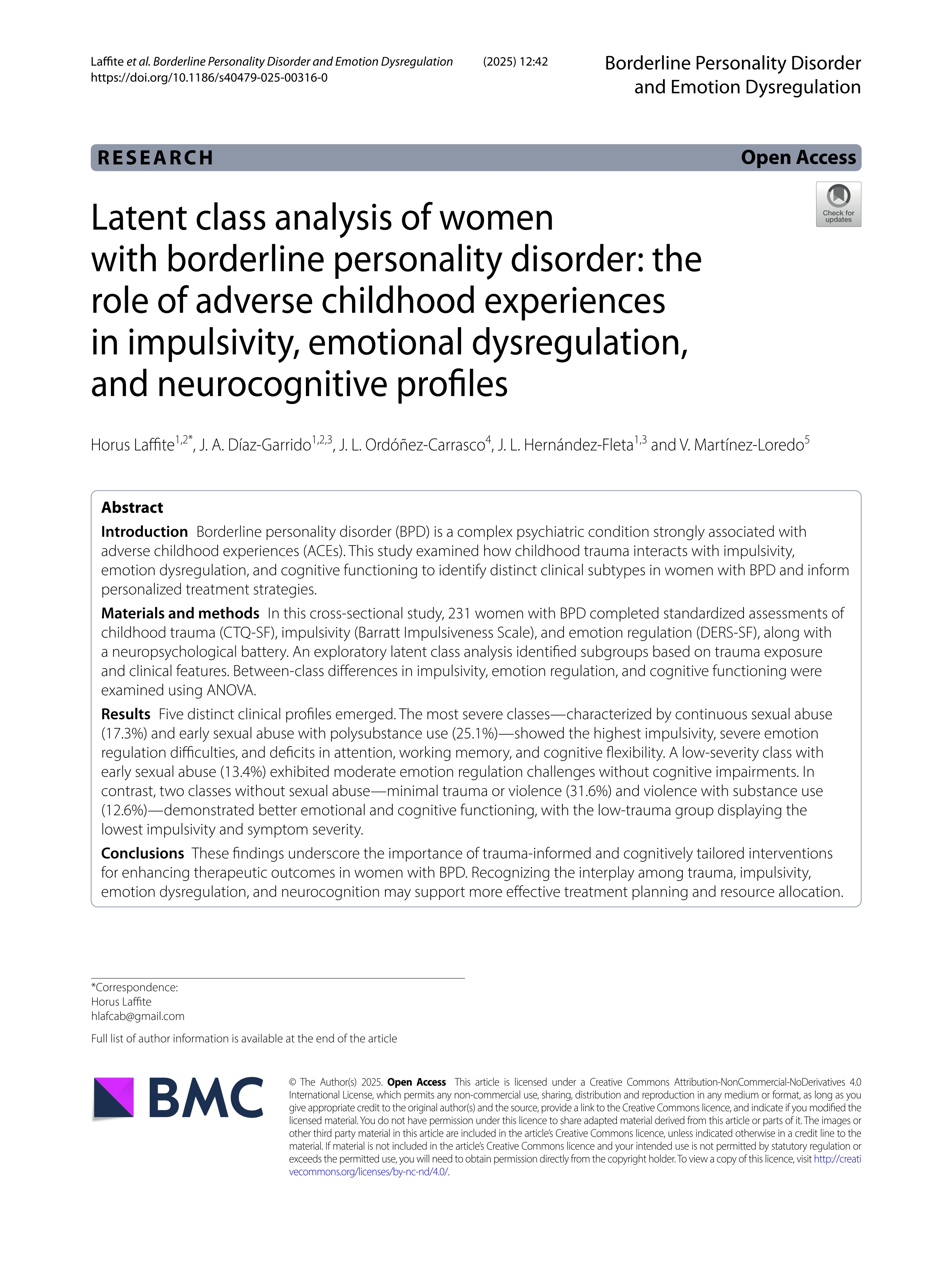
Resumen: Introduction: Borderline personality disorder (BPD) is a complex psychiatric condition strongly associated with adverse childhood experiences (ACEs). This study examined how childhood trauma interacts with impulsivity, emotion dysregulation, and cognitive functioning to identify distinct clinical subtypes in women with BPD and inform personalized treatment strategies.
Materials and methods: In this cross-sectional study, 231 women with BPD completed standardized assessments of childhood trauma (CTQ-SF), impulsivity (Barratt Impulsiveness Scale), and emotion regulation (DERS-SF), along with a neuropsychological battery. An exploratory latent class analysis identified subgroups based on trauma exposure and clinical features. Between-class differences in impulsivity, emotion regulation, and cognitive functioning were examined using ANOVA.
Results: Five distinct clinical profiles emerged. The most severe classes—characterized by continuous sexual abuse (17.3%) and early sexual abuse with polysubstance use (25.1%)—showed the highest impulsivity, severe emotion regulation difficulties, and deficits in attention, working memory, and cognitive flexibility. A low-severity class with early sexual abuse (13.4%) exhibited moderate emotion regulation challenges without cognitive impairments. In contrast, two classes without sexual abuse—minimal trauma or violence (31.6%) and violence with substance use (12.6%)—demonstrated better emotional and cognitive functioning, with the low-trauma group displaying the lowest impulsivity and symptom severity.
Conclusions: These findings underscore the importance of trauma-informed and cognitively tailored interventions for enhancing therapeutic outcomes in women with BPD. Recognizing the interplay among trauma, impulsivity, emotion dysregulation, and neurocognition may support more effective treatment planning and resource allocation.
Idioma: Inglés
DOI: 10.1186/s40479-025-00316-0
Año: 2025
Publicado en: Borderline Personality Disorder and Emotion Dysregulation 12, 1 (2025), [13 pp.]
ISSN: 2051-6673
Tipo y forma: Artículo (Versión definitiva)
Área (Departamento): Área Metod.Ciencias Comportam. (Dpto. Psicología y Sociología)
 Debe reconocer adecuadamente la autoría, proporcionar un enlace a la licencia e indicar si se han realizado cambios. Puede hacerlo de cualquier manera razonable, pero no de una manera que sugiera que tiene el apoyo del licenciador o lo recibe por el uso que hace. No puede utilizar el material para una finalidad comercial. Si remezcla, transforma o crea a partir del material, no puede difundir el material modificado.
Exportado de SIDERAL (2025-11-07-10:26:19)
Visitas y descargas
Materials and methods: In this cross-sectional study, 231 women with BPD completed standardized assessments of childhood trauma (CTQ-SF), impulsivity (Barratt Impulsiveness Scale), and emotion regulation (DERS-SF), along with a neuropsychological battery. An exploratory latent class analysis identified subgroups based on trauma exposure and clinical features. Between-class differences in impulsivity, emotion regulation, and cognitive functioning were examined using ANOVA.
Results: Five distinct clinical profiles emerged. The most severe classes—characterized by continuous sexual abuse (17.3%) and early sexual abuse with polysubstance use (25.1%)—showed the highest impulsivity, severe emotion regulation difficulties, and deficits in attention, working memory, and cognitive flexibility. A low-severity class with early sexual abuse (13.4%) exhibited moderate emotion regulation challenges without cognitive impairments. In contrast, two classes without sexual abuse—minimal trauma or violence (31.6%) and violence with substance use (12.6%)—demonstrated better emotional and cognitive functioning, with the low-trauma group displaying the lowest impulsivity and symptom severity.
Conclusions: These findings underscore the importance of trauma-informed and cognitively tailored interventions for enhancing therapeutic outcomes in women with BPD. Recognizing the interplay among trauma, impulsivity, emotion dysregulation, and neurocognition may support more effective treatment planning and resource allocation.
Idioma: Inglés
DOI: 10.1186/s40479-025-00316-0
Año: 2025
Publicado en: Borderline Personality Disorder and Emotion Dysregulation 12, 1 (2025), [13 pp.]
ISSN: 2051-6673
Tipo y forma: Artículo (Versión definitiva)
Área (Departamento): Área Metod.Ciencias Comportam. (Dpto. Psicología y Sociología)
Debe reconocer adecuadamente la autoría, proporcionar un enlace a la licencia e indicar si se han realizado cambios. Puede hacerlo de cualquier manera razonable, pero no de una manera que sugiera que tiene el apoyo del licenciador o lo recibe por el uso que hace. No puede utilizar el material para una finalidad comercial. Si remezcla, transforma o crea a partir del material, no puede difundir el material modificado.Exportado de SIDERAL (2025-11-07-10:26:19)
Enlace permanente:
Visitas y descargas
Este artículo se encuentra en las siguientes colecciones:
Artículos > Artículos por área > Metod. de las Ciencias del Comportamiento
Registro creado el 2025-11-07, última modificación el 2025-11-07