Cardiovascular risk factors in immigrants: an intersectional real world data approach to understand health inequalities
Collazo, Yuleydy ; Gamba, Adriana ; Malo, Sara (Universidad de Zaragoza) ; Rabanaque, MJ (Universidad de Zaragoza) ; Carela, Francisco Javier ; Aguilar-Palacio, Isabel (Universidad de Zaragoza)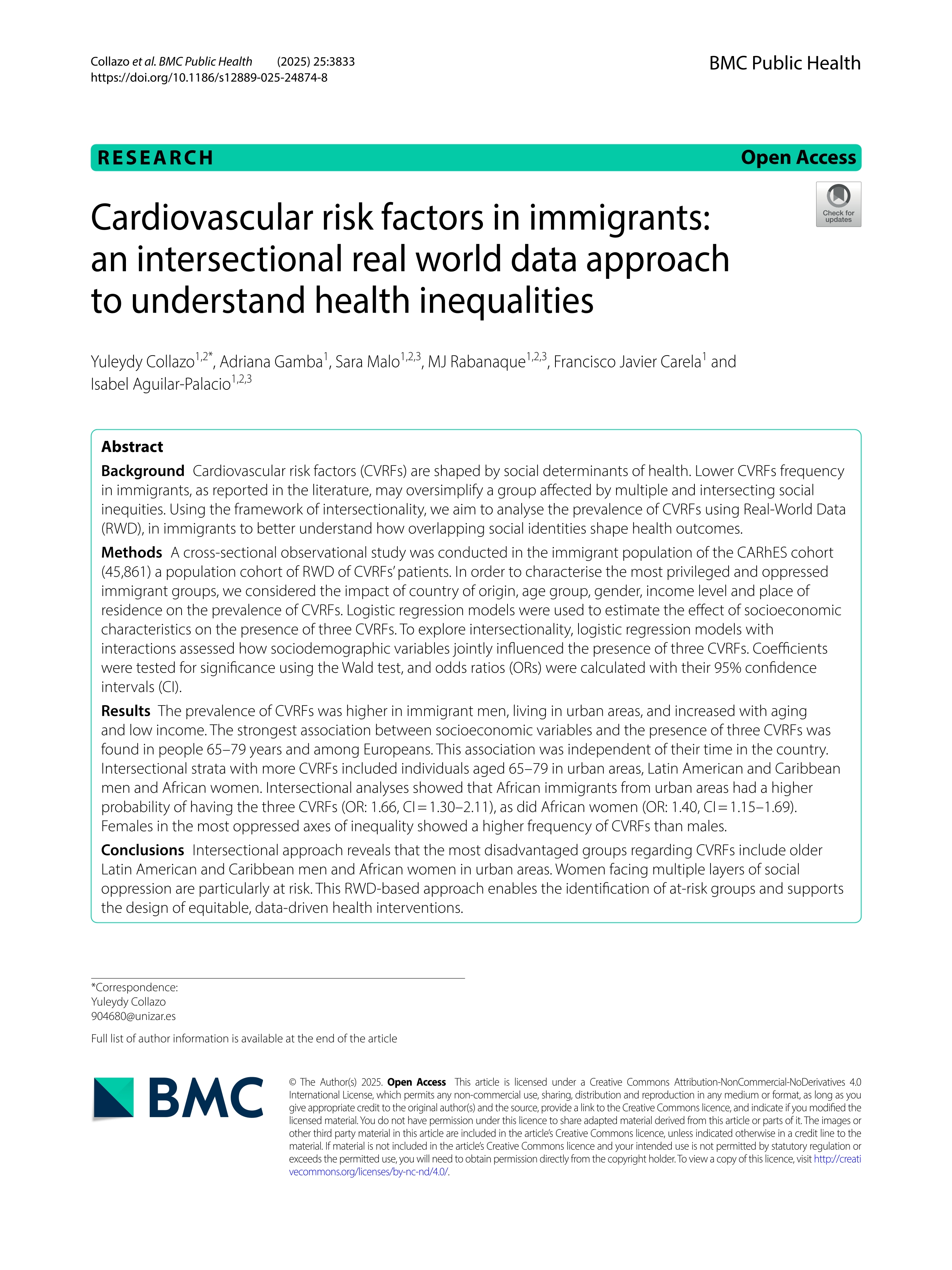
Resumen: Cardiovascular risk factors (CVRFs) are shaped by social determinants of health. Lower CVRFs frequency in immigrants, as reported in the literature, may oversimplify a group affected by multiple and intersecting social inequities. Using the framework of intersectionality, we aim to analyse the prevalence of CVRFs using Real-World Data (RWD), in immigrants to better understand how overlapping social identities shape health outcomes.
Methods. A cross-sectional observational study was conducted in the immigrant population of the CARhES cohort (45,861) a population cohort of RWD of CVRFs’ patients. In order to characterise the most privileged and oppressed immigrant groups, we considered the impact of country of origin, age group, gender, income level and place of residence on the prevalence of CVRFs. Logistic regression models were used to estimate the effect of socioeconomic characteristics on the presence of three CVRFs. To explore intersectionality, logistic regression models with interactions assessed how sociodemographic variables jointly influenced the presence of three CVRFs. Coefficients were tested for significance using the Wald test, and odds ratios (ORs) were calculated with their 95% confidence intervals (CI).
Results. The prevalence of CVRFs was higher in immigrant men, living in urban areas, and increased with aging and low income. The strongest association between socioeconomic variables and the presence of three CVRFs was found in people 65–79 years and among Europeans. This association was independent of their time in the country. Intersectional strata with more CVRFs included individuals aged 65–79 in urban areas, Latin American and Caribbean men and African women. Intersectional analyses showed that African immigrants from urban areas had a higher probability of having the three CVRFs (OR: 1.66, CI = 1.30–2.11), as did African women (OR: 1.40, CI = 1.15–1.69). Females in the most oppressed axes of inequality showed a higher frequency of CVRFs than males. Conclusions. Intersectional approach reveals that the most disadvantaged groups regarding CVRFs include older Latin American and Caribbean men and African women in urban areas. Women facing multiple layers of social oppression are particularly at risk. This RWD-based approach enables the identification of at-risk groups and supports the design of equitable, data-driven health interventions.
Idioma: Inglés
DOI: 10.1186/s12889-025-24874-8
Año: 2025
Publicado en: BMC PUBLIC HEALTH 25, 1 (2025), 11 pp.
ISSN: 1471-2458
Financiación: info:eu-repo/grantAgreement/ES/DGA-GRISSA/B09-23R
Financiación: info:eu-repo/grantAgreement/ES/ISCIII/PI22-01193
Tipo y forma: Artículo (Versión definitiva)
Área (Departamento): Área Medic.Prevent.Salud Públ. (Dpto. Microb.Ped.Radio.Sal.Pú.)
 Debe reconocer adecuadamente la autoría, proporcionar un enlace a la licencia e indicar si se han realizado cambios. Puede hacerlo de cualquier manera razonable, pero no de una manera que sugiera que tiene el apoyo del licenciador o lo recibe por el uso que hace. No puede utilizar el material para una finalidad comercial. Si remezcla, transforma o crea a partir del material, no puede difundir el material modificado.
Exportado de SIDERAL (2025-11-27-15:16:18)
Visitas y descargas
Methods. A cross-sectional observational study was conducted in the immigrant population of the CARhES cohort (45,861) a population cohort of RWD of CVRFs’ patients. In order to characterise the most privileged and oppressed immigrant groups, we considered the impact of country of origin, age group, gender, income level and place of residence on the prevalence of CVRFs. Logistic regression models were used to estimate the effect of socioeconomic characteristics on the presence of three CVRFs. To explore intersectionality, logistic regression models with interactions assessed how sociodemographic variables jointly influenced the presence of three CVRFs. Coefficients were tested for significance using the Wald test, and odds ratios (ORs) were calculated with their 95% confidence intervals (CI).
Results. The prevalence of CVRFs was higher in immigrant men, living in urban areas, and increased with aging and low income. The strongest association between socioeconomic variables and the presence of three CVRFs was found in people 65–79 years and among Europeans. This association was independent of their time in the country. Intersectional strata with more CVRFs included individuals aged 65–79 in urban areas, Latin American and Caribbean men and African women. Intersectional analyses showed that African immigrants from urban areas had a higher probability of having the three CVRFs (OR: 1.66, CI = 1.30–2.11), as did African women (OR: 1.40, CI = 1.15–1.69). Females in the most oppressed axes of inequality showed a higher frequency of CVRFs than males. Conclusions. Intersectional approach reveals that the most disadvantaged groups regarding CVRFs include older Latin American and Caribbean men and African women in urban areas. Women facing multiple layers of social oppression are particularly at risk. This RWD-based approach enables the identification of at-risk groups and supports the design of equitable, data-driven health interventions.
Idioma: Inglés
DOI: 10.1186/s12889-025-24874-8
Año: 2025
Publicado en: BMC PUBLIC HEALTH 25, 1 (2025), 11 pp.
ISSN: 1471-2458
Financiación: info:eu-repo/grantAgreement/ES/DGA-GRISSA/B09-23R
Financiación: info:eu-repo/grantAgreement/ES/ISCIII/PI22-01193
Tipo y forma: Artículo (Versión definitiva)
Área (Departamento): Área Medic.Prevent.Salud Públ. (Dpto. Microb.Ped.Radio.Sal.Pú.)
Debe reconocer adecuadamente la autoría, proporcionar un enlace a la licencia e indicar si se han realizado cambios. Puede hacerlo de cualquier manera razonable, pero no de una manera que sugiera que tiene el apoyo del licenciador o lo recibe por el uso que hace. No puede utilizar el material para una finalidad comercial. Si remezcla, transforma o crea a partir del material, no puede difundir el material modificado.Exportado de SIDERAL (2025-11-27-15:16:18)
Enlace permanente:
Visitas y descargas
Este artículo se encuentra en las siguientes colecciones:
Artículos > Artículos por área > Medicina Preventiva y Salud Pública
Registro creado el 2025-11-27, última modificación el 2025-11-27