Rethinking Organic Chemistry: The Dual Electronic Behavior of the Alkyl Group
Salvatella, Luis (Universidad de Zaragoza)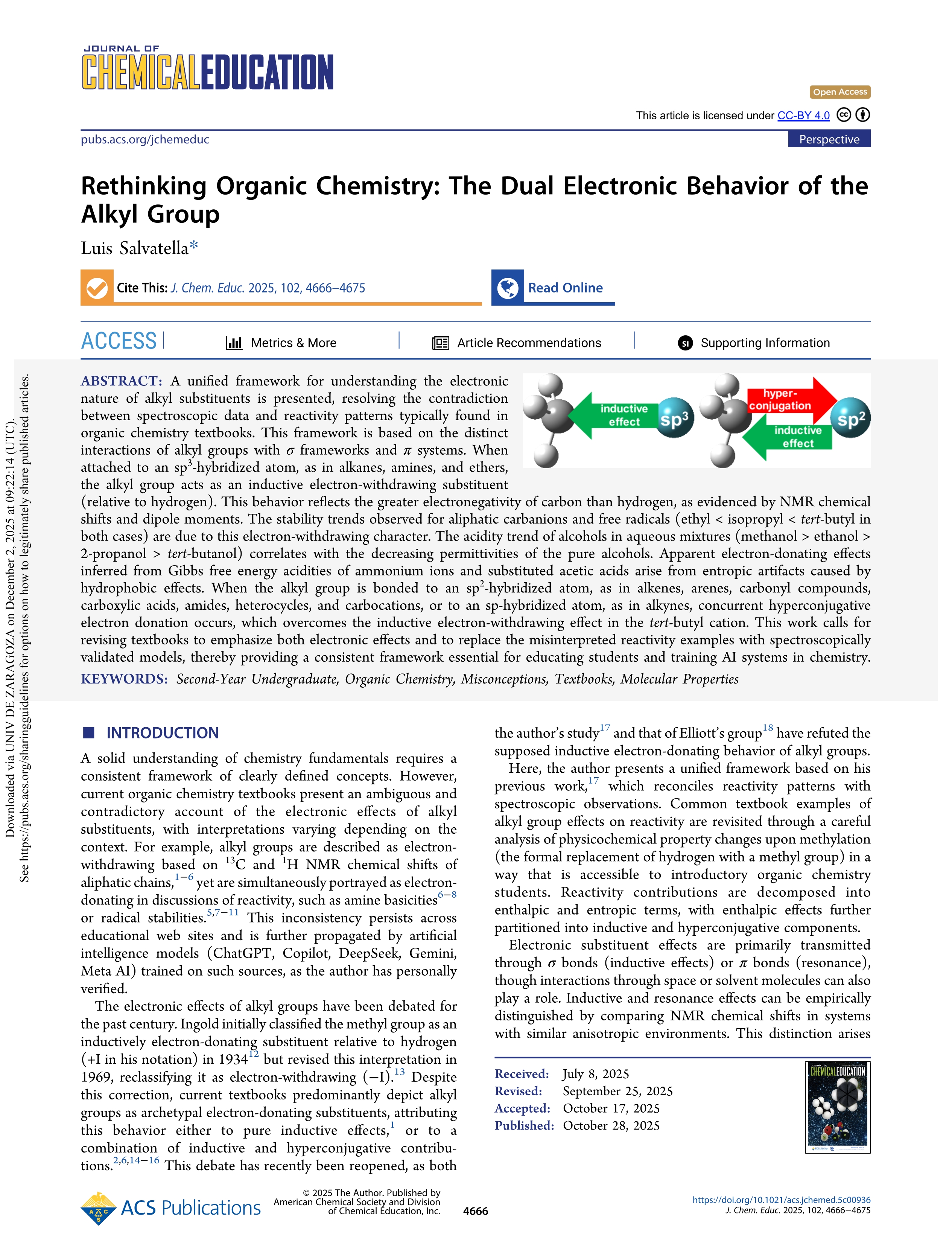
Resumen: A unified framework for understanding the electronic nature of alkyl substituents is presented, resolving the contradiction between spectroscopic data and reactivity patterns typically found in organic chemistry textbooks. This framework is based on the distinct interactions of alkyl groups with σ frameworks and π systems. When attached to an sp3-hybridized atom, as in alkanes, amines, and ethers, the alkyl group acts as an inductive electron-withdrawing substituent (relative to hydrogen). This behavior reflects the greater electronegativity of carbon than hydrogen, as evidenced by NMR chemical shifts and dipole moments. The stability trends observed for aliphatic carbanions and free radicals (ethyl < isopropyl < tert-butyl in both cases) are due to this electron-withdrawing character. The acidity trend of alcohols in aqueous mixtures (methanol > ethanol > 2-propanol > tert-butanol) correlates with the decreasing permittivities of the pure alcohols. Apparent electron-donating effects inferred from Gibbs free energy acidities of ammonium ions and substituted acetic acids arise from entropic artifacts caused by hydrophobic effects. When the alkyl group is bonded to an sp2-hybridized atom, as in alkenes, arenes, carbonyl compounds, carboxylic acids, amides, heterocycles, and carbocations, or to an sp-hybridized atom, as in alkynes, concurrent hyperconjugative electron donation occurs, which overcomes the inductive electron-withdrawing effect in the tert-butyl cation. This work calls for revising textbooks to emphasize both electronic effects and to replace the misinterpreted reactivity examples with spectroscopically validated models, thereby providing a consistent framework essential for educating students and training AI systems in chemistry.
Idioma: Inglés
DOI: 10.1021/acs.jchemed.5c00936
Año: 2025
Publicado en: Journal of chemical education 102, 11 (2025), 4666-4675
ISSN: 0021-9584
Financiación: info:eu-repo/grantAgreement/ES/DGA/E37-23R
Financiación: info:eu-repo/grantAgreement/ES/MINECO/PID2021-125762NB-I00
Tipo y forma: Artículo (Versión definitiva)
Área (Departamento): Área Química Orgánica (Dpto. Química Orgánica)
 Debe reconocer adecuadamente la autoría, proporcionar un enlace a la licencia e indicar si se han realizado cambios. Puede hacerlo de cualquier manera razonable, pero no de una manera que sugiera que tiene el apoyo del licenciador o lo recibe por el uso que hace.
Exportado de SIDERAL (2025-12-04-14:39:33)
Visitas y descargas
Idioma: Inglés
DOI: 10.1021/acs.jchemed.5c00936
Año: 2025
Publicado en: Journal of chemical education 102, 11 (2025), 4666-4675
ISSN: 0021-9584
Financiación: info:eu-repo/grantAgreement/ES/DGA/E37-23R
Financiación: info:eu-repo/grantAgreement/ES/MINECO/PID2021-125762NB-I00
Tipo y forma: Artículo (Versión definitiva)
Área (Departamento): Área Química Orgánica (Dpto. Química Orgánica)
Debe reconocer adecuadamente la autoría, proporcionar un enlace a la licencia e indicar si se han realizado cambios. Puede hacerlo de cualquier manera razonable, pero no de una manera que sugiera que tiene el apoyo del licenciador o lo recibe por el uso que hace. Exportado de SIDERAL (2025-12-04-14:39:33)
Enlace permanente:
Visitas y descargas
Este artículo se encuentra en las siguientes colecciones:
Artículos > Artículos por área > Química Orgánica
Registro creado el 2025-12-04, última modificación el 2025-12-04