Strapped to the app? Bridled labor at the crossroads of platform delivery and migration regulation
Cobarrubias, Sebastian ; Casas-Cortés, Maribel (Universidad de Zaragoza) ; Sanz de Miguel, Pablo (Universidad de Zaragoza) ; Montañés Grado, Miguel (Universidad de Zaragoza)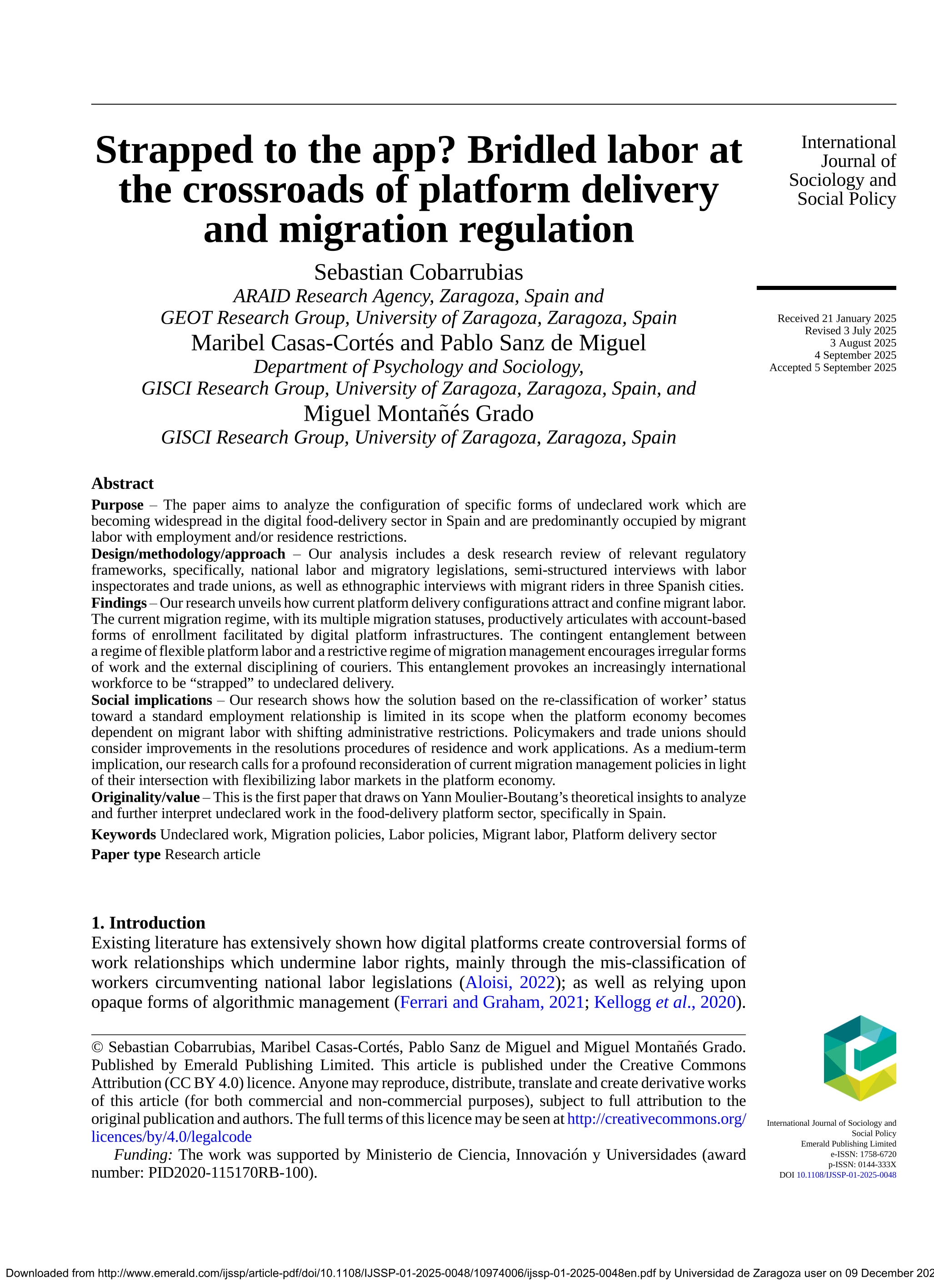
Resumen: Purpose
The paper aims to analyze the configuration of specific forms of undeclared work which are becoming widespread in the digital food-delivery sector in Spain and are predominantly occupied by migrant labor with employment and/or residence restrictions.
Design/methodology/approach
Our analysis includes a desk research review of relevant regulatory frameworks, specifically, national labor and migratory legislations, semi-structured interviews with labor inspectorates and trade unions, as well as ethnographic interviews with migrant riders in three Spanish cities.
Findings
Our research unveils how current platform delivery configurations attract and confine migrant labor. The current migration regime, with its multiple migration statuses, productively articulates with account-based forms of enrollment facilitated by digital platform infrastructures. The contingent entanglement between a regime of flexible platform labor and a restrictive regime of migration management encourages irregular forms of work and the external disciplining of couriers. This entanglement provokes an increasingly international workforce to be “strapped” to undeclared delivery.
Social implications
Our research shows how the solution based on the re-classification of worker’ status toward a standard employment relationship is limited in its scope when the platform economy becomes dependent on migrant labor with shifting administrative restrictions. Policymakers and trade unions should consider improvements in the resolutions procedures of residence and work applications. As a medium-term implication, our research calls for a profound reconsideration of current migration management policies in light of their intersection with flexibilizing labor markets in the platform economy.
Originality/value
This is the first paper that draws on Yann Moulier-Boutang's theoretical insights to analyze and further interpret undeclared work in the food-delivery platform sector, specifically in Spain.
Idioma: Inglés
DOI: 10.1108/IJSSP-01-2025-0048
Año: 2025
Publicado en: International Journal of Sociology and Social Policy (2025), 1-17
ISSN: 0144-333X
Financiación: info:eu-repo/grantAgreement/ES/MICINN-AEI/PID2020-115170RB-100
Tipo y forma: Artículo (Versión definitiva)
Área (Departamento): Área Sociología (Dpto. Psicología y Sociología)
Área (Departamento): Área Trabajo Social y Serv.Soc (Dpto. Psicología y Sociología)
Área (Departamento): Área Antropología Social (Dpto. Psicología y Sociología)
 Debe reconocer adecuadamente la autoría, proporcionar un enlace a la licencia e indicar si se han realizado cambios. Puede hacerlo de cualquier manera razonable, pero no de una manera que sugiera que tiene el apoyo del licenciador o lo recibe por el uso que hace.
Exportado de SIDERAL (2025-12-12-14:43:51)
Visitas y descargas
The paper aims to analyze the configuration of specific forms of undeclared work which are becoming widespread in the digital food-delivery sector in Spain and are predominantly occupied by migrant labor with employment and/or residence restrictions.
Design/methodology/approach
Our analysis includes a desk research review of relevant regulatory frameworks, specifically, national labor and migratory legislations, semi-structured interviews with labor inspectorates and trade unions, as well as ethnographic interviews with migrant riders in three Spanish cities.
Findings
Our research unveils how current platform delivery configurations attract and confine migrant labor. The current migration regime, with its multiple migration statuses, productively articulates with account-based forms of enrollment facilitated by digital platform infrastructures. The contingent entanglement between a regime of flexible platform labor and a restrictive regime of migration management encourages irregular forms of work and the external disciplining of couriers. This entanglement provokes an increasingly international workforce to be “strapped” to undeclared delivery.
Social implications
Our research shows how the solution based on the re-classification of worker’ status toward a standard employment relationship is limited in its scope when the platform economy becomes dependent on migrant labor with shifting administrative restrictions. Policymakers and trade unions should consider improvements in the resolutions procedures of residence and work applications. As a medium-term implication, our research calls for a profound reconsideration of current migration management policies in light of their intersection with flexibilizing labor markets in the platform economy.
Originality/value
This is the first paper that draws on Yann Moulier-Boutang's theoretical insights to analyze and further interpret undeclared work in the food-delivery platform sector, specifically in Spain.
Idioma: Inglés
DOI: 10.1108/IJSSP-01-2025-0048
Año: 2025
Publicado en: International Journal of Sociology and Social Policy (2025), 1-17
ISSN: 0144-333X
Financiación: info:eu-repo/grantAgreement/ES/MICINN-AEI/PID2020-115170RB-100
Tipo y forma: Artículo (Versión definitiva)
Área (Departamento): Área Sociología (Dpto. Psicología y Sociología)
Área (Departamento): Área Trabajo Social y Serv.Soc (Dpto. Psicología y Sociología)
Área (Departamento): Área Antropología Social (Dpto. Psicología y Sociología)
Debe reconocer adecuadamente la autoría, proporcionar un enlace a la licencia e indicar si se han realizado cambios. Puede hacerlo de cualquier manera razonable, pero no de una manera que sugiera que tiene el apoyo del licenciador o lo recibe por el uso que hace. Exportado de SIDERAL (2025-12-12-14:43:51)
Enlace permanente:
Visitas y descargas
Este artículo se encuentra en las siguientes colecciones:
Artículos > Artículos por área > Trabajo Social y Servicios Sociales
Artículos > Artículos por área > Antropologia Social
Artículos > Artículos por área > Sociología
Registro creado el 2025-12-12, última modificación el 2025-12-12