Evaluating the therapeutic role of salvianolic acid A on pancreatic cancer cells through interaction with the intrinsically disordered protein NUPR1
Álvarez-Rodríguez, María Gabriela ; Estaras, Matías ; Hornos, Felipe ; Rizzuti, Bruno ; Santofimia-Castaño, Patricia ; Iovanna, Juan L. ; Neira, José L.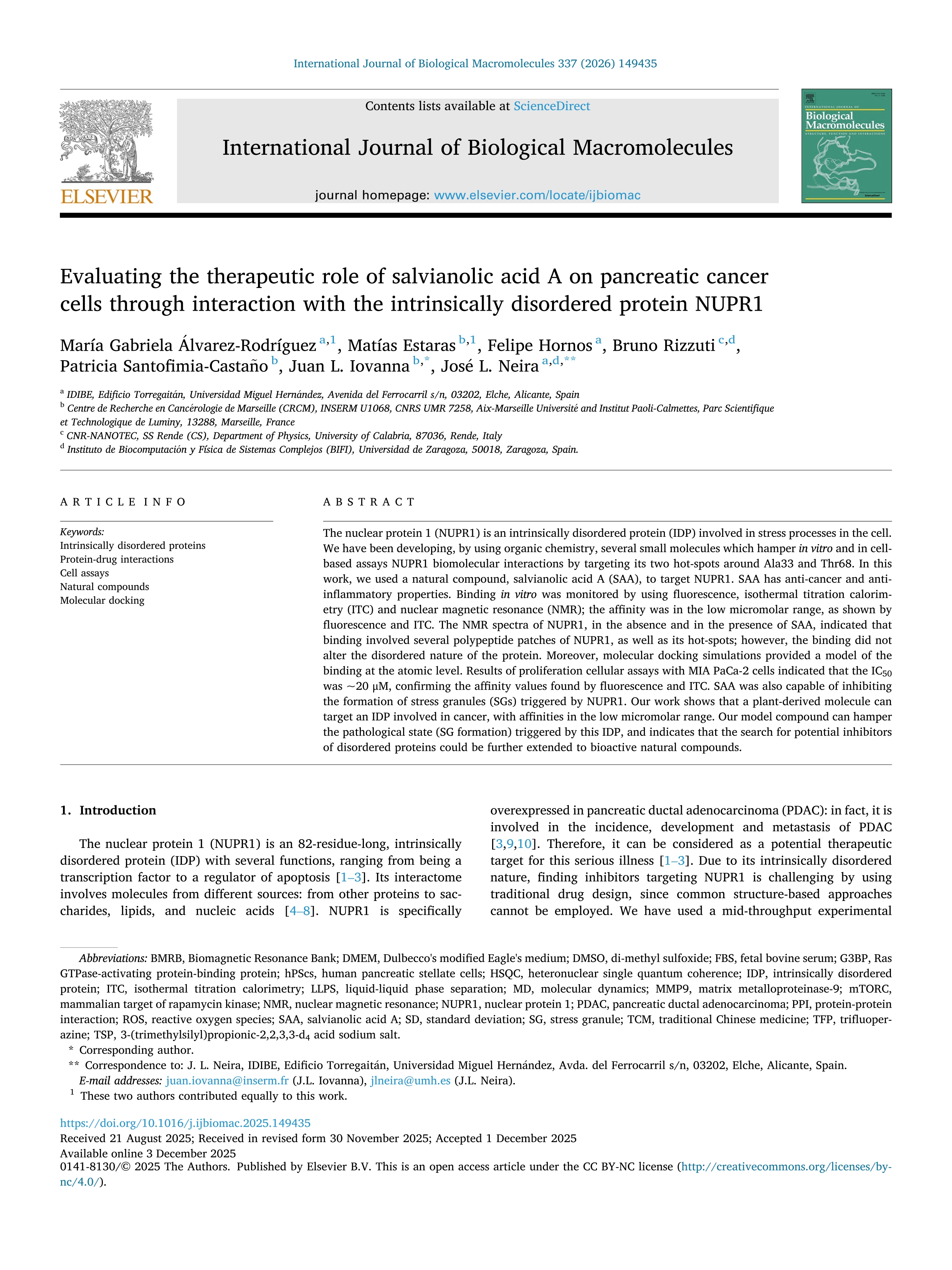
Resumen: The nuclear protein 1 (NUPR1) is an intrinsically disordered protein (IDP) involved in stress processes in the cell. We have been developing, by using organic chemistry, several small molecules which hamper in vitro and in cell-based assays NUPR1 biomolecular interactions by targeting its two hot-spots around Ala33 and Thr68. In this work, we used a natural compound, salvianolic acid A (SAA), to target NUPR1. SAA has anti-cancer and anti-inflammatory properties. Binding in vitro was monitored by using fluorescence, isothermal titration calorimetry (ITC) and nuclear magnetic resonance (NMR); the affinity was in the low micromolar range, as shown by fluorescence and ITC. The NMR spectra of NUPR1, in the absence and in the presence of SAA, indicated that binding involved several polypeptide patches of NUPR1, as well as its hot-spots; however, the binding did not alter the disordered nature of the protein. Moreover, molecular docking simulations provided a model of the binding at the atomic level. Results of proliferation cellular assays with MIA PaCa-2 cells indicated that the IC50 was ~20 μM, confirming the affinity values found by fluorescence and ITC. SAA was also capable of inhibiting the formation of stress granules (SGs) triggered by NUPR1. Our work shows that a plant-derived molecule can target an IDP involved in cancer, with affinities in the low micromolar range. Our model compound can hamper the pathological state (SG formation) triggered by this IDP, and indicates that the search for potential inhibitors of disordered proteins could be further extended to bioactive natural compounds.
Idioma: Inglés
DOI: 10.1016/j.ijbiomac.2025.149435
Año: 2025
Publicado en: International journal of biological macromolecules 337 (2025), 149435 [11 pp.]
ISSN: 0141-8130
Financiación: info:eu-repo/grantAgreement/EC/H2020/CL6-2024/EU/Circular economy and bioeconomy sectors/CIRCBIO-01/101181841
Tipo y forma: Artículo (Versión definitiva)
 Debe reconocer adecuadamente la autoría, proporcionar un enlace a la licencia e indicar si se han realizado cambios. Puede hacerlo de cualquier manera razonable, pero no de una manera que sugiera que tiene el apoyo del licenciador o lo recibe por el uso que hace. No puede utilizar el material para una finalidad comercial.
Exportado de SIDERAL (2025-12-19-14:43:53)
Visitas y descargas
Idioma: Inglés
DOI: 10.1016/j.ijbiomac.2025.149435
Año: 2025
Publicado en: International journal of biological macromolecules 337 (2025), 149435 [11 pp.]
ISSN: 0141-8130
Financiación: info:eu-repo/grantAgreement/EC/H2020/CL6-2024/EU/Circular economy and bioeconomy sectors/CIRCBIO-01/101181841
Tipo y forma: Artículo (Versión definitiva)
Debe reconocer adecuadamente la autoría, proporcionar un enlace a la licencia e indicar si se han realizado cambios. Puede hacerlo de cualquier manera razonable, pero no de una manera que sugiera que tiene el apoyo del licenciador o lo recibe por el uso que hace. No puede utilizar el material para una finalidad comercial.Exportado de SIDERAL (2025-12-19-14:43:53)
Enlace permanente:
Visitas y descargas
Este artículo se encuentra en las siguientes colecciones:
Artículos
Registro creado el 2025-12-19, última modificación el 2025-12-19