Generalising electrocardiogram detection and delineation: training convolutional neural networks with synthetic data augmentation
Jimenez-Perez, Guillermo ; Acosta, Juan ; Alcaine, Alejandro ; Camara, Oscar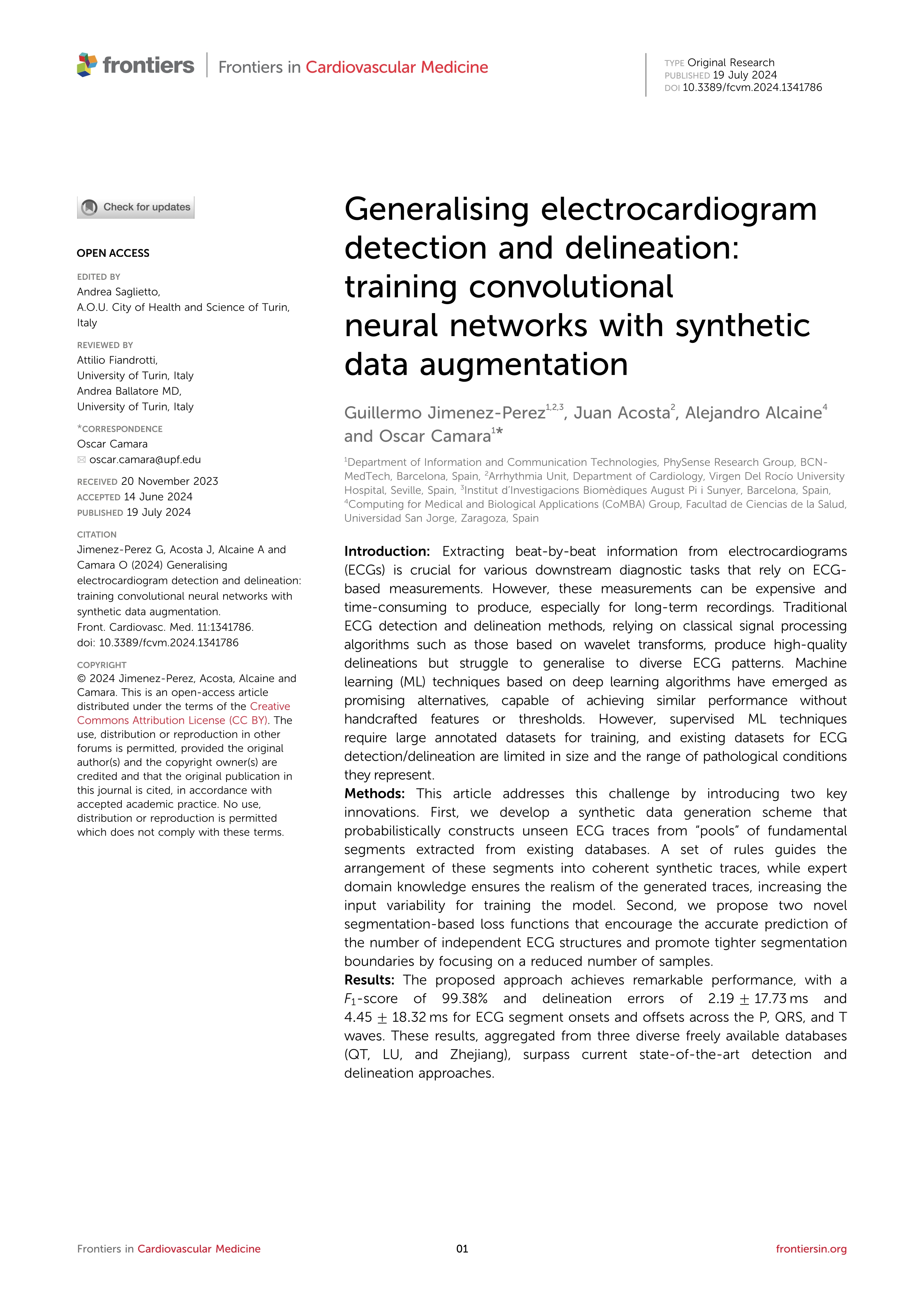
Resumen: Introduction: Extracting beat-by-beat information from electrocardiograms (ECGs) is crucial for various downstream diagnostic tasks that rely on ECG-based measurements. However, these measurements can be expensive and time-consuming to produce, especially for long-term recordings. Traditional ECG detection and delineation methods, relying on classical signal processing algorithms such as those based on wavelet transforms, produce high-quality delineations but struggle to generalise to diverse ECG patterns. Machine learning (ML) techniques based on deep learning algorithms have emerged as promising alternatives, capable of achieving similar performance without handcrafted features or thresholds. However, supervised ML techniques require large annotated datasets for training, and existing datasets for ECG detection/delineation are limited in size and the range of pathological conditions they represent.
Methods: This article addresses this challenge by introducing two key innovations. First, we develop a synthetic data generation scheme that probabilistically constructs unseen ECG traces from “pools” of fundamental segments extracted from existing databases. A set of rules guides the arrangement of these segments into coherent synthetic traces, while expert domain knowledge ensures the realism of the generated traces, increasing the input variability for training the model. Second, we propose two novel segmentation-based loss functions that encourage the accurate prediction of the number of independent ECG structures and promote tighter segmentation boundaries by focusing on a reduced number of samples.
Results: The proposed approach achieves remarkable performance, with a F1
-score of 99.38% and delineation errors of 2.19±17.73 ms and 4.45±18.32
ms for ECG segment onsets and offsets across the P, QRS, and T waves. These results, aggregated from three diverse freely available databases (QT, LU, and Zhejiang), surpass current state-of-the-art detection and delineation approaches.
Discussion: Notably, the model demonstrated exceptional performance despite variations in lead configurations, sampling frequencies, and represented pathophysiology mechanisms, underscoring its robust generalisation capabilities. Real-world examples, featuring clinical data with various pathologies, illustrate the potential of our approach to streamline ECG analysis across different medical settings, fostered by releasing the codes as open source.
Idioma: Inglés
DOI: 10.3389/fcvm.2024.1341786
Año: 2024
Publicado en: Frontiers in cardiovascular medicine 11 (2024), [15 pp.]
ISSN: 2297-055X
Factor impacto JCR: 2.9 (2024)
Categ. JCR: CARDIAC & CARDIOVASCULAR SYSTEMS rank: 80 / 231 = 0.346 (2024) - Q2 - T2
Factor impacto CITESCORE: 5.5 - Cardiology and Cardiovascular Medicine (Q1)
Factor impacto SCIMAGO: 0.975 - Cardiology and Cardiovascular Medicine (Q1)
Financiación: info:eu-repo/grantAgreement/ES/DGA/T71-23D
Financiación: info:eu-repo/grantAgreement/ES/MCIU/PID2022-139143OA-I00
Tipo y forma: Artículo (Versión definitiva)
Dataset asociado: Data from: QTDB annotations. ( 10.6084/m9.figshare.14035187.v1)
 Debe reconocer adecuadamente la autoría, proporcionar un enlace a la licencia e indicar si se han realizado cambios. Puede hacerlo de cualquier manera razonable, pero no de una manera que sugiera que tiene el apoyo del licenciador o lo recibe por el uso que hace.
Exportado de SIDERAL (2026-02-17-20:49:14)
Visitas y descargas
Methods: This article addresses this challenge by introducing two key innovations. First, we develop a synthetic data generation scheme that probabilistically constructs unseen ECG traces from “pools” of fundamental segments extracted from existing databases. A set of rules guides the arrangement of these segments into coherent synthetic traces, while expert domain knowledge ensures the realism of the generated traces, increasing the input variability for training the model. Second, we propose two novel segmentation-based loss functions that encourage the accurate prediction of the number of independent ECG structures and promote tighter segmentation boundaries by focusing on a reduced number of samples.
Results: The proposed approach achieves remarkable performance, with a F1
-score of 99.38% and delineation errors of 2.19±17.73 ms and 4.45±18.32
ms for ECG segment onsets and offsets across the P, QRS, and T waves. These results, aggregated from three diverse freely available databases (QT, LU, and Zhejiang), surpass current state-of-the-art detection and delineation approaches.
Discussion: Notably, the model demonstrated exceptional performance despite variations in lead configurations, sampling frequencies, and represented pathophysiology mechanisms, underscoring its robust generalisation capabilities. Real-world examples, featuring clinical data with various pathologies, illustrate the potential of our approach to streamline ECG analysis across different medical settings, fostered by releasing the codes as open source.
Idioma: Inglés
DOI: 10.3389/fcvm.2024.1341786
Año: 2024
Publicado en: Frontiers in cardiovascular medicine 11 (2024), [15 pp.]
ISSN: 2297-055X
Factor impacto JCR: 2.9 (2024)
Categ. JCR: CARDIAC & CARDIOVASCULAR SYSTEMS rank: 80 / 231 = 0.346 (2024) - Q2 - T2
Factor impacto CITESCORE: 5.5 - Cardiology and Cardiovascular Medicine (Q1)
Factor impacto SCIMAGO: 0.975 - Cardiology and Cardiovascular Medicine (Q1)
Financiación: info:eu-repo/grantAgreement/ES/DGA/T71-23D
Financiación: info:eu-repo/grantAgreement/ES/MCIU/PID2022-139143OA-I00
Tipo y forma: Artículo (Versión definitiva)
Dataset asociado: Data from: QTDB annotations. ( 10.6084/m9.figshare.14035187.v1)
Debe reconocer adecuadamente la autoría, proporcionar un enlace a la licencia e indicar si se han realizado cambios. Puede hacerlo de cualquier manera razonable, pero no de una manera que sugiera que tiene el apoyo del licenciador o lo recibe por el uso que hace. Exportado de SIDERAL (2026-02-17-20:49:14)
Enlace permanente:
Visitas y descargas
Este artículo se encuentra en las siguientes colecciones:
Artículos
Registro creado el 2025-12-19, última modificación el 2026-02-17