Diagnostic Accuracy of the Enhanced Liver Fibrosis (ELF\u00ae) Score Using HCV-Infected Serum Samples Cryopreserved for up to 25 Years
Puigvehí, Marc ; Hernández, Juanjo ; Broquetas, Teresa ; Coll, Susanna ; Garcia-Retortillo, Montserrat ; Cañete, Nuria ; Giménez, Maria Dolors ; Garcia, Mar ; Bory, Felipe ; Salvadó, Margarita ; Sola, Ricard ; Carrión, José A. ; Strnad, Pavel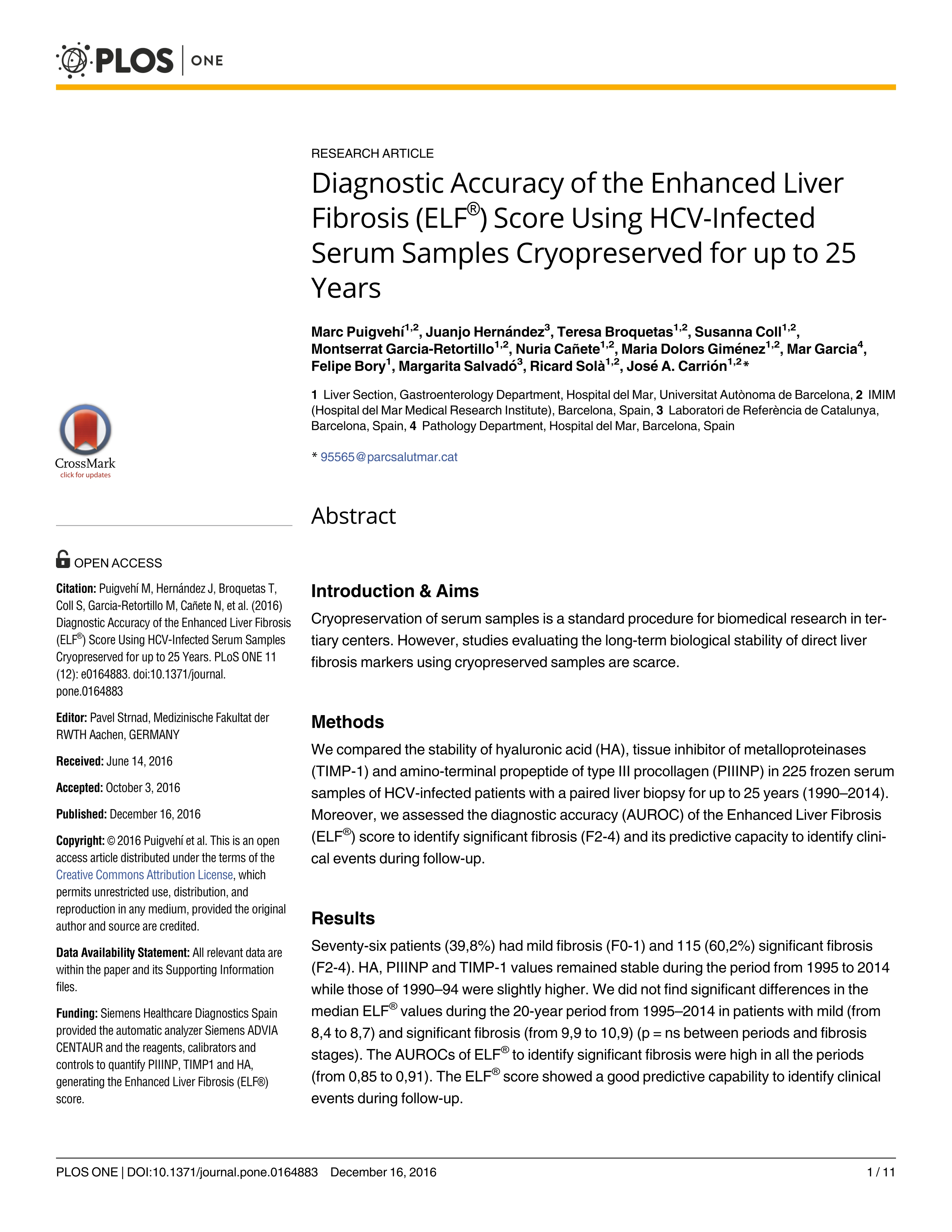
Resumen: Introduction & Aims
Cryopreservation of serum samples is a standard procedure for biomedical research in tertiary centers. However, studies evaluating the long-term biological stability of direct liver fibrosis markers using cryopreserved samples are scarce.
Methods
We compared the stability of hyaluronic acid (HA), tissue inhibitor of metalloproteinases (TIMP-1) and amino-terminal propeptide of type III procollagen (PIIINP) in 225 frozen serum samples of HCV-infected patients with a paired liver biopsy for up to 25 years (1990–2014). Moreover, we assessed the diagnostic accuracy (AUROC) of the Enhanced Liver Fibrosis (ELF®) score to identify significant fibrosis (F2-4) and its predictive capacity to identify clinical events during follow-up.
Results
Seventy-six patients (39,8%) had mild fibrosis (F0-1) and 115 (60,2%) significant fibrosis (F2-4). HA, PIIINP and TIMP-1 values remained stable during the period from 1995 to 2014 while those of 1990–94 were slightly higher. We did not find significant differences in the median ELF® values during the 20-year period from 1995–2014 in patients with mild (from 8,4 to 8,7) and significant fibrosis (from 9,9 to 10,9) (p = ns between periods and fibrosis stages). The AUROCs of ELF® to identify significant fibrosis were high in all the periods (from 0,85 to 0,91). The ELF® score showed a good predictive capability to identify clinical events during follow-up.
Conclusions
The biological stability of direct serum markers (HA, PIIINP and TIMP-1) using HCV-infected samples cryopreserved for 20 years is good. Therefore, the diagnostic accuracy of the ELF® score to identify significant fibrosis and clinical events during follow-up is very high.
Idioma: Inglés
DOI: 10.1371/journal.pone.0164883
Año: 2016
Publicado en: PLoS ONE 11, 12 (2016), e0164883
ISSN: 1932-6203
Factor impacto JCR: 2.806 (2016)
Categ. JCR: MULTIDISCIPLINARY SCIENCES rank: 15 / 63 = 0.238 (2016) - Q1 - T1
Factor impacto SCIMAGO: 1.236 - Agricultural and Biological Sciences (miscellaneous) (Q1) - Medicine (miscellaneous) (Q1) - Biochemistry, Genetics and Molecular Biology (miscellaneous) (Q1)
Tipo y forma: Artículo (Versión definitiva)
 Debe reconocer adecuadamente la autoría, proporcionar un enlace a la licencia e indicar si se han realizado cambios. Puede hacerlo de cualquier manera razonable, pero no de una manera que sugiera que tiene el apoyo del licenciador o lo recibe por el uso que hace.
Exportado de SIDERAL (2026-01-13-22:06:04)
Visitas y descargas
Cryopreservation of serum samples is a standard procedure for biomedical research in tertiary centers. However, studies evaluating the long-term biological stability of direct liver fibrosis markers using cryopreserved samples are scarce.
Methods
We compared the stability of hyaluronic acid (HA), tissue inhibitor of metalloproteinases (TIMP-1) and amino-terminal propeptide of type III procollagen (PIIINP) in 225 frozen serum samples of HCV-infected patients with a paired liver biopsy for up to 25 years (1990–2014). Moreover, we assessed the diagnostic accuracy (AUROC) of the Enhanced Liver Fibrosis (ELF®) score to identify significant fibrosis (F2-4) and its predictive capacity to identify clinical events during follow-up.
Results
Seventy-six patients (39,8%) had mild fibrosis (F0-1) and 115 (60,2%) significant fibrosis (F2-4). HA, PIIINP and TIMP-1 values remained stable during the period from 1995 to 2014 while those of 1990–94 were slightly higher. We did not find significant differences in the median ELF® values during the 20-year period from 1995–2014 in patients with mild (from 8,4 to 8,7) and significant fibrosis (from 9,9 to 10,9) (p = ns between periods and fibrosis stages). The AUROCs of ELF® to identify significant fibrosis were high in all the periods (from 0,85 to 0,91). The ELF® score showed a good predictive capability to identify clinical events during follow-up.
Conclusions
The biological stability of direct serum markers (HA, PIIINP and TIMP-1) using HCV-infected samples cryopreserved for 20 years is good. Therefore, the diagnostic accuracy of the ELF® score to identify significant fibrosis and clinical events during follow-up is very high.
Idioma: Inglés
DOI: 10.1371/journal.pone.0164883
Año: 2016
Publicado en: PLoS ONE 11, 12 (2016), e0164883
ISSN: 1932-6203
Factor impacto JCR: 2.806 (2016)
Categ. JCR: MULTIDISCIPLINARY SCIENCES rank: 15 / 63 = 0.238 (2016) - Q1 - T1
Factor impacto SCIMAGO: 1.236 - Agricultural and Biological Sciences (miscellaneous) (Q1) - Medicine (miscellaneous) (Q1) - Biochemistry, Genetics and Molecular Biology (miscellaneous) (Q1)
Tipo y forma: Artículo (Versión definitiva)
Debe reconocer adecuadamente la autoría, proporcionar un enlace a la licencia e indicar si se han realizado cambios. Puede hacerlo de cualquier manera razonable, pero no de una manera que sugiera que tiene el apoyo del licenciador o lo recibe por el uso que hace. Exportado de SIDERAL (2026-01-13-22:06:04)
Enlace permanente:
Visitas y descargas
Este artículo se encuentra en las siguientes colecciones:
Artículos
Registro creado el 2026-01-13, última modificación el 2026-01-13