Combustion of crude glycerol and its blends with acetals
Muelas, A. (Universidad de Zaragoza) ; Remacha, P. (Universidad de Zaragoza) ; Pina, A. ; Barroso, J. (Universidad de Zaragoza) ; Sobrino, A. (Universidad de Zaragoza) ; Aranda, D. ; Bayarri, N. ; Estévez, C. ; Ballester, J. (Universidad de Zaragoza)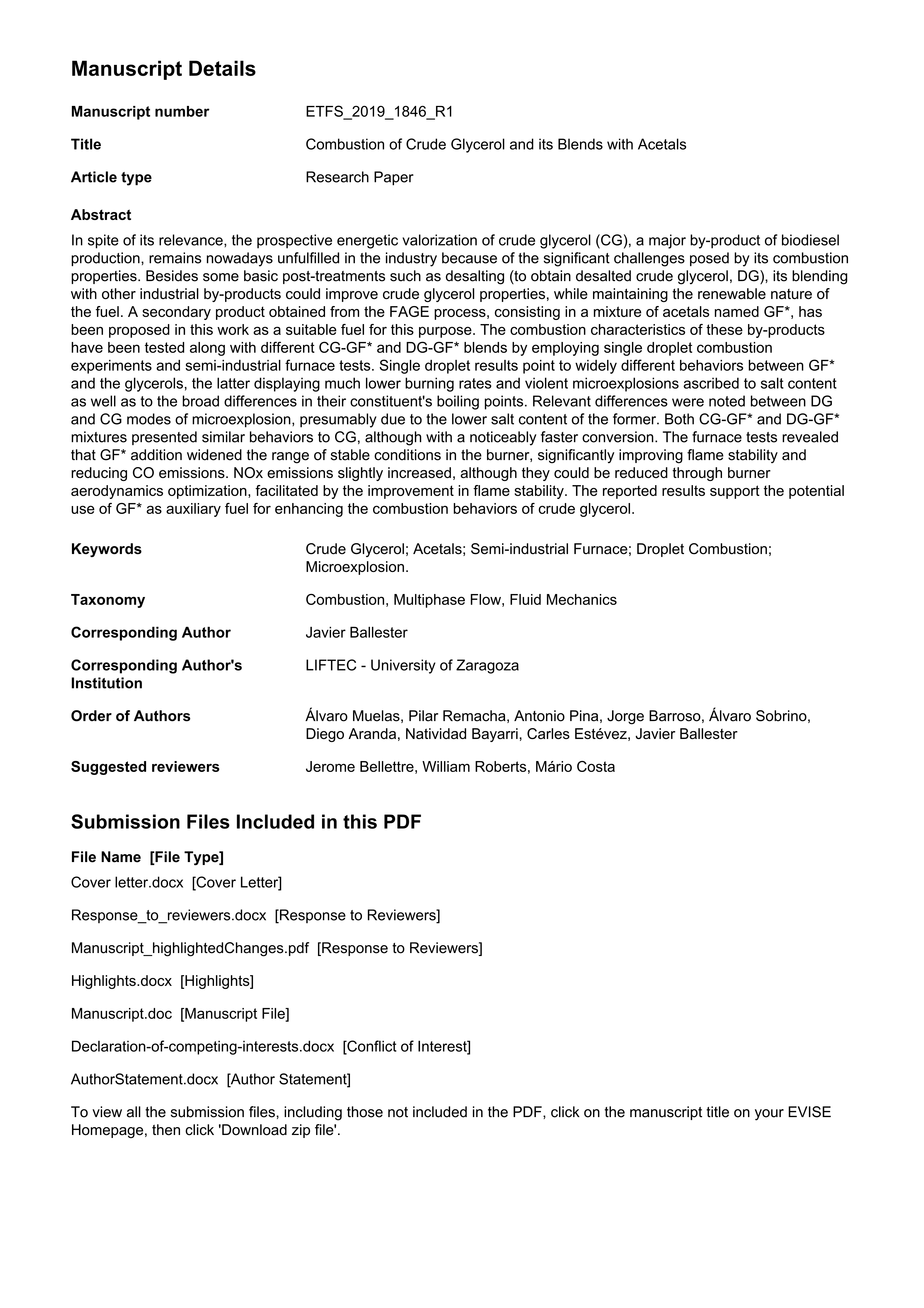
Resumen: In spite of its relevance, the prospective energetic valorization of crude glycerol (CG), a major by-product of biodiesel production, remains nowadays unfulfilled in the industry because of the significant challenges posed by its combustion properties. Besides some basic post-treatments such as desalting (to obtain desalted crude glycerol, DG), its blending with other industrial by-products could improve crude glycerol properties, while maintaining the renewable nature of the fuel. A secondary product obtained from the FAGE process, consisting in a mixture of acetals named GF*, has been proposed in this work as a suitable fuel for this purpose. The combustion characteristics of these by-products have been tested along with different CG-GF* and DG-GF* blends by employing single droplet combustion experiments and semi-industrial furnace tests. Single droplet results point to widely different behaviors between GF* and the glycerols, the latter displaying much lower burning rates and violent microexplosions ascribed to salt content as well as to the broad differences in their constituent''s boiling points. Relevant differences were noted between DG and CG modes of microexplosion, presumably due to the lower salt content of the former. Both CG-GF* and DG-GF* mixtures presented similar behaviors to CG, although with a noticeably faster conversion. The furnace tests revealed that GF* addition widened the range of stable conditions in the burner, significantly improving flame stability and reducing CO emissions. NOx emissions slightly increased, although they could be reduced through burner aerodynamics optimization, facilitated by the improvement in flame stability. The reported results support the potential use of GF* as auxiliary fuel for enhancing the combustion behaviors of crude glycerol. © 2020
Idioma: Inglés
DOI: 10.1016/j.expthermflusci.2020.110076
Año: 2020
Publicado en: Experimental Thermal and Fluid Science 114 (2020), 110076 [11 pp.]
ISSN: 0894-1777
Factor impacto JCR: 3.232 (2020)
Categ. JCR: PHYSICS, FLUIDS & PLASMAS rank: 7 / 34 = 0.206 (2020) - Q1 - T1
Categ. JCR: THERMODYNAMICS rank: 20 / 60 = 0.333 (2020) - Q2 - T2
Categ. JCR: ENGINEERING, MECHANICAL rank: 43 / 133 = 0.323 (2020) - Q2 - T1
Factor impacto SCIMAGO: 1.306 - Aerospace Engineering (Q1) - Chemical Engineering (miscellaneous) (Q1) - Nuclear Energy and Engineering (Q1) - Mechanical Engineering (Q1) - Fluid Flow and Transfer Processes (Q1)
Tipo y forma: Artículo (PostPrint)
Área (Departamento): Área Mecánica de Fluidos (Dpto. Ciencia Tecnol.Mater.Fl.)
 Debe reconocer adecuadamente la autoría, proporcionar un enlace a la licencia e indicar si se han realizado cambios. Puede hacerlo de cualquier manera razonable, pero no de una manera que sugiera que tiene el apoyo del licenciador o lo recibe por el uso que hace. No puede utilizar el material para una finalidad comercial. Si remezcla, transforma o crea a partir del material, no puede difundir el material modificado.
Exportado de SIDERAL (2026-01-22-16:07:10)
Visitas y descargas
Idioma: Inglés
DOI: 10.1016/j.expthermflusci.2020.110076
Año: 2020
Publicado en: Experimental Thermal and Fluid Science 114 (2020), 110076 [11 pp.]
ISSN: 0894-1777
Factor impacto JCR: 3.232 (2020)
Categ. JCR: PHYSICS, FLUIDS & PLASMAS rank: 7 / 34 = 0.206 (2020) - Q1 - T1
Categ. JCR: THERMODYNAMICS rank: 20 / 60 = 0.333 (2020) - Q2 - T2
Categ. JCR: ENGINEERING, MECHANICAL rank: 43 / 133 = 0.323 (2020) - Q2 - T1
Factor impacto SCIMAGO: 1.306 - Aerospace Engineering (Q1) - Chemical Engineering (miscellaneous) (Q1) - Nuclear Energy and Engineering (Q1) - Mechanical Engineering (Q1) - Fluid Flow and Transfer Processes (Q1)
Tipo y forma: Artículo (PostPrint)
Área (Departamento): Área Mecánica de Fluidos (Dpto. Ciencia Tecnol.Mater.Fl.)
Debe reconocer adecuadamente la autoría, proporcionar un enlace a la licencia e indicar si se han realizado cambios. Puede hacerlo de cualquier manera razonable, pero no de una manera que sugiera que tiene el apoyo del licenciador o lo recibe por el uso que hace. No puede utilizar el material para una finalidad comercial. Si remezcla, transforma o crea a partir del material, no puede difundir el material modificado.Exportado de SIDERAL (2026-01-22-16:07:10)
Enlace permanente:
Visitas y descargas
Este artículo se encuentra en las siguientes colecciones:
Artículos > Artículos por área > Mecánica de Fluidos
Registro creado el 2026-01-22, última modificación el 2026-01-22