Lactarius deliciosus extract from green microwave-assisted eutectic solvent extraction as a therapeutic candidate against colon cancer
Bidooki, Seyed Hesamoddin (Universidad de Zaragoza) ; Rodríguez-Martínez, Beatriz ; Quero, Javier ; Herrera-Marcos, Luis Vicente (Universidad de Zaragoza) ; Paesa, Mónica (Universidad de Zaragoza) ; Delgado-Machuca, Marina ; Beas-Guzmán, Oscar F. ; Osada, Jesús (Universidad de Zaragoza) ; Ferreira-Santos, Pedro ; Rodríguez-Yoldi, María Jesús (Universidad de Zaragoza)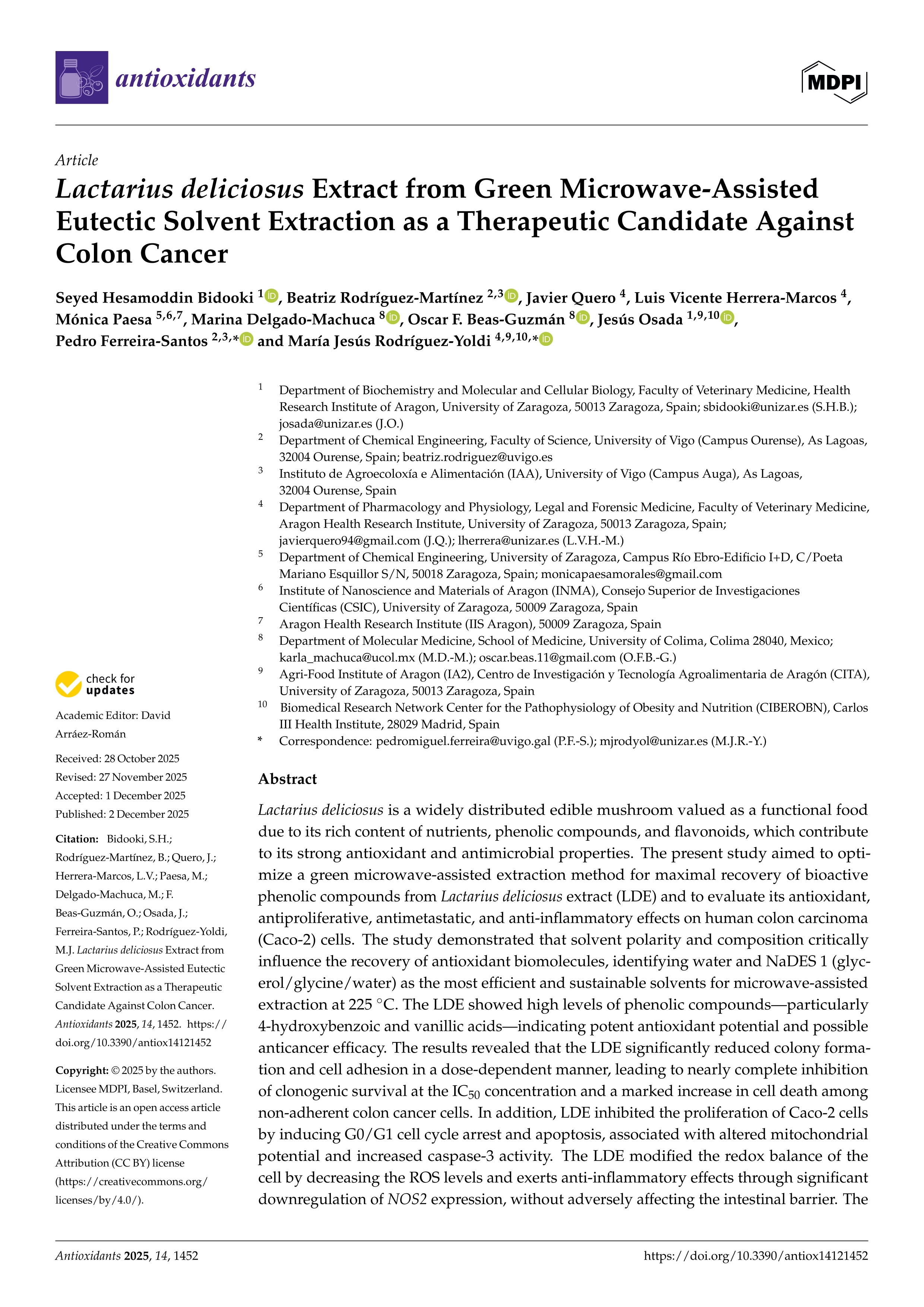
Resumen: Lactarius deliciosus is a widely distributed edible mushroom valued as a functional food due to its rich content of nutrients, phenolic compounds, and flavonoids, which contribute to its strong antioxidant and antimicrobial properties. The present study aimed to optimize a green microwave-assisted extraction method for maximal recovery of bioactive phenolic compounds from Lactarius deliciosus extract (LDE) and to evaluate its antioxidant, antiproliferative, antimetastatic, and anti-inflammatory effects on human colon carcinoma (Caco-2) cells. The study demonstrated that solvent polarity and composition critically influence the recovery of antioxidant biomolecules, identifying water and NaDES 1 (glycerol/glycine/water) as the most efficient and sustainable solvents for microwave-assisted extraction at 225 °C. The LDE showed high levels of phenolic compounds—particularly 4-hydroxybenzoic and vanillic acids—indicating potent antioxidant potential and possible anticancer efficacy. The results revealed that the LDE significantly reduced colony formation and cell adhesion in a dose-dependent manner, leading to nearly complete inhibition of clonogenic survival at the IC50 concentration and a marked increase in cell death among non-adherent colon cancer cells. In addition, LDE inhibited the proliferation of Caco-2 cells by inducing G0/G1 cell cycle arrest and apoptosis, associated with altered mitochondrial potential and increased caspase-3 activity. The LDE modified the redox balance of the cell by decreasing the ROS levels and exerts anti-inflammatory effects through significant downregulation of NOS2 expression, without adversely affecting the intestinal barrier. The study concludes that LDE bioactive compounds show strong promise as anticancer and functional ingredients, demonstrating antioxidant, antiproliferative, antimetastatic, and anti-inflammatory effects.
Idioma: Inglés
DOI: 10.3390/antiox14121452
Año: 2025
Publicado en: Antioxidants 14, 12 (2025), 1452 [21 pp.]
ISSN: 2076-3921
Financiación: info:eu-repo/grantAgreement/ES/CIBERObn/CB06-03-1012
Financiación: info:eu-repo/grantAgreement/ES/DGA/B16-23R
Financiación: info:eu-repo/grantAgreement/ES/DGA/GCP-2018-002300
Financiación: info:eu-repo/grantAgreement/ES/MCINN/PID2022-136414OB-I00
Financiación: info:eu-repo/grantAgreement/EUR/SUDOE/INTERREG/NEWPOWER-S1-1.1-E01116
Tipo y forma: Artículo (Versión definitiva)
Área (Departamento): Área Fisiología (Dpto. Farmac.Fisiol.y Med.L.F.)
Área (Departamento): Área Ingeniería Química (Dpto. Ing.Quím.Tecnol.Med.Amb.)
Área (Departamento): Área Farmacología (Dpto. Farmac.Fisiol.y Med.L.F.)
Área (Departamento): Área Bioquímica y Biolog.Mole. (Dpto. Bioq.Biolog.Mol. Celular)
 Debe reconocer adecuadamente la autoría, proporcionar un enlace a la licencia e indicar si se han realizado cambios. Puede hacerlo de cualquier manera razonable, pero no de una manera que sugiera que tiene el apoyo del licenciador o lo recibe por el uso que hace.
Exportado de SIDERAL (2026-02-04-13:14:49)
Visitas y descargas
Idioma: Inglés
DOI: 10.3390/antiox14121452
Año: 2025
Publicado en: Antioxidants 14, 12 (2025), 1452 [21 pp.]
ISSN: 2076-3921
Financiación: info:eu-repo/grantAgreement/ES/CIBERObn/CB06-03-1012
Financiación: info:eu-repo/grantAgreement/ES/DGA/B16-23R
Financiación: info:eu-repo/grantAgreement/ES/DGA/GCP-2018-002300
Financiación: info:eu-repo/grantAgreement/ES/MCINN/PID2022-136414OB-I00
Financiación: info:eu-repo/grantAgreement/EUR/SUDOE/INTERREG/NEWPOWER-S1-1.1-E01116
Tipo y forma: Artículo (Versión definitiva)
Área (Departamento): Área Fisiología (Dpto. Farmac.Fisiol.y Med.L.F.)
Área (Departamento): Área Ingeniería Química (Dpto. Ing.Quím.Tecnol.Med.Amb.)
Área (Departamento): Área Farmacología (Dpto. Farmac.Fisiol.y Med.L.F.)
Área (Departamento): Área Bioquímica y Biolog.Mole. (Dpto. Bioq.Biolog.Mol. Celular)
Debe reconocer adecuadamente la autoría, proporcionar un enlace a la licencia e indicar si se han realizado cambios. Puede hacerlo de cualquier manera razonable, pero no de una manera que sugiera que tiene el apoyo del licenciador o lo recibe por el uso que hace. Exportado de SIDERAL (2026-02-04-13:14:49)
Enlace permanente:
Visitas y descargas
Este artículo se encuentra en las siguientes colecciones:
Artículos > Artículos por área > Bioquímica y Biología Molecular
Artículos > Artículos por área > Ingeniería Química
Artículos > Artículos por área > Farmacología
Artículos > Artículos por área > Fisiología
Registro creado el 2026-02-04, última modificación el 2026-02-04