Perceived Stress, Burnout, Professional Quality of Life, and Occupational Balance Among University Faculty in Health Sciences Disciplines in Spain—Protocol and Descriptive Results
Rodríguez-Pérez, M.P. ; León-Herrera, S. (Universidad de Zaragoza) ; Asensio-Martínez, A. (Universidad de Zaragoza) ; García-Bravo, C. ; García-Bravo, S. ; Gómez-Bravo, R. ; Huertas-Hoyas, E.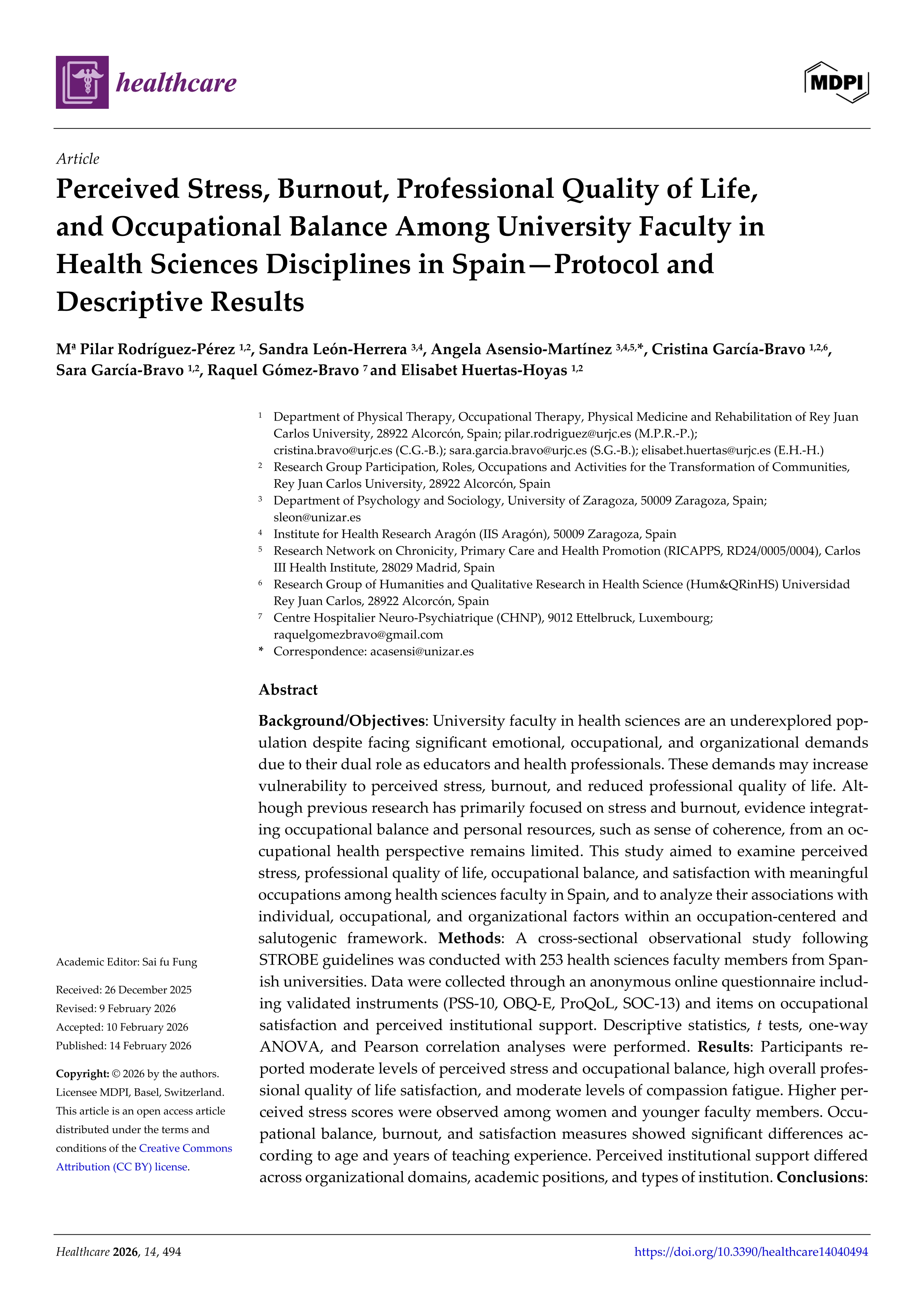
Resumen: Background/Objectives: University faculty in health sciences are an underexplored population despite facing significant emotional, occupational, and organizational demands due to their dual role as educators and health professionals. These demands may increase vulnerability to perceived stress, burnout, and reduced professional quality of life. Although previous research has primarily focused on stress and burnout, evidence integrating occupational balance and personal resources, such as sense of coherence, from an occupational health perspective remains limited. This study aimed to examine perceived stress, professional quality of life, occupational balance, and satisfaction with meaningful occupations among health sciences faculty in Spain, and to analyze their associations with individual, occupational, and organizational factors within an occupation-centered and salutogenic framework. Methods: A cross-sectional observational study following STROBE guidelines was conducted with 253 health sciences faculty members from Spanish universities. Data were collected through an anonymous online questionnaire including validated instruments (PSS-10, OBQ-E, ProQoL, SOC-13) and items on occupational satisfaction and perceived institutional support. Descriptive statistics, t tests, one-way ANOVA, and Pearson correlation analyses were performed. Results: Participants reported moderate levels of perceived stress and occupational balance, high overall professional quality of life satisfaction, and moderate levels of compassion fatigue. Higher perceived stress scores were observed among women and younger faculty members. Occupational balance, burnout, and satisfaction measures showed significant differences according to age and years of teaching experience. Perceived institutional support differed across organizational domains, academic positions, and types of institution. Conclusions: Health sciences faculty in Spain experience notable psychosocial demands affecting stress, occupational balance, and professional quality of life. Occupational balance and sense of coherence emerged as relevant constructs associated with lower perceived stress and burnout and higher professional satisfaction. By integrating these occupation-centered and salutogenic resources, the study extends existing research beyond traditional stress–burnout models and contributes to a more comprehensive understanding of professional well-being among health sciences faculty.
Idioma: Inglés
DOI: 10.3390/healthcare14040494
Año: 2026
Publicado en: Healthcare 14, 4 (2026), [19 pp.]
ISSN: 2213-0764
Tipo y forma: Artículo (Versión definitiva)
Área (Departamento): Área Psicología Social (Dpto. Psicología y Sociología)
 Debe reconocer adecuadamente la autoría, proporcionar un enlace a la licencia e indicar si se han realizado cambios. Puede hacerlo de cualquier manera razonable, pero no de una manera que sugiera que tiene el apoyo del licenciador o lo recibe por el uso que hace.
Exportado de SIDERAL (2026-03-26-14:48:26)
Visitas y descargas
Idioma: Inglés
DOI: 10.3390/healthcare14040494
Año: 2026
Publicado en: Healthcare 14, 4 (2026), [19 pp.]
ISSN: 2213-0764
Tipo y forma: Artículo (Versión definitiva)
Área (Departamento): Área Psicología Social (Dpto. Psicología y Sociología)
Debe reconocer adecuadamente la autoría, proporcionar un enlace a la licencia e indicar si se han realizado cambios. Puede hacerlo de cualquier manera razonable, pero no de una manera que sugiera que tiene el apoyo del licenciador o lo recibe por el uso que hace. Exportado de SIDERAL (2026-03-26-14:48:26)
Enlace permanente:
Visitas y descargas
Este artículo se encuentra en las siguientes colecciones:
Artículos > Artículos por área > Psicología Social
Registro creado el 2026-02-17, última modificación el 2026-03-26