Student-led video project to develop teamwork, communication and digital skills in first-year nursing students: a longitudinal quasi-experimental study
Gómez-Torres, Piedad ; Castro, Marta (Universidad de Zaragoza) ; Galarreta-Aperte, Sergio ; Fabra, Javier (Universidad de Zaragoza) ; Martínez-Martínez, Ana-Belén (Universidad de Zaragoza)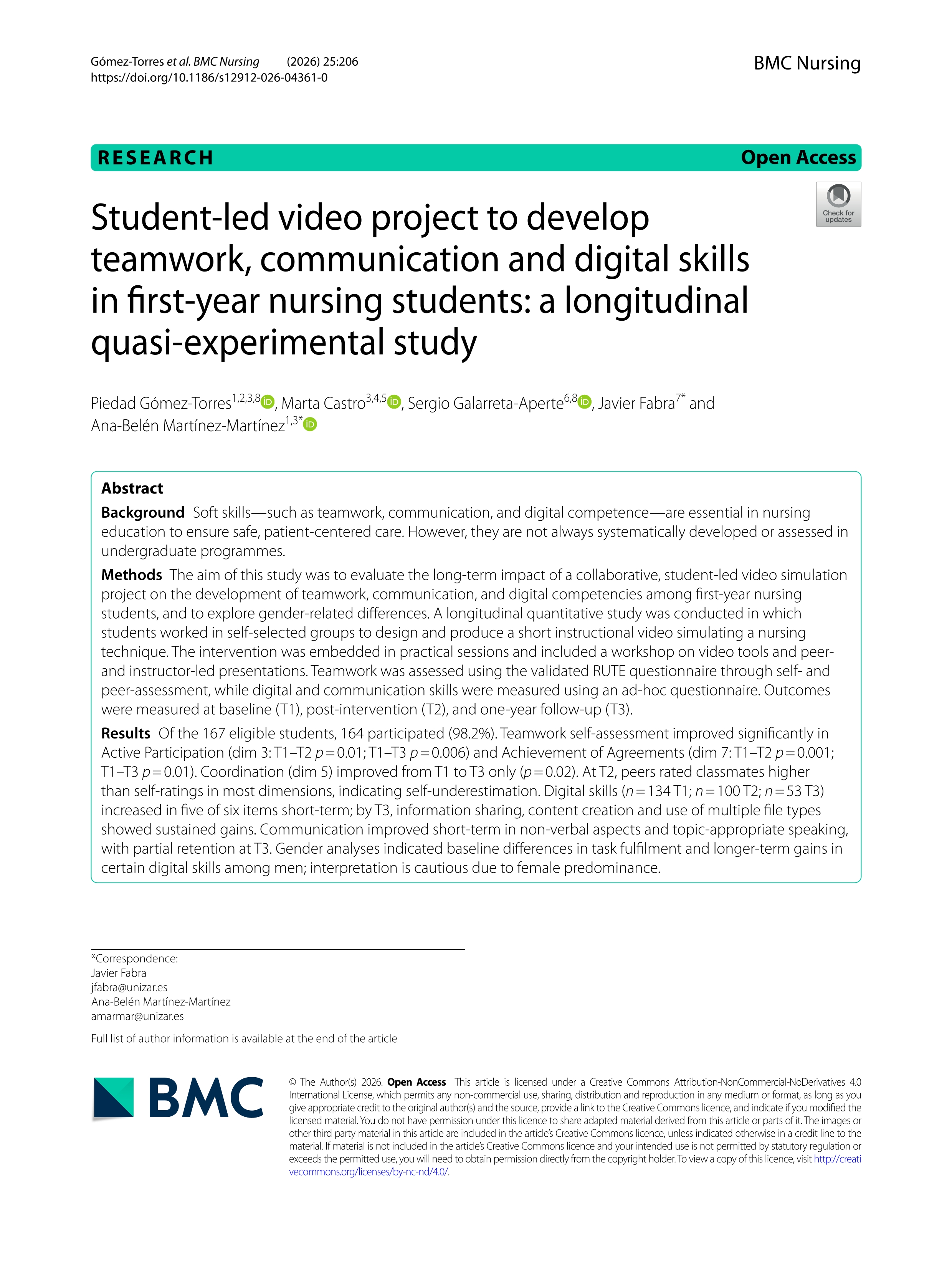
Resumen: Background
Soft skills—such as teamwork, communication, and digital competence—are essential in nursing education to ensure safe, patient-centered care. However, they are not always systematically developed or assessed in undergraduate programmes.
Methods
The aim of this study was to evaluate the long-term impact of a collaborative, student-led video simulation project on the development of teamwork, communication, and digital competencies among first-year nursing students, and to explore gender-related differences. A longitudinal quantitative study was conducted in which students worked in self-selected groups to design and produce a short instructional video simulating a nursing technique. The intervention was embedded in practical sessions and included a workshop on video tools and peer- and instructor-led presentations. Teamwork was assessed using the validated RUTE questionnaire through self- and peer-assessment, while digital and communication skills were measured using an ad-hoc questionnaire. Outcomes were measured at baseline (T1), post-intervention (T2), and one-year follow-up (T3).
Results
Of the 167 eligible students, 164 participated (98.2%). Teamwork self-assessment improved significantly in Active Participation (dim 3: T1–T2 p = 0.01; T1–T3 p = 0.006) and Achievement of Agreements (dim 7: T1–T2 p = 0.001; T1–T3 p = 0.01). Coordination (dim 5) improved from T1 to T3 only (p = 0.02). At T2, peers rated classmates higher than self-ratings in most dimensions, indicating self-underestimation. Digital skills (n = 134 T1; n = 100 T2; n = 53 T3) increased in five of six items short-term; by T3, information sharing, content creation and use of multiple file types showed sustained gains. Communication improved short-term in non-verbal aspects and topic-appropriate speaking, with partial retention at T3. Gender analyses indicated baseline differences in task fulfilment and longer-term gains in certain digital skills among men; interpretation is cautious due to female predominance.
Conclusions
A low-complexity, student-led video project integrated into practical teaching produced immediate and sustained improvements in key soft skills, especially active participation, consensus-building, non-verbal communication and digital creation. Some competencies (e.g., coordination, digital sharing) developed gradually, underscoring the value of repeated exposure across the curriculum. Inclusive group design and reflective practices may help address observed gender-related patterns.
Idioma: Inglés
DOI: 10.1186/s12912-026-04361-0
Año: 2026
Publicado en: BMC Nursing 25 (2026), 206 [15 pp.]
ISSN: 1472-6955
Financiación: info:eu-repo/grantAgreement/ES/AEI/PID2023-148202OB-C22
Financiación: info:eu-repo/grantAgreement/ES/UZ/PI-DTOST-2023-676
Tipo y forma: Artículo (Versión definitiva)
Área (Departamento): Área Enfermería (Dpto. Fisiatría y Enfermería)
Área (Departamento): Área Fisiología (Dpto. Farmac.Fisiol.y Med.L.F.)
Área (Departamento): Área Lenguajes y Sistemas Inf. (Dpto. Informát.Ingenie.Sistms.)
 Debe reconocer adecuadamente la autoría, proporcionar un enlace a la licencia e indicar si se han realizado cambios. Puede hacerlo de cualquier manera razonable, pero no de una manera que sugiera que tiene el apoyo del licenciador o lo recibe por el uso que hace. No puede utilizar el material para una finalidad comercial. Si remezcla, transforma o crea a partir del material, no puede difundir el material modificado.
Exportado de SIDERAL (2026-03-16-08:17:43)
Visitas y descargas
Soft skills—such as teamwork, communication, and digital competence—are essential in nursing education to ensure safe, patient-centered care. However, they are not always systematically developed or assessed in undergraduate programmes.
Methods
The aim of this study was to evaluate the long-term impact of a collaborative, student-led video simulation project on the development of teamwork, communication, and digital competencies among first-year nursing students, and to explore gender-related differences. A longitudinal quantitative study was conducted in which students worked in self-selected groups to design and produce a short instructional video simulating a nursing technique. The intervention was embedded in practical sessions and included a workshop on video tools and peer- and instructor-led presentations. Teamwork was assessed using the validated RUTE questionnaire through self- and peer-assessment, while digital and communication skills were measured using an ad-hoc questionnaire. Outcomes were measured at baseline (T1), post-intervention (T2), and one-year follow-up (T3).
Results
Of the 167 eligible students, 164 participated (98.2%). Teamwork self-assessment improved significantly in Active Participation (dim 3: T1–T2 p = 0.01; T1–T3 p = 0.006) and Achievement of Agreements (dim 7: T1–T2 p = 0.001; T1–T3 p = 0.01). Coordination (dim 5) improved from T1 to T3 only (p = 0.02). At T2, peers rated classmates higher than self-ratings in most dimensions, indicating self-underestimation. Digital skills (n = 134 T1; n = 100 T2; n = 53 T3) increased in five of six items short-term; by T3, information sharing, content creation and use of multiple file types showed sustained gains. Communication improved short-term in non-verbal aspects and topic-appropriate speaking, with partial retention at T3. Gender analyses indicated baseline differences in task fulfilment and longer-term gains in certain digital skills among men; interpretation is cautious due to female predominance.
Conclusions
A low-complexity, student-led video project integrated into practical teaching produced immediate and sustained improvements in key soft skills, especially active participation, consensus-building, non-verbal communication and digital creation. Some competencies (e.g., coordination, digital sharing) developed gradually, underscoring the value of repeated exposure across the curriculum. Inclusive group design and reflective practices may help address observed gender-related patterns.
Idioma: Inglés
DOI: 10.1186/s12912-026-04361-0
Año: 2026
Publicado en: BMC Nursing 25 (2026), 206 [15 pp.]
ISSN: 1472-6955
Financiación: info:eu-repo/grantAgreement/ES/AEI/PID2023-148202OB-C22
Financiación: info:eu-repo/grantAgreement/ES/UZ/PI-DTOST-2023-676
Tipo y forma: Artículo (Versión definitiva)
Área (Departamento): Área Enfermería (Dpto. Fisiatría y Enfermería)
Área (Departamento): Área Fisiología (Dpto. Farmac.Fisiol.y Med.L.F.)
Área (Departamento): Área Lenguajes y Sistemas Inf. (Dpto. Informát.Ingenie.Sistms.)
Debe reconocer adecuadamente la autoría, proporcionar un enlace a la licencia e indicar si se han realizado cambios. Puede hacerlo de cualquier manera razonable, pero no de una manera que sugiera que tiene el apoyo del licenciador o lo recibe por el uso que hace. No puede utilizar el material para una finalidad comercial. Si remezcla, transforma o crea a partir del material, no puede difundir el material modificado.Exportado de SIDERAL (2026-03-16-08:17:43)
Enlace permanente:
Visitas y descargas
Este artículo se encuentra en las siguientes colecciones:
Artículos > Artículos por área > Lenguajes y Sistemas Informáticos
Artículos > Artículos por área > Fisiología
Artículos > Artículos por área > Enfermería
Registro creado el 2026-03-16, última modificación el 2026-03-16