The effect of therapeutic exercises and ultrasound for rehabilitation of partially injured hamstring muscles in elite football players: a study protocol for a randomized controlled trial
Abdulridha, Kamal Hadib ; Cuenca-Zaldivar, Juan Nicolás ; Aguilar-Latorre, Alejandra (Universidad de Zaragoza) ; Gómez-Soria, Isabel (Universidad de Zaragoza) ; Calatayud, Estela (Universidad de Zaragoza)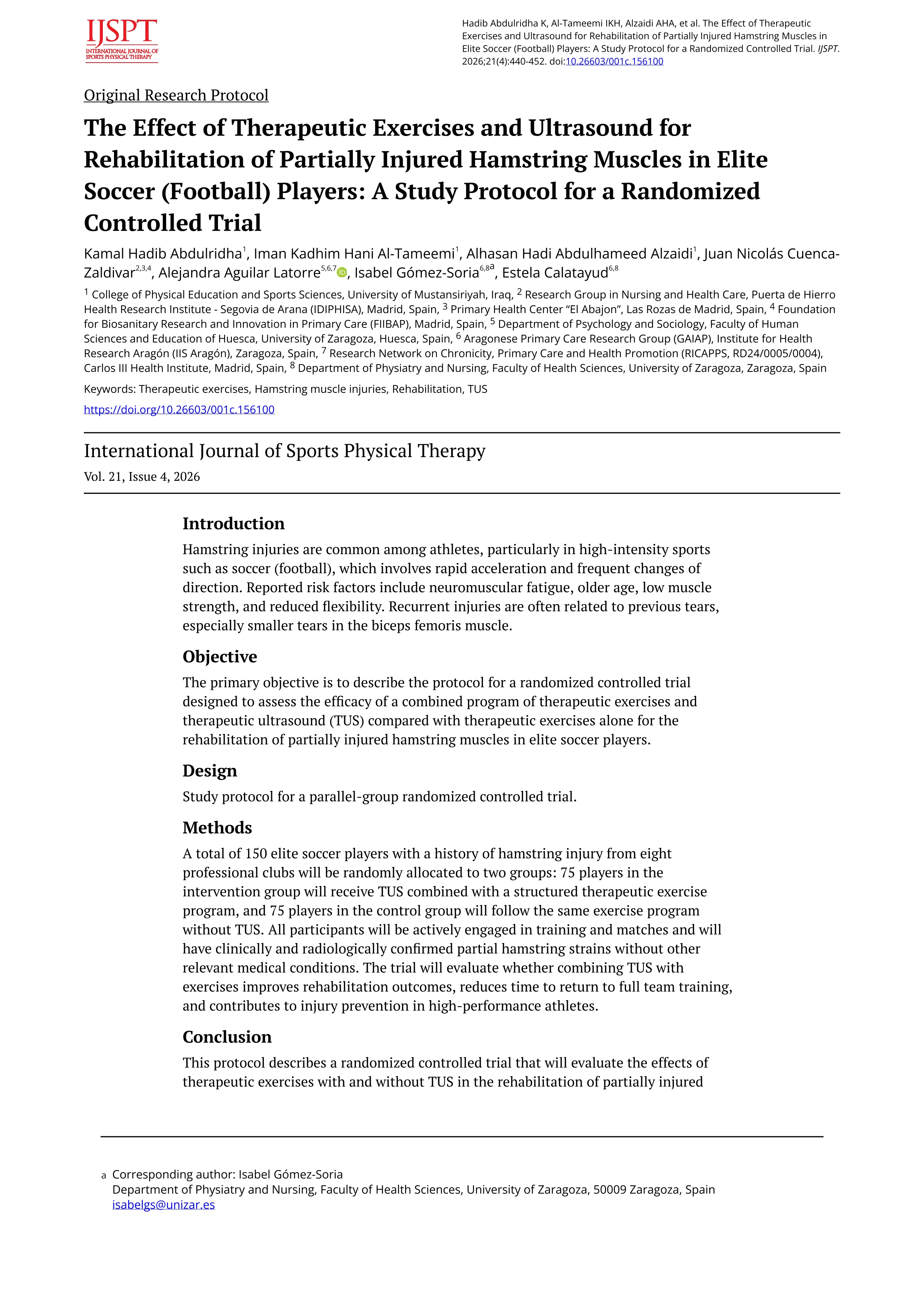
Resumen: Hamstring injuries are common among athletes, particularly in high-intensity sports such as soccer (football), which involves rapid acceleration and frequent changes of direction. Reported risk factors include neuromuscular fatigue, older age, low muscle strength, and reduced flexibility. Recurrent injuries are often related to previous tears, especially smaller tears in the biceps femoris muscle.
Objective: The primary objective is to describe the protocol for a randomized controlled trial designed to assess the efficacy of a combined program of therapeutic exercises and therapeutic ultrasound (TUS) compared with therapeutic exercises alone for the rehabilitation of partially injured hamstring muscles in elite soccer players.
Design: Study protocol for a parallel-group randomized controlled trial.
Methods: A total of 150 elite soccer players with a history of hamstring injury from eight professional clubs will be randomly allocated to two groups: 75 players in the intervention group will receive TUS combined with a structured therapeutic exercise program, and 75 players in the control group will follow the same exercise program without TUS. All participants will be actively engaged in training and matches and will have clinically and radiologically confirmed partial hamstring strains without other relevant medical conditions. The trial will evaluate whether combining TUS with exercises improves rehabilitation outcomes, reduces time to return to full team training, and contributes to injury prevention in high-performance athletes.
Conclusion: This protocol describes a randomized controlled trial that will evaluate the effects of therapeutic exercises with and without TUS in the rehabilitation of partially injured hamstring muscles in elite soccer players. The findings are expected to inform sports medicine practitioners about the potential role of TUS as an adjunct to exercise-based rehabilitation. Given the mixed evidence regarding the effectiveness of TUS in musculoskeletal conditions, this study will contribute additional data on its possible benefits in this specific athletic population.
Trial registration: NCT06165783.
Idioma: Inglés
DOI: 10.26603/001c.156100
Año: 2026
Publicado en: International Journal of Sports Physical Therapy 21, 4 (2026), 440-452
ISSN: 2159-2896
Financiación: info:eu-repo/grantAgreement/ES/DGA/B21-23R-GAIAP
Tipo y forma: Artículo (Versión definitiva)
Área (Departamento): Área Fisioterapia (Dpto. Fisiatría y Enfermería)
Área (Departamento): Área Psicolog.Evolut.Educac (Dpto. Psicología y Sociología)
 Debe reconocer adecuadamente la autoría, proporcionar un enlace a la licencia e indicar si se han realizado cambios. Puede hacerlo de cualquier manera razonable, pero no de una manera que sugiera que tiene el apoyo del licenciador o lo recibe por el uso que hace. No puede utilizar el material para una finalidad comercial.
Exportado de SIDERAL (2026-04-18-10:49:45)
Visitas y descargas
Objective: The primary objective is to describe the protocol for a randomized controlled trial designed to assess the efficacy of a combined program of therapeutic exercises and therapeutic ultrasound (TUS) compared with therapeutic exercises alone for the rehabilitation of partially injured hamstring muscles in elite soccer players.
Design: Study protocol for a parallel-group randomized controlled trial.
Methods: A total of 150 elite soccer players with a history of hamstring injury from eight professional clubs will be randomly allocated to two groups: 75 players in the intervention group will receive TUS combined with a structured therapeutic exercise program, and 75 players in the control group will follow the same exercise program without TUS. All participants will be actively engaged in training and matches and will have clinically and radiologically confirmed partial hamstring strains without other relevant medical conditions. The trial will evaluate whether combining TUS with exercises improves rehabilitation outcomes, reduces time to return to full team training, and contributes to injury prevention in high-performance athletes.
Conclusion: This protocol describes a randomized controlled trial that will evaluate the effects of therapeutic exercises with and without TUS in the rehabilitation of partially injured hamstring muscles in elite soccer players. The findings are expected to inform sports medicine practitioners about the potential role of TUS as an adjunct to exercise-based rehabilitation. Given the mixed evidence regarding the effectiveness of TUS in musculoskeletal conditions, this study will contribute additional data on its possible benefits in this specific athletic population.
Trial registration: NCT06165783.
Idioma: Inglés
DOI: 10.26603/001c.156100
Año: 2026
Publicado en: International Journal of Sports Physical Therapy 21, 4 (2026), 440-452
ISSN: 2159-2896
Financiación: info:eu-repo/grantAgreement/ES/DGA/B21-23R-GAIAP
Tipo y forma: Artículo (Versión definitiva)
Área (Departamento): Área Fisioterapia (Dpto. Fisiatría y Enfermería)
Área (Departamento): Área Psicolog.Evolut.Educac (Dpto. Psicología y Sociología)
Debe reconocer adecuadamente la autoría, proporcionar un enlace a la licencia e indicar si se han realizado cambios. Puede hacerlo de cualquier manera razonable, pero no de una manera que sugiera que tiene el apoyo del licenciador o lo recibe por el uso que hace. No puede utilizar el material para una finalidad comercial.Exportado de SIDERAL (2026-04-18-10:49:45)
Enlace permanente:
Visitas y descargas
Este artículo se encuentra en las siguientes colecciones:
Artículos > Artículos por área > Psicología Evolutiva y de la Educación
Artículos > Artículos por área > Fisioterapia
Registro creado el 2026-04-18, última modificación el 2026-04-20