Seroprevalence and associated factors ofLeishmania infantum in small ruminants in Portugal
Quintas, Hélder ; Lebrero, María (Universidad de Zaragoza) ; Jacob-Ferreira, João ; Quilez, Pablo (Universidad de Zaragoza) ; Guallar, David (Universidad de Zaragoza) ; Coelho, Ana ; Lacasta, Delia (Universidad de Zaragoza) ; Marteles-Aragüés, Diana (Universidad de Zaragoza) ; Ruiz de Arcaute Rivero, Marta (Universidad de Zaragoza) ; Cardoso, Luís ; Villanueva, Sergio (Universidad de Zaragoza)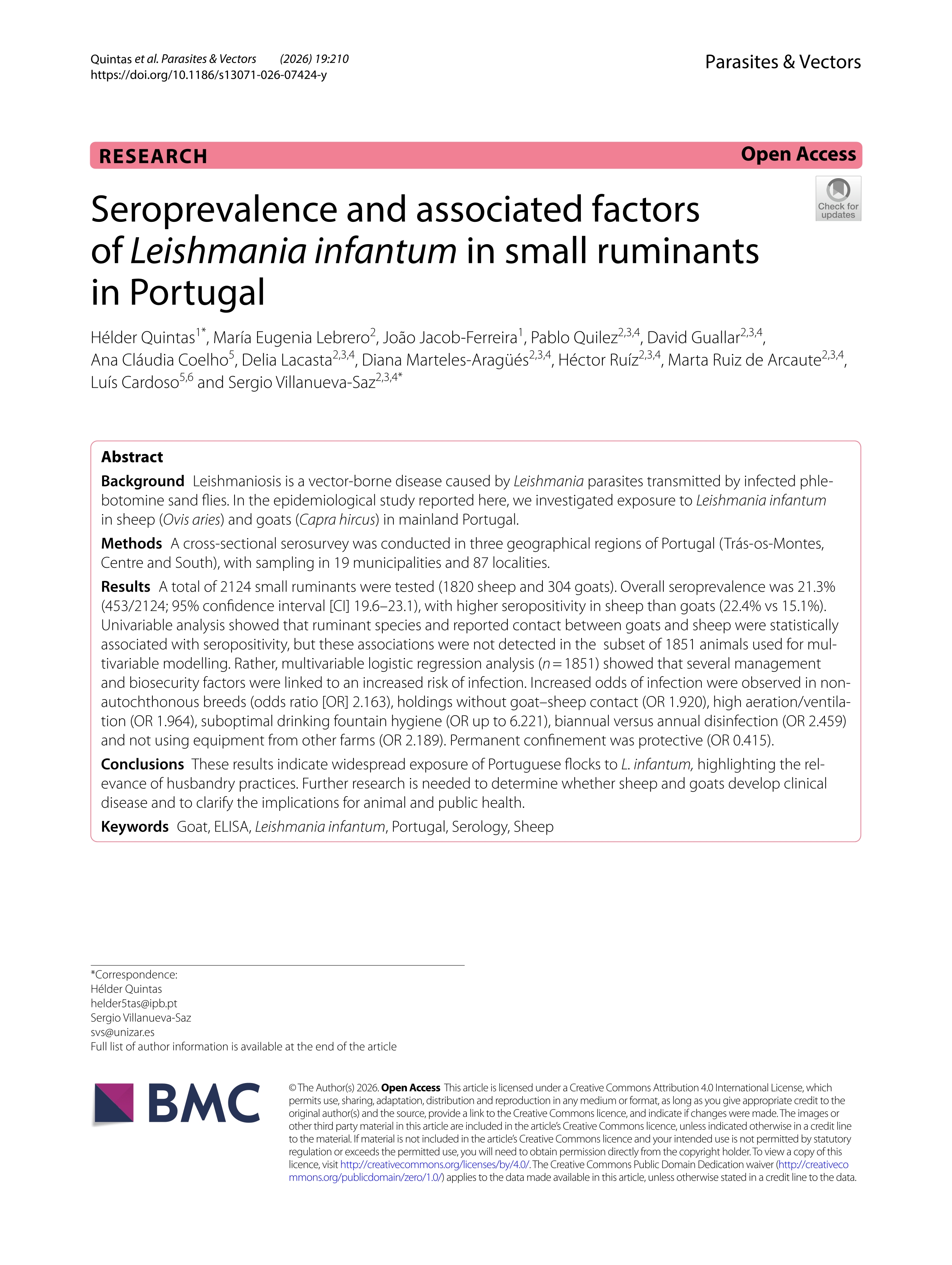
Resumen: Background
Leishmaniosis is a vector-borne disease caused by Leishmania parasites transmitted by infected phlebotomine sand flies. In the epidemiological study reported here, we investigated exposure to Leishmania infantum in sheep (Ovis aries) and goats (Capra hircus) in mainland Portugal.
Methods
A cross-sectional serosurvey was conducted in three geographical regions of Portugal (Trás-os-Montes, Centre and South), with sampling in 19 municipalities and 87 localities.
Results
A total of 2124 small ruminants were tested (1820 sheep and 304 goats). Overall seroprevalence was 21.3% (453/2124; 95% confidence interval [CI] 19.6–23.1), with higher seropositivity in sheep than goats (22.4% vs 15.1%). Univariable analysis showed that ruminant species and reported contact between goats and sheep were statistically associated with seropositivity, but these associations were not detected in the subset of 1851 animals used for multivariable modelling. Rather, multivariable logistic regression analysis (n = 1851) showed that several management and biosecurity factors were linked to an increased risk of infection. Increased odds of infection were observed in non-autochthonous breeds (odds ratio [OR] 2.163), holdings without goat–sheep contact (OR 1.920), high aeration/ventilation (OR 1.964), suboptimal drinking fountain hygiene (OR up to 6.221), biannual versus annual disinfection (OR 2.459) and not using equipment from other farms (OR 2.189). Permanent confinement was protective (OR 0.415).
Conclusions
These results indicate widespread exposure of Portuguese flocks to L. infantum, highlighting the relevance of husbandry practices. Further research is needed to determine whether sheep and goats develop clinical disease and to clarify the implications for animal and public health.
Idioma: Inglés
DOI: 10.1186/s1307
Año: 2026
Publicado en: Parasites & vectors 9, 210 (2026), [11 pp.]
ISSN: 1756-3305
Tipo y forma: Artículo (Versión definitiva)
Área (Departamento): Área Medicina y Cirugía Animal (Dpto. Patología Animal)
 Debe reconocer adecuadamente la autoría, proporcionar un enlace a la licencia e indicar si se han realizado cambios. Puede hacerlo de cualquier manera razonable, pero no de una manera que sugiera que tiene el apoyo del licenciador o lo recibe por el uso que hace.
Exportado de SIDERAL (2026-05-15-14:54:32)
Visitas y descargas
Leishmaniosis is a vector-borne disease caused by Leishmania parasites transmitted by infected phlebotomine sand flies. In the epidemiological study reported here, we investigated exposure to Leishmania infantum in sheep (Ovis aries) and goats (Capra hircus) in mainland Portugal.
Methods
A cross-sectional serosurvey was conducted in three geographical regions of Portugal (Trás-os-Montes, Centre and South), with sampling in 19 municipalities and 87 localities.
Results
A total of 2124 small ruminants were tested (1820 sheep and 304 goats). Overall seroprevalence was 21.3% (453/2124; 95% confidence interval [CI] 19.6–23.1), with higher seropositivity in sheep than goats (22.4% vs 15.1%). Univariable analysis showed that ruminant species and reported contact between goats and sheep were statistically associated with seropositivity, but these associations were not detected in the subset of 1851 animals used for multivariable modelling. Rather, multivariable logistic regression analysis (n = 1851) showed that several management and biosecurity factors were linked to an increased risk of infection. Increased odds of infection were observed in non-autochthonous breeds (odds ratio [OR] 2.163), holdings without goat–sheep contact (OR 1.920), high aeration/ventilation (OR 1.964), suboptimal drinking fountain hygiene (OR up to 6.221), biannual versus annual disinfection (OR 2.459) and not using equipment from other farms (OR 2.189). Permanent confinement was protective (OR 0.415).
Conclusions
These results indicate widespread exposure of Portuguese flocks to L. infantum, highlighting the relevance of husbandry practices. Further research is needed to determine whether sheep and goats develop clinical disease and to clarify the implications for animal and public health.
Idioma: Inglés
DOI: 10.1186/s1307
Año: 2026
Publicado en: Parasites & vectors 9, 210 (2026), [11 pp.]
ISSN: 1756-3305
Tipo y forma: Artículo (Versión definitiva)
Área (Departamento): Área Medicina y Cirugía Animal (Dpto. Patología Animal)
Debe reconocer adecuadamente la autoría, proporcionar un enlace a la licencia e indicar si se han realizado cambios. Puede hacerlo de cualquier manera razonable, pero no de una manera que sugiera que tiene el apoyo del licenciador o lo recibe por el uso que hace. Exportado de SIDERAL (2026-05-15-14:54:32)
Enlace permanente:
Visitas y descargas
Este artículo se encuentra en las siguientes colecciones:
Artículos > Artículos por área > Medicina y Cirugía Animal
Registro creado el 2026-05-15, última modificación el 2026-05-15