Understanding tonic–clonic seizure transitions as secondary bifurcations in a neural field model
Cattell, O. ; Mayora-Cebollero, A. (Universidad de Zaragoza) ; O'Dea, R. D. ; Barrio, R. (Universidad de Zaragoza) ; Coombes, S.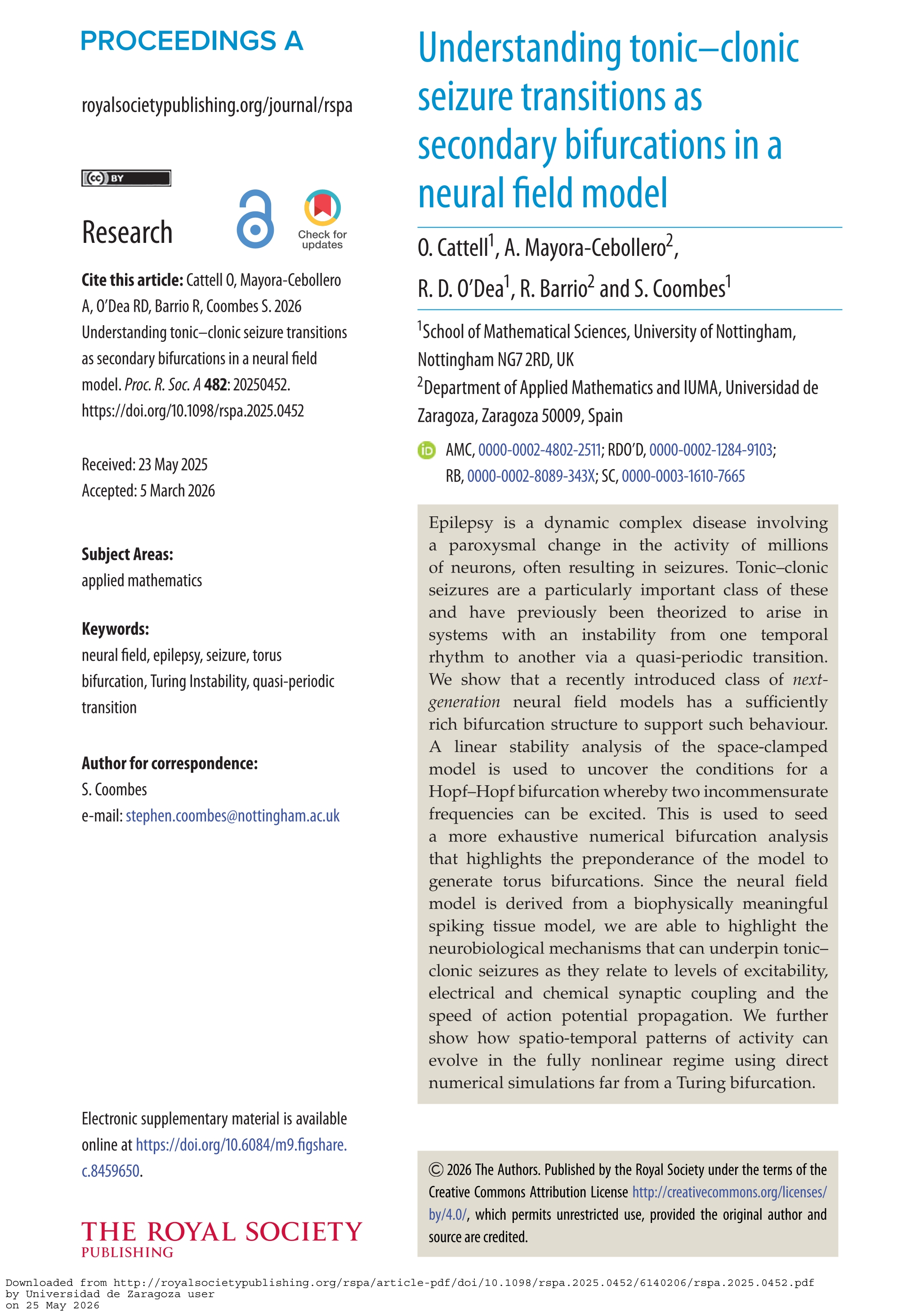
Resumen: Epilepsy is a dynamic complex disease involving a paroxysmal change in the activity of millions of neurons, often resulting in seizures. Tonic–clonic seizures are a particularly important class of these and have previously been theorized to arise in systems with an instability from one temporal rhythm to another via a quasi-periodic transition. We show that a recently introduced class of next-generation neural field models has a sufficiently rich bifurcation structure to support such behaviour. A linear stability analysis of the space-clamped model is used to uncover the conditions for a Hopf–Hopf bifurcation whereby two incommensurate frequencies can be excited. This is used to seed a more exhaustive numerical bifurcation analysis that highlights the preponderance of the model to generate torus bifurcations. Since the neural field model is derived from a biophysically meaningful spiking tissue model, we are able to highlight the neurobiological mechanisms that can underpin tonic–clonic seizures as they relate to levels of excitability, electrical and chemical synaptic coupling and the speed of action potential propagation. We further show how spatio-temporal patterns of activity can evolve in the fully nonlinear regime using direct numerical simulations far from a Turing bifurcation.
Idioma: Inglés
DOI: 10.1098/rspa.2025.0452
Año: 2026
Publicado en: Proceedings - Royal Society. Mathematical, physical and engineering sciences 482, 2338 (2026), 20250452 [28 pp.]
ISSN: 1364-5021
Financiación: info:eu-repo/grantAgreement/ES/AEI/PID2021-122961NB-I00
Financiación: info:eu-repo/grantAgreement/ES/DGA/E24-20R
Financiación: info:eu-repo/grantAgreement/ES/DGA/E24-23R
Financiación: info:eu-repo/grantAgreement/ES/DGA/LMP94_21
Financiación: info:eu-repo/grantAgreement/ES/MCINN/PID2024-156032NB-I00
Financiación: info:eu-repo/grantAgreement/EUR/MICINN/TED2021-130459B-I00
Tipo y forma: Artículo (Versión definitiva)
Área (Departamento): Área Matemática Aplicada (Dpto. Matemática Aplicada)
 Debe reconocer adecuadamente la autoría, proporcionar un enlace a la licencia e indicar si se han realizado cambios. Puede hacerlo de cualquier manera razonable, pero no de una manera que sugiera que tiene el apoyo del licenciador o lo recibe por el uso que hace.
Exportado de SIDERAL (2026-05-27-11:25:00)
Visitas y descargas
Idioma: Inglés
DOI: 10.1098/rspa.2025.0452
Año: 2026
Publicado en: Proceedings - Royal Society. Mathematical, physical and engineering sciences 482, 2338 (2026), 20250452 [28 pp.]
ISSN: 1364-5021
Financiación: info:eu-repo/grantAgreement/ES/AEI/PID2021-122961NB-I00
Financiación: info:eu-repo/grantAgreement/ES/DGA/E24-20R
Financiación: info:eu-repo/grantAgreement/ES/DGA/E24-23R
Financiación: info:eu-repo/grantAgreement/ES/DGA/LMP94_21
Financiación: info:eu-repo/grantAgreement/ES/MCINN/PID2024-156032NB-I00
Financiación: info:eu-repo/grantAgreement/EUR/MICINN/TED2021-130459B-I00
Tipo y forma: Artículo (Versión definitiva)
Área (Departamento): Área Matemática Aplicada (Dpto. Matemática Aplicada)
Debe reconocer adecuadamente la autoría, proporcionar un enlace a la licencia e indicar si se han realizado cambios. Puede hacerlo de cualquier manera razonable, pero no de una manera que sugiera que tiene el apoyo del licenciador o lo recibe por el uso que hace. Exportado de SIDERAL (2026-05-27-11:25:00)
Enlace permanente:
Visitas y descargas
Este artículo se encuentra en las siguientes colecciones:
Artículos > Artículos por área > Matemática Aplicada
Registro creado el 2026-05-27, última modificación el 2026-05-27