Bile acid synthesis precursors in subjects with genetic hypercholesterolemia negative for LDLR/APOB/PCSK9/APOE mutations. Association with lipids and carotid atherosclerosis
Baila-Rueda, L. ; Cenarro, A. ; Lamiquiz-Moneo, I. ; Mateo-Gallego, R. (Universidad de Zaragoza) ; Bea, A.M. ; Perez-Calahorra, S. ; Marco-Benedi, V. ; Civeira, F. (Universidad de Zaragoza)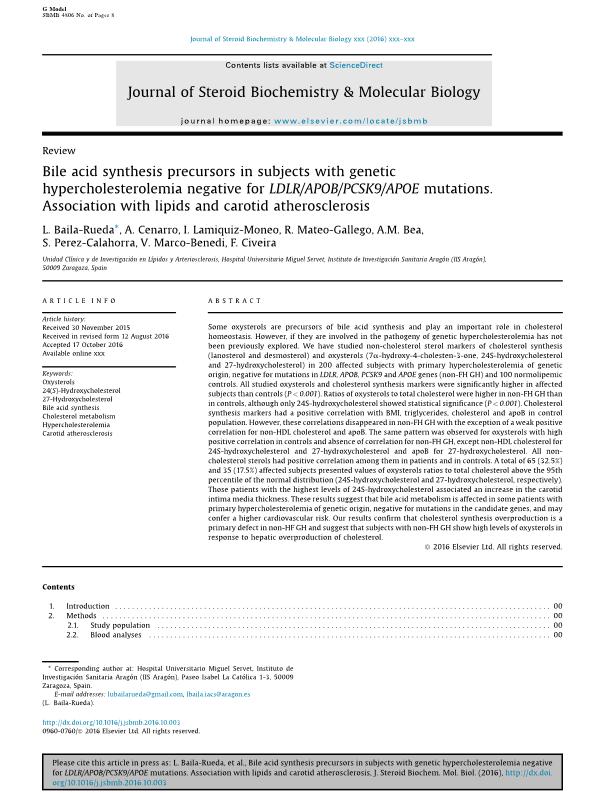
Resumen: Some oxysterols are precursors of bile acid synthesis and play an important role in cholesterol homeostasis. However, if they are involved in the pathogeny of genetic hypercholesterolemia has not been previously explored. We have studied non-cholesterol sterol markers of cholesterol synthesis (lanosterol and desmosterol) and oxysterols (7a-hydroxy-4-cholesten-3-one, 24S-hydroxycholesterol and 27-hydroxycholesterol) in 200 affected subjects with primary hypercholesterolemia of genetic origin, negative for mutations in LDLR, APOB, PCSK9 and APOE genes (non-FH GH) and 100 normolipemic controls. All studied oxysterols and cholesterol synthesis markers were significantly higher in affected subjects than controls (P < 0.001). Ratios of oxysterols to total cholesterol were higher in non-FH GH than in controls, although only 24S-hydroxycholesterol showed statistical significance (P < 0.001). Cholesterol synthesis markers had a positive correlation with BMI, triglycerides, cholesterol and apoB in control population. However, these correlations disappeared in non-FH GH with the exception of a weak positive correlation for non-HDL cholesterol and apoB. The same pattern was observed for oxysterols with high positive correlation in controls and absence of correlation for non-FH GH, except non-HDL cholesterol for 24S-hydroxycholesterol and 27-hydroxycholesterol and apoB for 27-hydroxycholesterol. All non-cholesterol sterols had positive correlation among them in patients and in controls. A total of 65 (32.5%) and 35 (17.5%) affected subjects presented values of oxysterols ratios to total cholesterol above the 95th percentile of the normal distribution (24S-hydroxycholesterol and 27-hydroxycholesterol, respectively). Those patients with the highest levels of 24S-hydroxycholesterol associated an increase in the carotid intima media thickness. These results suggest that bile acid metabolism is affected in some patients with primary hypercholesterolemia of genetic origin, negative for mutations in the candidate genes, and may confer a higher cardiovascular risk. Our results confirm that cholesterol synthesis overproduction is a primary defect in non-HF GH and suggest that subjects with non-FH GH show high levels of oxysterols in response to hepatic overproduction of cholesterol.
Idioma: Inglés
DOI: 10.1016/j.jsbmb.2016.10.003
Año: 2017
Publicado en: JOURNAL OF STEROID BIOCHEMISTRY AND MOLECULAR BIOLOGY 169 (2017), 226-233
ISSN: 0960-0760
Factor impacto JCR: 4.095 (2017)
Categ. JCR: ENDOCRINOLOGY & METABOLISM rank: 32 / 141 = 0.227 (2017) - Q1 - T1
Categ. JCR: BIOCHEMISTRY & MOLECULAR BIOLOGY rank: 69 / 292 = 0.236 (2017) - Q1 - T1
Factor impacto SCIMAGO: 1.431 - Endocrinology, Diabetes and Metabolism (Q1) - Clinical Biochemistry (Q1) - Biochemistry (Q1) - Molecular Biology (Q2) - Molecular Medicine (Q2) - Endocrinology (Q2) - Cell Biology (Q2)
Financiación: info:eu-repo/grantAgreement/ES/ISCIII/RD12-0042-0055
Financiación: info:eu-repo/grantAgreement/ES/MINECO/PI12-01087
Tipo y forma: Revisión (PostPrint)
Área (Departamento): Area Medicina (Dpto. Medicina, Psiqu. y Derm.)
 Debe reconocer adecuadamente la autoría, proporcionar un enlace a la licencia e indicar si se han realizado cambios. Puede hacerlo de cualquier manera razonable, pero no de una manera que sugiera que tiene el apoyo del licenciador o lo recibe por el uso que hace. No puede utilizar el material para una finalidad comercial. Si remezcla, transforma o crea a partir del material, no puede difundir el material modificado.
Exportado de SIDERAL (2024-01-22-15:31:11)
Visitas y descargas
Idioma: Inglés
DOI: 10.1016/j.jsbmb.2016.10.003
Año: 2017
Publicado en: JOURNAL OF STEROID BIOCHEMISTRY AND MOLECULAR BIOLOGY 169 (2017), 226-233
ISSN: 0960-0760
Factor impacto JCR: 4.095 (2017)
Categ. JCR: ENDOCRINOLOGY & METABOLISM rank: 32 / 141 = 0.227 (2017) - Q1 - T1
Categ. JCR: BIOCHEMISTRY & MOLECULAR BIOLOGY rank: 69 / 292 = 0.236 (2017) - Q1 - T1
Factor impacto SCIMAGO: 1.431 - Endocrinology, Diabetes and Metabolism (Q1) - Clinical Biochemistry (Q1) - Biochemistry (Q1) - Molecular Biology (Q2) - Molecular Medicine (Q2) - Endocrinology (Q2) - Cell Biology (Q2)
Financiación: info:eu-repo/grantAgreement/ES/ISCIII/RD12-0042-0055
Financiación: info:eu-repo/grantAgreement/ES/MINECO/PI12-01087
Tipo y forma: Revisión (PostPrint)
Área (Departamento): Area Medicina (Dpto. Medicina, Psiqu. y Derm.)
Debe reconocer adecuadamente la autoría, proporcionar un enlace a la licencia e indicar si se han realizado cambios. Puede hacerlo de cualquier manera razonable, pero no de una manera que sugiera que tiene el apoyo del licenciador o lo recibe por el uso que hace. No puede utilizar el material para una finalidad comercial. Si remezcla, transforma o crea a partir del material, no puede difundir el material modificado.Exportado de SIDERAL (2024-01-22-15:31:11)
Enlace permanente:
Visitas y descargas
Este artículo se encuentra en las siguientes colecciones:
Artículos > Artículos por área > Medicina
Registro creado el 2018-12-19, última modificación el 2024-01-22