El desarrollo de la epigrafía pública indígena en el mediterráneo occidental: la base de datos Enceom
Herrera Rando, J. (Universidad de Zaragoza) ; de Tord Basterra, G. (Universidad de Zaragoza)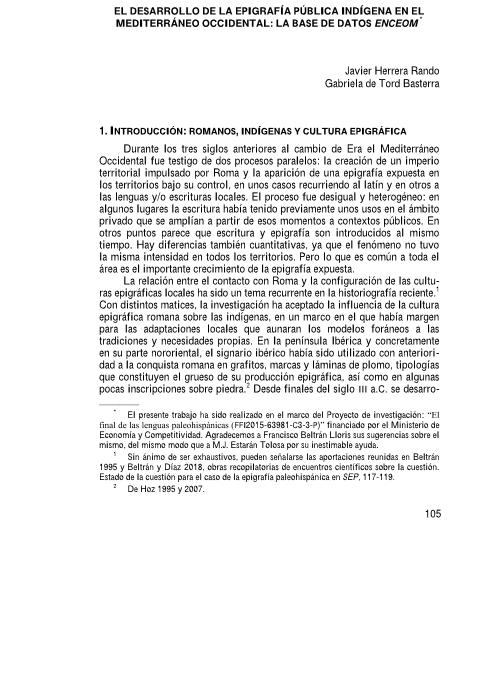
Resumen: Durante los tres siglos anteriores al cambio de Era el Mediterráneo Occidental fue testigo de dos procesos paralelos: la creación de un imperio territorial impulsado por Roma y la aparición de una epigrafía expuesta en los territorios bajo su control, en unos casos recurriendo al latín y en otros a las lenguas y/o escrituras locales. El proceso fue desigual y heterogéneo: en algunos lugares la escritura había tenido previamente unos usos en el ámbito privado que se amplían a partir de esos momentos a contextos públicos. En otros puntos parece que escritura y epigrafía son introducidos al mismo tiempo. Hay diferencias también cuantitativas, ya que el fenómeno no tuvo la misma intensidad en todos los territorios. Pero lo que es común a toda el área es el importante crecimiento de la epigrafía expuesta...
The aim of this article is to present the preliminary results of the ENCEOM database. Created as one of the main objectives of the Spanish research project "El nacimiento de las culturas epigraficas del Mediterraneo Occidental", the database looks for the compilation of public displayed inscriptions in indigenous languages and writings and its relationship with the Romanization process. The description of the database and the inclusion criteria used throughout this work will follow a brief introduction covering the development of the different epigraphic cultures. Then, the specific results for each one of the epigraphic spaces included until now in the database (Paleohispanic, Gaulish and Osco-Umbrian) will be presented. The article finishes with a general comparative which shows the potential of this new epigraphic cataloguing too.
Idioma: Español
Año: 2018
Publicado en: Palaeohispánica (Zaragoza) 18 (2018), 105-136
ISSN: 1578-5386
Originalmente disponible en: Texto completo de la revista
Financiación: info:eu-repo/grantAgreement/ES/MINECO/FFI2015-63981-C3-3-P
Tipo y forma: Artículo (Versión definitiva)
Área (Departamento): Área Historia Antigua (Dpto. Ciencias de la Antigüed.)
 Debe reconocer adecuadamente la autoría, proporcionar un enlace a la licencia e indicar si se han realizado cambios. Puede hacerlo de cualquier manera razonable, pero no de una manera que sugiera que tiene el apoyo del licenciador o lo recibe por el uso que hace. No puede utilizar el material para una finalidad comercial. Si remezcla, transforma o crea a partir del material, no puede difundir el material modificado.
Exportado de SIDERAL (2020-01-17-21:52:06)
Visitas y descargas
The aim of this article is to present the preliminary results of the ENCEOM database. Created as one of the main objectives of the Spanish research project "El nacimiento de las culturas epigraficas del Mediterraneo Occidental", the database looks for the compilation of public displayed inscriptions in indigenous languages and writings and its relationship with the Romanization process. The description of the database and the inclusion criteria used throughout this work will follow a brief introduction covering the development of the different epigraphic cultures. Then, the specific results for each one of the epigraphic spaces included until now in the database (Paleohispanic, Gaulish and Osco-Umbrian) will be presented. The article finishes with a general comparative which shows the potential of this new epigraphic cataloguing too.
Idioma: Español
Año: 2018
Publicado en: Palaeohispánica (Zaragoza) 18 (2018), 105-136
ISSN: 1578-5386
Originalmente disponible en: Texto completo de la revista
Financiación: info:eu-repo/grantAgreement/ES/MINECO/FFI2015-63981-C3-3-P
Tipo y forma: Artículo (Versión definitiva)
Área (Departamento): Área Historia Antigua (Dpto. Ciencias de la Antigüed.)
Debe reconocer adecuadamente la autoría, proporcionar un enlace a la licencia e indicar si se han realizado cambios. Puede hacerlo de cualquier manera razonable, pero no de una manera que sugiera que tiene el apoyo del licenciador o lo recibe por el uso que hace. No puede utilizar el material para una finalidad comercial. Si remezcla, transforma o crea a partir del material, no puede difundir el material modificado.Exportado de SIDERAL (2020-01-17-21:52:06)
Enlace permanente:
Visitas y descargas
Este artículo se encuentra en las siguientes colecciones:
Artículos
Registro creado el 2019-02-01, última modificación el 2020-01-17