A consensus document on definition and diagnostic criteria for orthorexia nervosa
Donini, Lorenzo M. ; Barrada, Juan Ramón (Universidad de Zaragoza) ; Barthels, Friederike ; Dunn, Thomas M. ; Babeau, Camille ; Brytek-Matera, Anna ; Cena, Hellas ; Cerolini, Silvia ; Cho, Hye-hyun ; Coimbra, Maria ; Cuzzolaro, Massimo ; Ferreira, Claudia ; Galfano, Valeria ; Grammatikopoulou, Maria G. ; Hallit, Souheil ; Håman, Linn ; Hay, Phillipa ; Jimbo, Masahito ; Lasson, Clotilde ; Lindgren, Eva-Carin ; McGregor, Renee ; Minnetti, Marianna ; Mocini, Edoardo ; Obeid, Sahar ; Oberle, Crystal D. ; Onieva-Zafra, Maria-Dolores ; Opitz, Marie-Christine ; Parra-Fernández, María-Laura ; Pietrowsky, Reinhard ; Plasonja, Natalija ; Poggiogalle, Eleonora ; Rigó, Adrien ; Rodgers, Rachel F. ; Roncero, Maria ; Saldaña, Carmina ; Segura-Garcia, Cristina ; Setnick, Jessica ; Shin, Ji-Yeon ; Spitoni, Grazia ; Strahler, Jana ; Stroebele-Benschop, Nanette ; Todisco, Patrizia ; Vacca, Mariacarolina ; Valente, Martina ; Varga, Màrta ; Zagaria, Andrea ; Zickgraf, Hana Flynn ; Lombardo, Caterina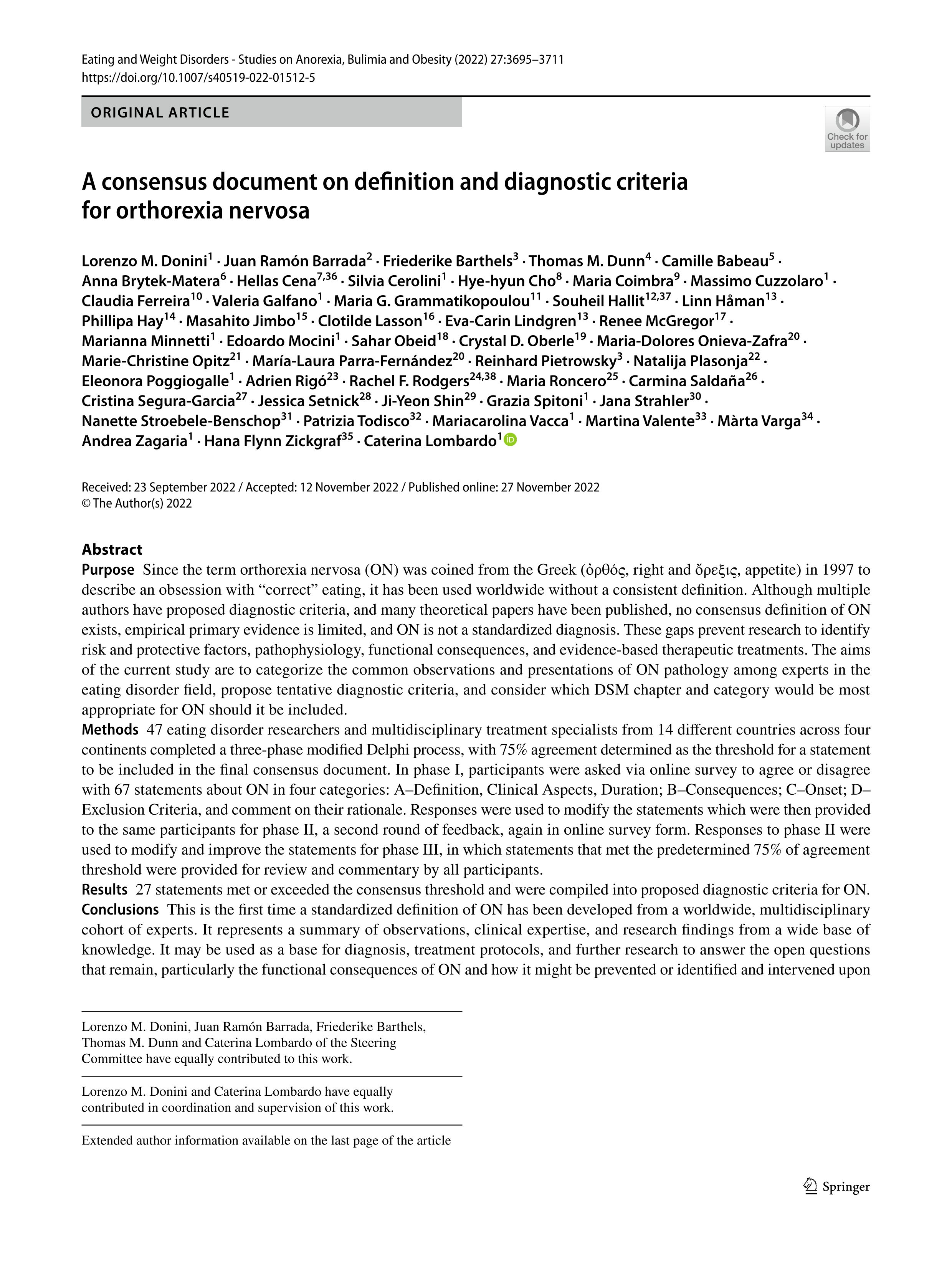
Resumen: Purpose: Since the term orthorexia nervosa (ON) was coined from the Greek (ὀρθός, right and ὄρεξις, appetite) in 1997 to describe an obsession with “correct” eating, it has been used worldwide without a consistent definition. Although multiple authors have proposed diagnostic criteria, and many theoretical papers have been published, no consensus definition of ON exists, empirical primary evidence is limited, and ON is not a standardized diagnosis. These gaps prevent research to identify risk and protective factors, pathophysiology, functional consequences, and evidence-based therapeutic treatments. The aims of the current study are to categorize the common observations and presentations of ON pathology among experts in the eating disorder field, propose tentative diagnostic criteria, and consider which DSM chapter and category would be most appropriate for ON should it be included. Methods: 47 eating disorder researchers and multidisciplinary treatment specialists from 14 different countries across four continents completed a three-phase modified Delphi process, with 75% agreement determined as the threshold for a statement to be included in the final consensus document. In phase I, participants were asked via online survey to agree or disagree with 67 statements about ON in four categories: A–Definition, Clinical Aspects, Duration; B–Consequences; C–Onset; D–Exclusion Criteria, and comment on their rationale. Responses were used to modify the statements which were then provided to the same participants for phase II, a second round of feedback, again in online survey form. Responses to phase II were used to modify and improve the statements for phase III, in which statements that met the predetermined 75% of agreement threshold were provided for review and commentary by all participants. Results: 27 statements met or exceeded the consensus threshold and were compiled into proposed diagnostic criteria for ON. Conclusions:
This is the first time a standardized definition of ON has been developed from a worldwide, multidisciplinary cohort of experts. It represents a summary of observations, clinical expertise, and research findings from a wide base of knowledge. It may be used as a base for diagnosis, treatment protocols, and further research to answer the open questions that remain, particularly the functional consequences of ON and how it might be prevented or identified and intervened upon in its early stages. Although the participants encompass many countries and disciplines, further research will be needed to determine if these diagnostic criteria are applicable to the experience of ON in geographic areas not represented in the current expert panel. Level of evidence_ Level V: opinions of expert committees
Idioma: Inglés
DOI: 10.1007/s40519-022-01512-5
Año: 2022
Publicado en: Eating and Weight Disorders - Studies on Anorexia, Bulimia and Obesity 27, 8 (2022), 3695-3711
ISSN: 1590-1262
Tipo y forma: Artículo (Versión definitiva)
Área (Departamento): Área Psicolog.Evolut.Educac (Dpto. Psicología y Sociología)
 Debe reconocer adecuadamente la autoría, proporcionar un enlace a la licencia e indicar si se han realizado cambios. Puede hacerlo de cualquier manera razonable, pero no de una manera que sugiera que tiene el apoyo del licenciador o lo recibe por el uso que hace.
Exportado de SIDERAL (2023-01-11-08:48:19)
Visitas y descargas
This is the first time a standardized definition of ON has been developed from a worldwide, multidisciplinary cohort of experts. It represents a summary of observations, clinical expertise, and research findings from a wide base of knowledge. It may be used as a base for diagnosis, treatment protocols, and further research to answer the open questions that remain, particularly the functional consequences of ON and how it might be prevented or identified and intervened upon in its early stages. Although the participants encompass many countries and disciplines, further research will be needed to determine if these diagnostic criteria are applicable to the experience of ON in geographic areas not represented in the current expert panel. Level of evidence_ Level V: opinions of expert committees
Idioma: Inglés
DOI: 10.1007/s40519-022-01512-5
Año: 2022
Publicado en: Eating and Weight Disorders - Studies on Anorexia, Bulimia and Obesity 27, 8 (2022), 3695-3711
ISSN: 1590-1262
Tipo y forma: Artículo (Versión definitiva)
Área (Departamento): Área Psicolog.Evolut.Educac (Dpto. Psicología y Sociología)
Debe reconocer adecuadamente la autoría, proporcionar un enlace a la licencia e indicar si se han realizado cambios. Puede hacerlo de cualquier manera razonable, pero no de una manera que sugiera que tiene el apoyo del licenciador o lo recibe por el uso que hace. Exportado de SIDERAL (2023-01-11-08:48:19)
Enlace permanente:
Visitas y descargas
Este artículo se encuentra en las siguientes colecciones:
Artículos > Artículos por área > Psicología Evolutiva y de la Educación
Registro creado el 2023-01-11, última modificación el 2023-01-11