Protective role of mindfulness, self-compassion and psychological flexibility on the burnout subtypes among psychology and nursing undergraduate students
Martínez-Rubio D. ; Martínez-Brotons C. ; Monreal-Bartolomé A. ; Barceló-Soler A. ; Campos D. (Universidad de Zaragoza) ; Pérez-Aranda A. ; Colomer-Carbonell A. ; Cervera-Torres S. ; Solé S. ; Moreno Y. ; Montero-Marín J.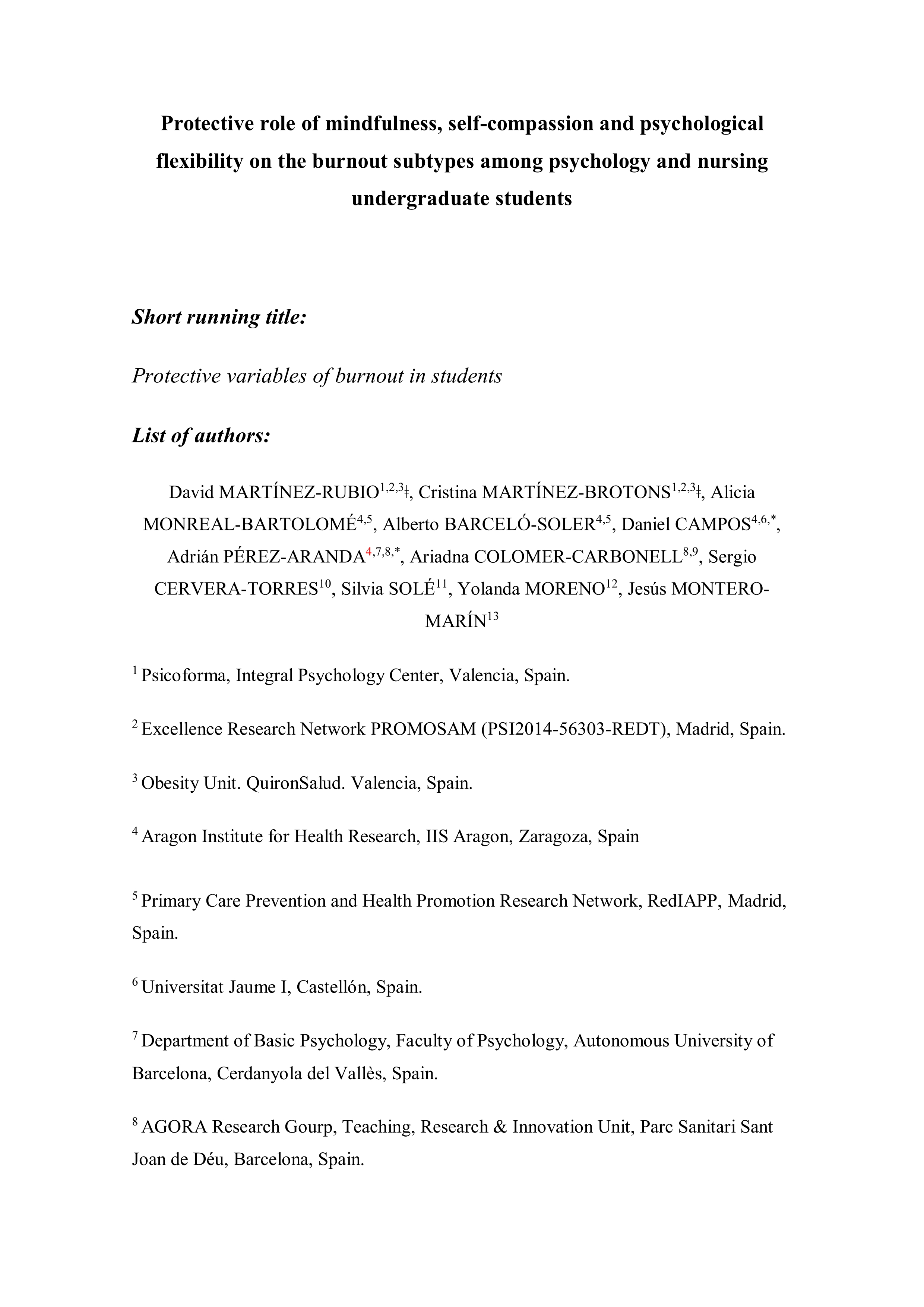
Resumen: Aims: To explore the relationship between mindfulness, self-compassion and psychological flexibility, and the burnout subtypes in university students of the Psychology and Nursing degrees, and to analyse possible risk factors for developing burnout among socio-demographic and studies-related characteristics. Design: Cross-sectional study conducted on a sample of 644 undergraduate students of Nursing and Psychology from two Spanish universities. Methods: The study was conducted between December 2015 and May 2016. Bivariate Pearson''s correlations were computed to analyse the association between mindfulness facets, self-compassion and psychological flexibility, and levels of burnout. Multivariate linear regression models and bivariate and multivariate binary logistic regressions were also computed. Results: The three subtypes of burnout presented significant correlations with psychological flexibility, self-compassion and some mindfulness facets. Psychological flexibility, self-compassion and the mindfulness facets of observing and acting with awareness were significantly associated to burnout. Among the risk factors, ‘year of study’ was the only variable to show significantly higher risk for every burnout subtype. Conclusion: The significant associations found between mindfulness, self-compassion, psychological flexibility and burnout levels underline the need of including these variables as therapeutic targets when addressing the burnout syndrome in university students. Impact. Undergraduate students, especially those of health sciences, often experience burnout. This study delves into the protective role of some psychological variables: mindfulness, self-compassion and psychological flexibility. These should be considered as potentially protective skills for developing burnout, and therefore, undergraduate students could be trained on these abilities to face their studies and their future profession to prevent experiencing burnout syndrome. © 2021 John Wiley & Sons Ltd
Idioma: Inglés
DOI: 10.1111/jan.14870
Año: 2021
Publicado en: Journal of Advanced Nursing 77, 8 (2021), 3398-3411
ISSN: 0309-2402
Factor impacto JCR: 3.057 (2021)
Categ. JCR: NURSING rank: 21 / 125 = 0.168 (2021) - Q1 - T1
Categ. JCR: NURSING rank: 20 / 123 = 0.163 (2021) - Q1 - T1
Factor impacto CITESCORE: 4.3 - Nursing (Q1)
Factor impacto SCIMAGO: 0.774 - Nursing (miscellaneous) (Q1)
Financiación: info:eu-repo/grantAgreement/ES/ISCIII/CD20-00181
Financiación: info:eu-repo/grantAgreement/ES/ISCIII-MECD-IISZ/FI17-00180
Financiación: info:eu-repo/grantAgreement/ES/ISCIII-MECD-IISZ/FPU014-04987
Tipo y forma: Artículo (PostPrint)
Área (Departamento): Área Psicolog.Evolut.Educac (Dpto. Psicología y Sociología)
 Debe reconocer adecuadamente la autoría, proporcionar un enlace a la licencia e indicar si se han realizado cambios. Puede hacerlo de cualquier manera razonable, pero no de una manera que sugiera que tiene el apoyo del licenciador o lo recibe por el uso que hace. No puede utilizar el material para una finalidad comercial. Si remezcla, transforma o crea a partir del material, no puede difundir el material modificado.
Exportado de SIDERAL (2024-01-22-15:40:00)
Visitas y descargas
Idioma: Inglés
DOI: 10.1111/jan.14870
Año: 2021
Publicado en: Journal of Advanced Nursing 77, 8 (2021), 3398-3411
ISSN: 0309-2402
Factor impacto JCR: 3.057 (2021)
Categ. JCR: NURSING rank: 21 / 125 = 0.168 (2021) - Q1 - T1
Categ. JCR: NURSING rank: 20 / 123 = 0.163 (2021) - Q1 - T1
Factor impacto CITESCORE: 4.3 - Nursing (Q1)
Factor impacto SCIMAGO: 0.774 - Nursing (miscellaneous) (Q1)
Financiación: info:eu-repo/grantAgreement/ES/ISCIII/CD20-00181
Financiación: info:eu-repo/grantAgreement/ES/ISCIII-MECD-IISZ/FI17-00180
Financiación: info:eu-repo/grantAgreement/ES/ISCIII-MECD-IISZ/FPU014-04987
Tipo y forma: Artículo (PostPrint)
Área (Departamento): Área Psicolog.Evolut.Educac (Dpto. Psicología y Sociología)
Debe reconocer adecuadamente la autoría, proporcionar un enlace a la licencia e indicar si se han realizado cambios. Puede hacerlo de cualquier manera razonable, pero no de una manera que sugiera que tiene el apoyo del licenciador o lo recibe por el uso que hace. No puede utilizar el material para una finalidad comercial. Si remezcla, transforma o crea a partir del material, no puede difundir el material modificado.Exportado de SIDERAL (2024-01-22-15:40:00)
Enlace permanente:
Visitas y descargas
Este artículo se encuentra en las siguientes colecciones:
Artículos > Artículos por área > Psicología Evolutiva y de la Educación
Registro creado el 2023-12-19, última modificación el 2024-01-22