Phosphorescent Iridium(III) Complexes with a Dianionic C, C', N, N'-Tetradentate Ligand
Benavent, L. (Universidad de Zaragoza) ; Boudreault, P.L.T. ; Esteruelas, M.A. ; López, A.M. (Universidad de Zaragoza) ; Oñate, E. ; Tsai, J.Y.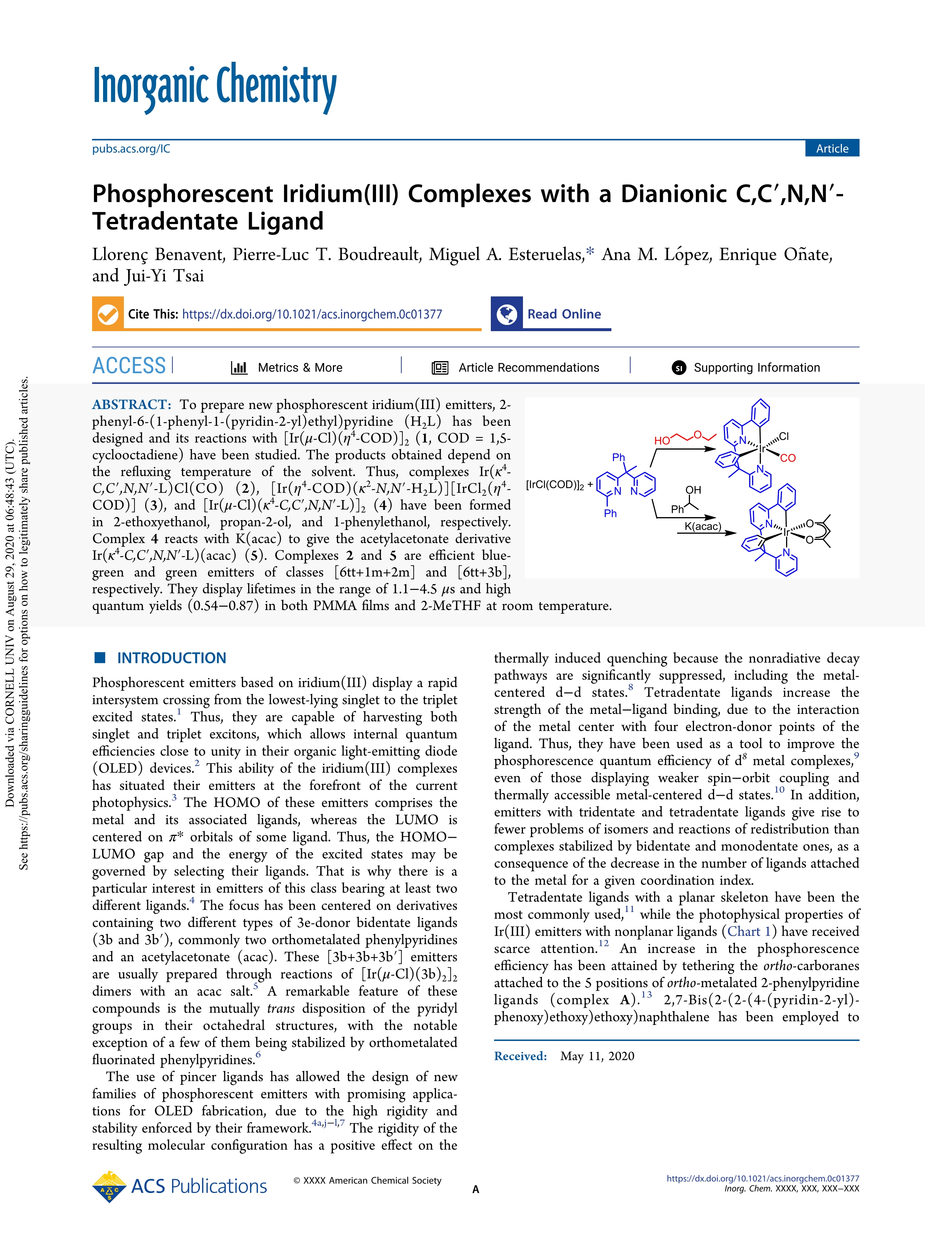
Resumen: To prepare new phosphorescent iridium(III) emitters, 2-phenyl-6-(1-phenyl-1-(pyridin-2-yl)ethyl)pyridine (H2L) has been designed and its reactions with [Ir(μ-Cl)(η4-COD)]2 (1, COD = 1,5-cyclooctadiene) have been studied. The products obtained depend on the refluxing temperature of the solvent. Thus, complexes Ir(κ4-C,C′,N,N′-L)Cl(CO) (2), [Ir(η4-COD)(κ2-N,N′-H2L)][IrCl2(η4-COD)] (3), and [Ir(μ-Cl)(κ4-C,C′,N,N′-L)]2 (4) have been formed in 2-ethoxyethanol, propan-2-ol, and 1-phenylethanol, respectively. Complex 4 reacts with K(acac) to give the acetylacetonate derivative Ir(κ4-C,C′,N,N′-L)(acac) (5). Complexes 2 and 5 are efficient blue-green and green emitters of classes [6tt+1m+2m] and [6tt+3b], respectively. They display lifetimes in the range of 1.1–4.5 μs and high quantum yields (0.54–0.87) in both PMMA films and 2-MeTHF at room temperature.
Idioma: Inglés
DOI: 10.1021/acs.inorgchem.0c01377
Año: 2020
Publicado en: Inorganic Chemistry 59 (2020), 12286-12294
ISSN: 0020-1669
Factor impacto JCR: 5.165 (2020)
Categ. JCR: CHEMISTRY, INORGANIC & NUCLEAR rank: 5 / 45 = 0.111 (2020) - Q1 - T1
Factor impacto SCIMAGO: 1.348 - Chemistry (miscellaneous) (Q1) - Physical and Theoretical Chemistry (Q1) - Inorganic Chemistry (Q1)
Financiación: info:eu-repo/grantAgreement/ES/DGA/E06-20R
Financiación: info:eu-repo/grantAgreement/ES/DGA/LMP148-18
Financiación: info:eu-repo/grantAgreement/ES/MINECO-AEI-FEDER/CTQ2017-82935-P
Financiación: info:eu-repo/grantAgreement/ES/MINECO-AEI-FEDER/RED2018-102387-T
Tipo y forma: Article (PostPrint)
Área (Departamento): Área Química Inorgánica (Dpto. Química Inorgánica)
Exportado de SIDERAL (2021-09-02-10:55:42)
Visitas y descargas
Idioma: Inglés
DOI: 10.1021/acs.inorgchem.0c01377
Año: 2020
Publicado en: Inorganic Chemistry 59 (2020), 12286-12294
ISSN: 0020-1669
Factor impacto JCR: 5.165 (2020)
Categ. JCR: CHEMISTRY, INORGANIC & NUCLEAR rank: 5 / 45 = 0.111 (2020) - Q1 - T1
Factor impacto SCIMAGO: 1.348 - Chemistry (miscellaneous) (Q1) - Physical and Theoretical Chemistry (Q1) - Inorganic Chemistry (Q1)
Financiación: info:eu-repo/grantAgreement/ES/DGA/E06-20R
Financiación: info:eu-repo/grantAgreement/ES/DGA/LMP148-18
Financiación: info:eu-repo/grantAgreement/ES/MINECO-AEI-FEDER/CTQ2017-82935-P
Financiación: info:eu-repo/grantAgreement/ES/MINECO-AEI-FEDER/RED2018-102387-T
Tipo y forma: Article (PostPrint)
Área (Departamento): Área Química Inorgánica (Dpto. Química Inorgánica)
Exportado de SIDERAL (2021-09-02-10:55:42)
Permalink:
Visitas y descargas
Este artículo se encuentra en las siguientes colecciones:
articulos > articulos-por-area > quimica_inorganica
Notice créée le 2021-09-01, modifiée le 2021-09-02