Propiedades psicométricas del Inventario de Situaciones y Respuestas de Ansiedad Breve (ISRA-B)
Cano-Vindel, A. ; Muñoz-Navarro, R. (Universidad de Zaragoza) ; Moretti, L.S. ; Medrano, L.A.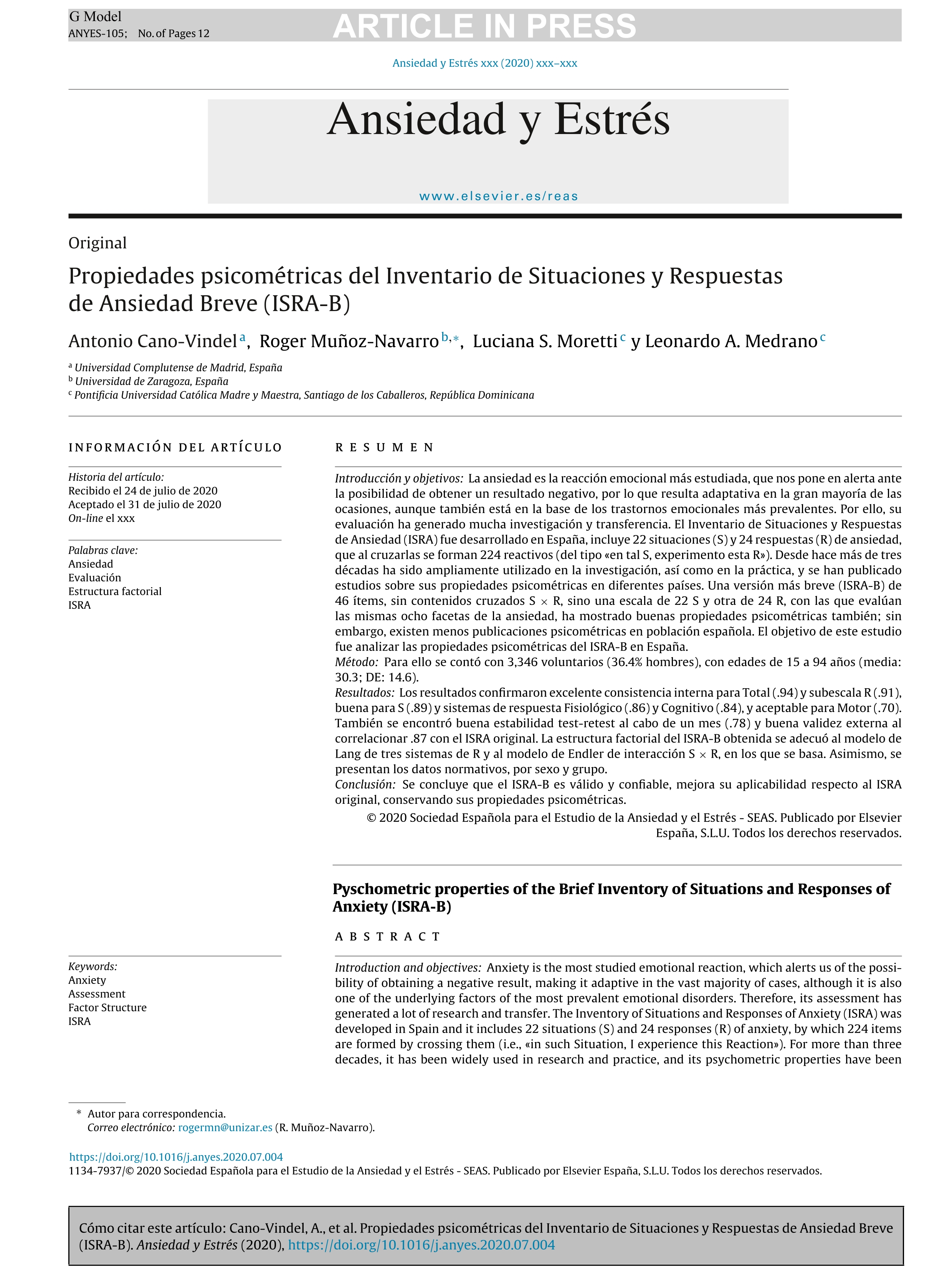
Resumen: Introducción y objetivos
La ansiedad es la reacción emocional más estudiada, que nos pone en alerta ante la posibilidad de obtener un resultado negativo, por lo que resulta adaptativa en la gran mayoría de las ocasiones, aunque también está en la base de los trastornos emocionales más prevalentes. Por ello, su evaluación ha generado mucha investigación y transferencia. El Inventario de Situaciones y Respuestas de Ansiedad (ISRA) fue desarrollado en España, incluye 22 situaciones (S) y 24 respuestas (R) de ansiedad, que al cruzarlas se forman 224 reactivos (del tipo «en tal S, experimento esta R»). Desde hace más de tres décadas ha sido ampliamente utilizado en la investigación, así como en la práctica, y se han publicado estudios sobre sus propiedades psicométricas en diferentes países. Una versión más breve (ISRA-B) de 46 ítems, sin contenidos cruzados S × R, sino una escala de 22 S y otra de 24 R, con las que evalúan las mismas ocho facetas de la ansiedad, ha mostrado buenas propiedades psicométricas también; sin embargo, existen menos publicaciones psicométricas en población española. El objetivo de este estudio fue analizar las propiedades psicométricas del ISRA-B en España.
Método
Para ello se contó con 3, 346 voluntarios (36.4% hombres), con edades de 15 a 94 años (media: 30.3; DE: 14.6).
Resultados
Los resultados confirmaron excelente consistencia interna para Total (.94) y subescala R (.91), buena para S (.89) y sistemas de respuesta Fisiológico (.86) y Cognitivo (.84), y aceptable para Motor (.70). También se encontró buena estabilidad test-retest al cabo de un mes (.78) y buena validez externa al correlacionar .87 con el ISRA original. La estructura factorial del ISRA-B obtenida se adecuó al modelo de Lang de tres sistemas de R y al modelo de Endler de interacción S × R, en los que se basa. Asimismo, se presentan los datos normativos, por sexo y grupo.
Conclusión
Se concluye que el ISRA-B es válido y confiable, mejora su aplicabilidad respecto al ISRA original, conservando sus propiedades psicométricas.
Introduction and objectives: Anxiety is the most studied emotional reaction, which alerts us of the possibility of obtaining a negative result, making it adaptive in the vast majority of cases, although it is also one of the underlying factors of the most prevalent emotional disorders. Therefore, its assessment has generated a lot of research and transfer. The Inventory of Situations and Responses of Anxiety (ISRA) was developed in Spain and it includes 22 situations (S) and 24 responses (R) of anxiety, by which 224 items are formed by crossing them (i.e., «in such Situation, I experience this Reaction»). For more than three decades, it has been widely used in research and practice, and its psychometric properties have been published in different countries. A shorter, 46-item version (ISRA-B), with a 22 S scale plus another of 24 R was developed. The same eight facets of anxiety were assessed, showing good psychometric properties as well. However, there are few publications on the psychometric data using Spanish population. The objective of this study was to analyze the psychometric properties of ISRA-B in Spain.
Methods: Three thousand three hundred and forty six volunteers (36.4% men), aged 15 to 94 years (mean: 30.3; SD: 14.6) were included.
Results: The results confirmed excellent internal consistency for the Total (.94) and the Responses subscale (0.91), good for the Situations (0.89), as well as the Physiological (, 86) and Cognitive (0.84) response systems, and acceptable for the Motor (0.70). Good test-retest stability was also found after two months (0.78) and good external validity when correlated with the original ISRA (0.87). The results confirm the factor structure of the ISRA-B, adjusted to Lang''s triple response system model and to Endler''s S × R interaction model, on which it is based. Likewise, the normative data are presented, differentiated by sex and group.
Conclusions: It is concluded that the ISRA-B is a valid and reliable instrument, which improves its applicability compared to the original ISRA by simplifying its format and number of items, while preserving its psychometric properties.
Idioma: Español
DOI: 10.1016/j.anyes.2020.07.004
Año: 2020
Publicado en: Ansiedad y estrés 26, 2-3 (2020), 155-166
ISSN: 1134-7937
Factor impacto SCIMAGO: 0.342 - Applied Psychology (Q3) - Social Psychology (Q3) - Psychiatry and Mental Health (Q3)
Tipo y forma: Artículo (PostPrint)
Área (Departamento): Área Person.Eval.Trat.Psicoló. (Dpto. Psicología y Sociología)
 Debe reconocer adecuadamente la autoría, proporcionar un enlace a la licencia e indicar si se han realizado cambios. Puede hacerlo de cualquier manera razonable, pero no de una manera que sugiera que tiene el apoyo del licenciador o lo recibe por el uso que hace. No puede utilizar el material para una finalidad comercial. Si remezcla, transforma o crea a partir del material, no puede difundir el material modificado.
Exportado de SIDERAL (2022-05-03-12:46:01)
Visitas y descargas
La ansiedad es la reacción emocional más estudiada, que nos pone en alerta ante la posibilidad de obtener un resultado negativo, por lo que resulta adaptativa en la gran mayoría de las ocasiones, aunque también está en la base de los trastornos emocionales más prevalentes. Por ello, su evaluación ha generado mucha investigación y transferencia. El Inventario de Situaciones y Respuestas de Ansiedad (ISRA) fue desarrollado en España, incluye 22 situaciones (S) y 24 respuestas (R) de ansiedad, que al cruzarlas se forman 224 reactivos (del tipo «en tal S, experimento esta R»). Desde hace más de tres décadas ha sido ampliamente utilizado en la investigación, así como en la práctica, y se han publicado estudios sobre sus propiedades psicométricas en diferentes países. Una versión más breve (ISRA-B) de 46 ítems, sin contenidos cruzados S × R, sino una escala de 22 S y otra de 24 R, con las que evalúan las mismas ocho facetas de la ansiedad, ha mostrado buenas propiedades psicométricas también; sin embargo, existen menos publicaciones psicométricas en población española. El objetivo de este estudio fue analizar las propiedades psicométricas del ISRA-B en España.
Método
Para ello se contó con 3, 346 voluntarios (36.4% hombres), con edades de 15 a 94 años (media: 30.3; DE: 14.6).
Resultados
Los resultados confirmaron excelente consistencia interna para Total (.94) y subescala R (.91), buena para S (.89) y sistemas de respuesta Fisiológico (.86) y Cognitivo (.84), y aceptable para Motor (.70). También se encontró buena estabilidad test-retest al cabo de un mes (.78) y buena validez externa al correlacionar .87 con el ISRA original. La estructura factorial del ISRA-B obtenida se adecuó al modelo de Lang de tres sistemas de R y al modelo de Endler de interacción S × R, en los que se basa. Asimismo, se presentan los datos normativos, por sexo y grupo.
Conclusión
Se concluye que el ISRA-B es válido y confiable, mejora su aplicabilidad respecto al ISRA original, conservando sus propiedades psicométricas.
Introduction and objectives: Anxiety is the most studied emotional reaction, which alerts us of the possibility of obtaining a negative result, making it adaptive in the vast majority of cases, although it is also one of the underlying factors of the most prevalent emotional disorders. Therefore, its assessment has generated a lot of research and transfer. The Inventory of Situations and Responses of Anxiety (ISRA) was developed in Spain and it includes 22 situations (S) and 24 responses (R) of anxiety, by which 224 items are formed by crossing them (i.e., «in such Situation, I experience this Reaction»). For more than three decades, it has been widely used in research and practice, and its psychometric properties have been published in different countries. A shorter, 46-item version (ISRA-B), with a 22 S scale plus another of 24 R was developed. The same eight facets of anxiety were assessed, showing good psychometric properties as well. However, there are few publications on the psychometric data using Spanish population. The objective of this study was to analyze the psychometric properties of ISRA-B in Spain.
Methods: Three thousand three hundred and forty six volunteers (36.4% men), aged 15 to 94 years (mean: 30.3; SD: 14.6) were included.
Results: The results confirmed excellent internal consistency for the Total (.94) and the Responses subscale (0.91), good for the Situations (0.89), as well as the Physiological (, 86) and Cognitive (0.84) response systems, and acceptable for the Motor (0.70). Good test-retest stability was also found after two months (0.78) and good external validity when correlated with the original ISRA (0.87). The results confirm the factor structure of the ISRA-B, adjusted to Lang''s triple response system model and to Endler''s S × R interaction model, on which it is based. Likewise, the normative data are presented, differentiated by sex and group.
Conclusions: It is concluded that the ISRA-B is a valid and reliable instrument, which improves its applicability compared to the original ISRA by simplifying its format and number of items, while preserving its psychometric properties.
Idioma: Español
DOI: 10.1016/j.anyes.2020.07.004
Año: 2020
Publicado en: Ansiedad y estrés 26, 2-3 (2020), 155-166
ISSN: 1134-7937
Factor impacto SCIMAGO: 0.342 - Applied Psychology (Q3) - Social Psychology (Q3) - Psychiatry and Mental Health (Q3)
Tipo y forma: Artículo (PostPrint)
Área (Departamento): Área Person.Eval.Trat.Psicoló. (Dpto. Psicología y Sociología)
Debe reconocer adecuadamente la autoría, proporcionar un enlace a la licencia e indicar si se han realizado cambios. Puede hacerlo de cualquier manera razonable, pero no de una manera que sugiera que tiene el apoyo del licenciador o lo recibe por el uso que hace. No puede utilizar el material para una finalidad comercial. Si remezcla, transforma o crea a partir del material, no puede difundir el material modificado.Exportado de SIDERAL (2022-05-03-12:46:01)
Enlace permanente:
Visitas y descargas
Este artículo se encuentra en las siguientes colecciones:
Artículos > Artículos por área > Personalidad,Evaluación y Tratamiento Psicológicos
Registro creado el 2021-09-30, última modificación el 2022-05-03