Sandwich-type zeolite intergrowths with MFI and the novel extralarge pore IDM-1 as ordered end-members
Villaescusa, L. A. ; Li, Jain. ; Mayoral, Álvaro (Universidad de Zaragoza) ; Gao, Zihao Rei ; Camblor, Miguel A.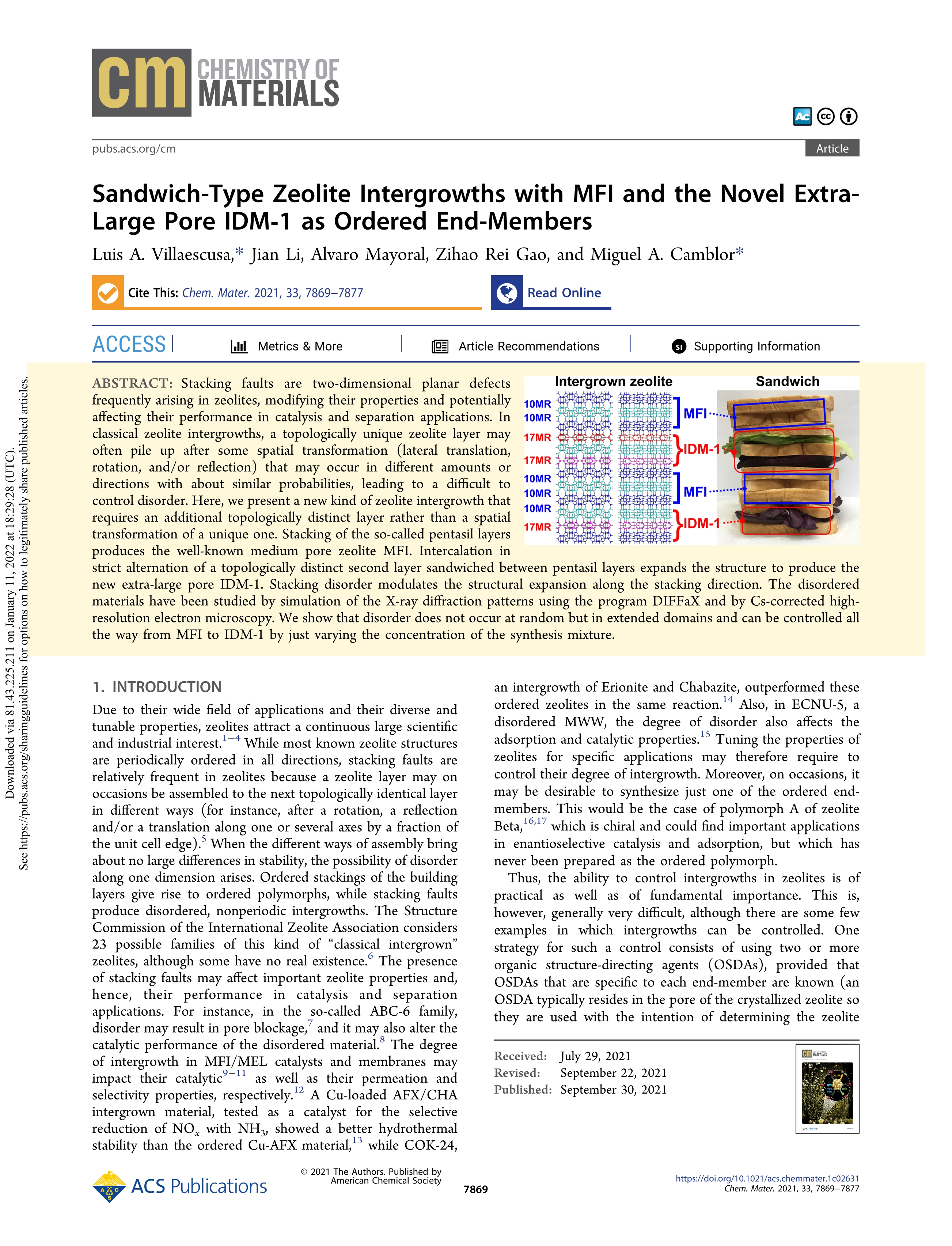
Resumen: Stacking faults are two-dimensional planar defects frequently arising in zeolites, modifying their properties and potentially affecting their performance in catalysis and separation applications. In classical zeolite intergrowths, a topologically unique zeolite layer may often pile up after some spatial transformation (lateral translation, rotation, and/or reflection) that may occur in different amounts or directions with about similar probabilities, leading to a difficult to control disorder. Here, we present a new kind of zeolite intergrowth that requires an additional topologically distinct layer rather than a spatial transformation of a unique one. Stacking of the so-called pentasil layers produces the well-known medium pore zeolite MFI. Intercalation in strict alternation of a topologically distinct second layer sandwiched between pentasil layers expands the structure to produce the new extra-large pore IDM-1. Stacking disorder modulates the structural expansion along the stacking direction. The disordered materials have been studied by simulation of the X-ray diffraction patterns using the program DIFFaX and by Cs-corrected high-resolution electron microscopy. We show that disorder does not occur at random but in extended domains and can be controlled all the way from MFI to IDM-1 by just varying the concentration of the synthesis mixture.
Idioma: Inglés
DOI: 10.1021/acs.chemmater.1c02631
Año: 2021
Publicado en: CHEMISTRY OF MATERIALS 33, 19 (2021), 7869-7877
ISSN: 0897-4756
Factor impacto JCR: 10.508 (2021)
Categ. JCR: MATERIALS SCIENCE, MULTIDISCIPLINARY rank: 48 / 345 = 0.139 (2021) - Q1 - T1
Categ. JCR: CHEMISTRY, PHYSICAL rank: 31 / 165 = 0.188 (2021) - Q1 - T1
Factor impacto CITESCORE: 15.9 - Chemical Engineering (Q1) - Materials Science (Q1)
Factor impacto SCIMAGO: 2.93 - Chemistry (miscellaneous) (Q1) - Chemical Engineering (miscellaneous) (Q1)
Financiación: info:eu-repo/grantAgreement/ES/DGA/E13-20R
Financiación: info:eu-repo/grantAgreement/ES/MCIU-FEDER/RTI2018-101599-B-C22
Financiación: info:eu-repo/grantAgreement/ES/MCIU/PID2019- 105479RB-I00
Financiación: info:eu-repo/grantAgreement/ES/MCIU/RYC-2018-024561-I
Financiación: info:eu-repo/grantAgreement/ES/MINECO-AEI-FEDER/MAT2015-71117-R
Tipo y forma: Article (Published version)
Área (Departamento): Área Física Materia Condensada (Dpto. Física Materia Condensa.)
Exportado de SIDERAL (2023-05-18-14:16:25)
Visitas y descargas
Idioma: Inglés
DOI: 10.1021/acs.chemmater.1c02631
Año: 2021
Publicado en: CHEMISTRY OF MATERIALS 33, 19 (2021), 7869-7877
ISSN: 0897-4756
Factor impacto JCR: 10.508 (2021)
Categ. JCR: MATERIALS SCIENCE, MULTIDISCIPLINARY rank: 48 / 345 = 0.139 (2021) - Q1 - T1
Categ. JCR: CHEMISTRY, PHYSICAL rank: 31 / 165 = 0.188 (2021) - Q1 - T1
Factor impacto CITESCORE: 15.9 - Chemical Engineering (Q1) - Materials Science (Q1)
Factor impacto SCIMAGO: 2.93 - Chemistry (miscellaneous) (Q1) - Chemical Engineering (miscellaneous) (Q1)
Financiación: info:eu-repo/grantAgreement/ES/DGA/E13-20R
Financiación: info:eu-repo/grantAgreement/ES/MCIU-FEDER/RTI2018-101599-B-C22
Financiación: info:eu-repo/grantAgreement/ES/MCIU/PID2019- 105479RB-I00
Financiación: info:eu-repo/grantAgreement/ES/MCIU/RYC-2018-024561-I
Financiación: info:eu-repo/grantAgreement/ES/MINECO-AEI-FEDER/MAT2015-71117-R
Tipo y forma: Article (Published version)
Área (Departamento): Área Física Materia Condensada (Dpto. Física Materia Condensa.)
Exportado de SIDERAL (2023-05-18-14:16:25)
Permalink:
Visitas y descargas
Este artículo se encuentra en las siguientes colecciones:
articulos > articulos-por-area > fisica_de_la_materia_condensada
Notice créée le 2022-01-15, modifiée le 2023-05-19