Synthesis of hydroxyfatty esters by sequential epoxidation-hydrogenolysis: Solvent effects
Dorado, V. ; Herrerias, C. I. (Universidad de Zaragoza) ; Fraile, J. M.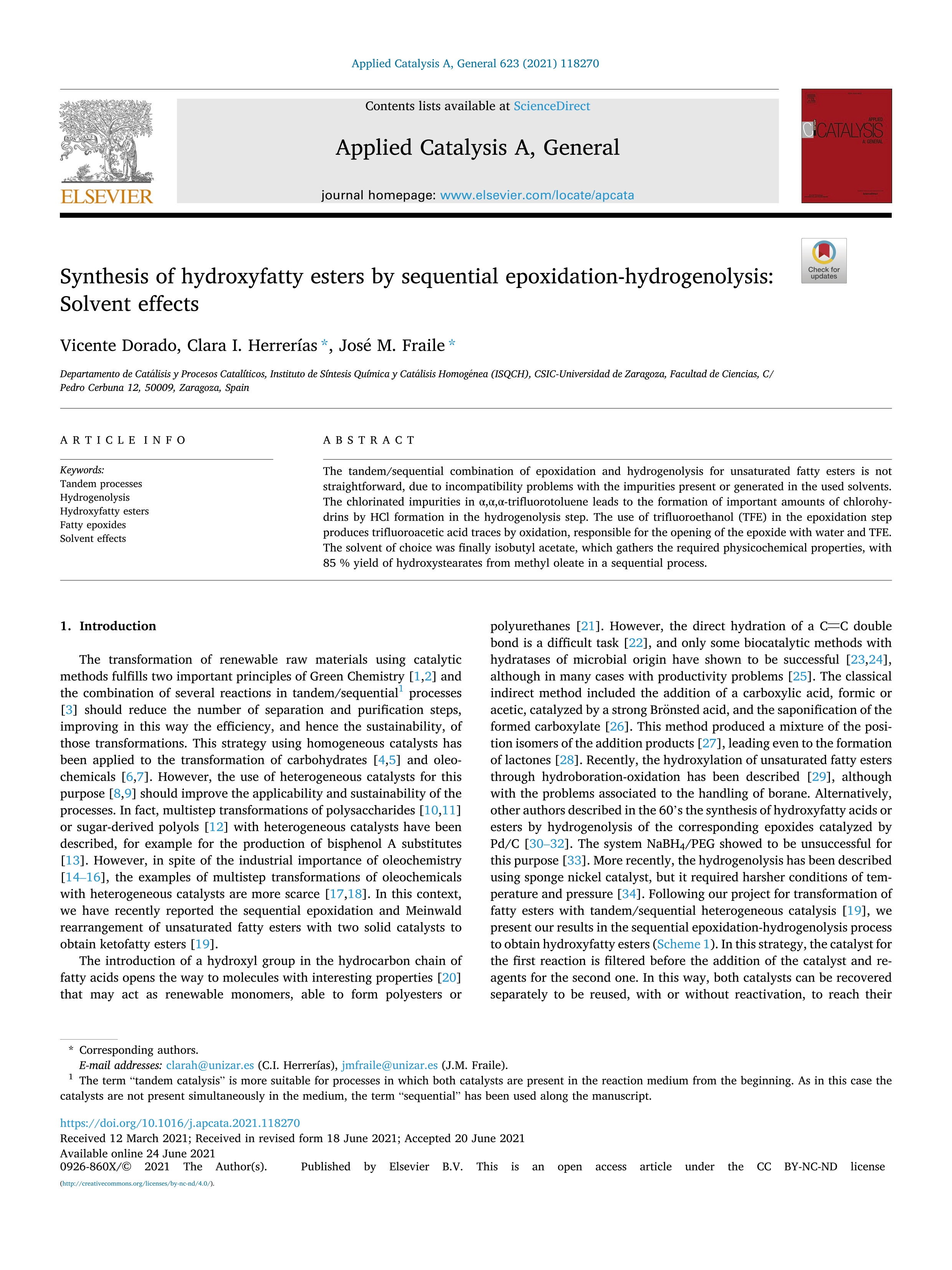
Resumen: The tandem/sequential combination of epoxidation and hydrogenolysis for unsaturated fatty esters is not straightforward, due to incompatibility problems with the impurities present or generated in the used solvents. The chlorinated impurities in alpha, alpha, alpha-trifluorotoluene leads to the formation of important amounts of chlorohydrins by HCl formation in the hydrogenolysis step. The use of trifluoroethanol (TFE) in the epoxidation step produces trifluoroacetic acid traces by oxidation, responsible for the opening of the epoxide with water and TFE. The solvent of choice was finally isobutyl acetate, which gathers the required physicochemical properties, with 85 % yield of hydroxystearates from methyl oleate in a sequential process.
Idioma: Inglés
DOI: 10.1016/j.apcata.2021.118270
Año: 2021
Publicado en: APPLIED CATALYSIS A-GENERAL 623 (2021), 118270 [8 pp.]
ISSN: 0926-860X
Factor impacto JCR: 5.723 (2021)
Categ. JCR: ENVIRONMENTAL SCIENCES rank: 77 / 279 = 0.276 (2021) - Q2 - T1
Categ. JCR: CHEMISTRY, PHYSICAL rank: 60 / 165 = 0.364 (2021) - Q2 - T2
Factor impacto CITESCORE: 9.8 - Chemical Engineering (Q1)
Factor impacto SCIMAGO: 1.08 - Process Chemistry and Technology (Q1) - Catalysis (Q1)
Financiación: info:eu-repo/grantAgreement/ES/DGA-ERDF/E37-20R
Financiación: info:eu-repo/grantAgreement/ES/MCIU/RTI2018-093431-B-I00
Tipo y forma: Article (Published version)
Área (Departamento): Área Química Orgánica (Dpto. Química Orgánica)
Exportado de SIDERAL (2024-01-24-15:17:35)
Visitas y descargas
Idioma: Inglés
DOI: 10.1016/j.apcata.2021.118270
Año: 2021
Publicado en: APPLIED CATALYSIS A-GENERAL 623 (2021), 118270 [8 pp.]
ISSN: 0926-860X
Factor impacto JCR: 5.723 (2021)
Categ. JCR: ENVIRONMENTAL SCIENCES rank: 77 / 279 = 0.276 (2021) - Q2 - T1
Categ. JCR: CHEMISTRY, PHYSICAL rank: 60 / 165 = 0.364 (2021) - Q2 - T2
Factor impacto CITESCORE: 9.8 - Chemical Engineering (Q1)
Factor impacto SCIMAGO: 1.08 - Process Chemistry and Technology (Q1) - Catalysis (Q1)
Financiación: info:eu-repo/grantAgreement/ES/DGA-ERDF/E37-20R
Financiación: info:eu-repo/grantAgreement/ES/MCIU/RTI2018-093431-B-I00
Tipo y forma: Article (Published version)
Área (Departamento): Área Química Orgánica (Dpto. Química Orgánica)
Exportado de SIDERAL (2024-01-24-15:17:35)
Permalink:
Visitas y descargas
Este artículo se encuentra en las siguientes colecciones:
articulos > articulos-por-area > quimica_organica
Notice créée le 2022-02-08, modifiée le 2024-01-24