The association of circulating miR-191 and miR-375 expression levels with markers of insulin resistance in overweight children: an exploratory analysis of the I.Family Study
Iacomino, G. ; Lauria, F. ; Russo, P. ; Venezia, A. ; Iannaccone, N. ; Marena, P. ; Ahrens, W. ; De Henauw, S. ; Molnár, D. ; Eiben, G. ; Foraita, R. ; Hebestreit, A. ; Kourides, G. ; Moreno, L.A. (Universidad de Zaragoza) ; Veidebaum, T. ; Siani, A. ; on behalf of the I.Family Consortium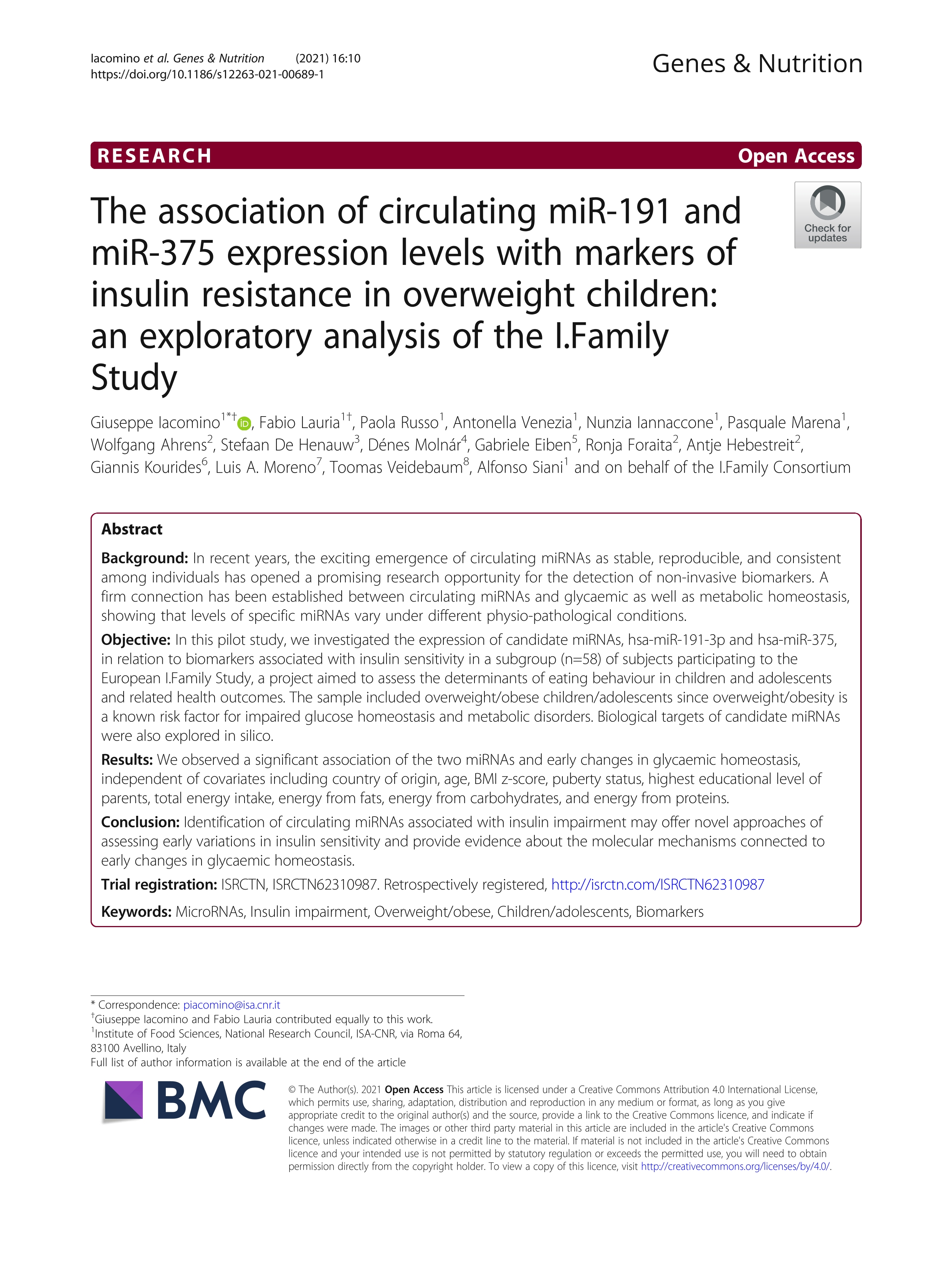

Resumen: Background: In recent years, the exciting emergence of circulating miRNAs as stable, reproducible, and consistent among individuals has opened a promising research opportunity for the detection of non-invasive biomarkers. A firm connection has been established between circulating miRNAs and glycaemic as well as metabolic homeostasis, showing that levels of specific miRNAs vary under different physio-pathological conditions. Objective: In this pilot study, we investigated the expression of candidate miRNAs, hsa-miR-191-3p and hsa-miR-375, in relation to biomarkers associated with insulin sensitivity in a subgroup (n=58) of subjects participating to the European I.Family Study, a project aimed to assess the determinants of eating behaviour in children and adolescents and related health outcomes. The sample included overweight/obese children/adolescents since overweight/obesity is a known risk factor for impaired glucose homeostasis and metabolic disorders. Biological targets of candidate miRNAs were also explored in silico. Results: We observed a significant association of the two miRNAs and early changes in glycaemic homeostasis, independent of covariates including country of origin, age, BMI z-score, puberty status, highest educational level of parents, total energy intake, energy from fats, energy from carbohydrates, and energy from proteins. Conclusion: Identification of circulating miRNAs associated with insulin impairment may offer novel approaches of assessing early variations in insulin sensitivity and provide evidence about the molecular mechanisms connected to early changes in glycaemic homeostasis. Trial registration: ISRCTN, ISRCTN62310987. Retrospectively registered, http://isrctn.com/ISRCTN62310987 © 2021, The Author(s).
Idioma: Inglés
DOI: 10.1186/s12263-021-00689-1
Año: 2021
Publicado en: Genes and Nutrition 16, 1 (2021), 10 [9 pp]
ISSN: 1555-8932
Factor impacto JCR: 4.423 (2021)
Categ. JCR: NUTRITION & DIETETICS rank: 44 / 90 = 0.489 (2021) - Q2 - T2
Categ. JCR: GENETICS & HEREDITY rank: 55 / 177 = 0.311 (2021) - Q2 - T1
Factor impacto CITESCORE: 8.8 - Medicine (Q1) - Biochemistry, Genetics and Molecular Biology (Q1)
Factor impacto SCIMAGO: 0.967 - Genetics (Q2) - Endocrinology, Diabetes and Metabolism (Q2)
Financiación: info:eu-repo/grantAgreement/EC/FP7/266044/EU/Determinants of eating behaviour in European children, adolescents and their parents/I.FAMILY
Tipo y forma: Artículo (Versión definitiva)
Área (Departamento): Área Enfermería (Dpto. Fisiatría y Enfermería)
 Debe reconocer adecuadamente la autoría, proporcionar un enlace a la licencia e indicar si se han realizado cambios. Puede hacerlo de cualquier manera razonable, pero no de una manera que sugiera que tiene el apoyo del licenciador o lo recibe por el uso que hace.
Exportado de SIDERAL (2023-05-18-15:57:34)
Visitas y descargas
Idioma: Inglés
DOI: 10.1186/s12263-021-00689-1
Año: 2021
Publicado en: Genes and Nutrition 16, 1 (2021), 10 [9 pp]
ISSN: 1555-8932
Factor impacto JCR: 4.423 (2021)
Categ. JCR: NUTRITION & DIETETICS rank: 44 / 90 = 0.489 (2021) - Q2 - T2
Categ. JCR: GENETICS & HEREDITY rank: 55 / 177 = 0.311 (2021) - Q2 - T1
Factor impacto CITESCORE: 8.8 - Medicine (Q1) - Biochemistry, Genetics and Molecular Biology (Q1)
Factor impacto SCIMAGO: 0.967 - Genetics (Q2) - Endocrinology, Diabetes and Metabolism (Q2)
Financiación: info:eu-repo/grantAgreement/EC/FP7/266044/EU/Determinants of eating behaviour in European children, adolescents and their parents/I.FAMILY
Tipo y forma: Artículo (Versión definitiva)
Área (Departamento): Área Enfermería (Dpto. Fisiatría y Enfermería)
Debe reconocer adecuadamente la autoría, proporcionar un enlace a la licencia e indicar si se han realizado cambios. Puede hacerlo de cualquier manera razonable, pero no de una manera que sugiera que tiene el apoyo del licenciador o lo recibe por el uso que hace. Exportado de SIDERAL (2023-05-18-15:57:34)
Enlace permanente:
Visitas y descargas
Este artículo se encuentra en las siguientes colecciones:
Artículos > Artículos por área > Enfermería
Registro creado el 2022-02-15, última modificación el 2023-05-19