Mediterranean old-growth forests exhibit resistance to climate warming
Colangelo, M. ; Camarero, J.J. ; Gazol, A. ; Piovesan, G. ; Borghetti, M. ; Baliva, M. ; Gentilesca, T. ; Rita, A. ; Schettino, A. ; Ripullone, F.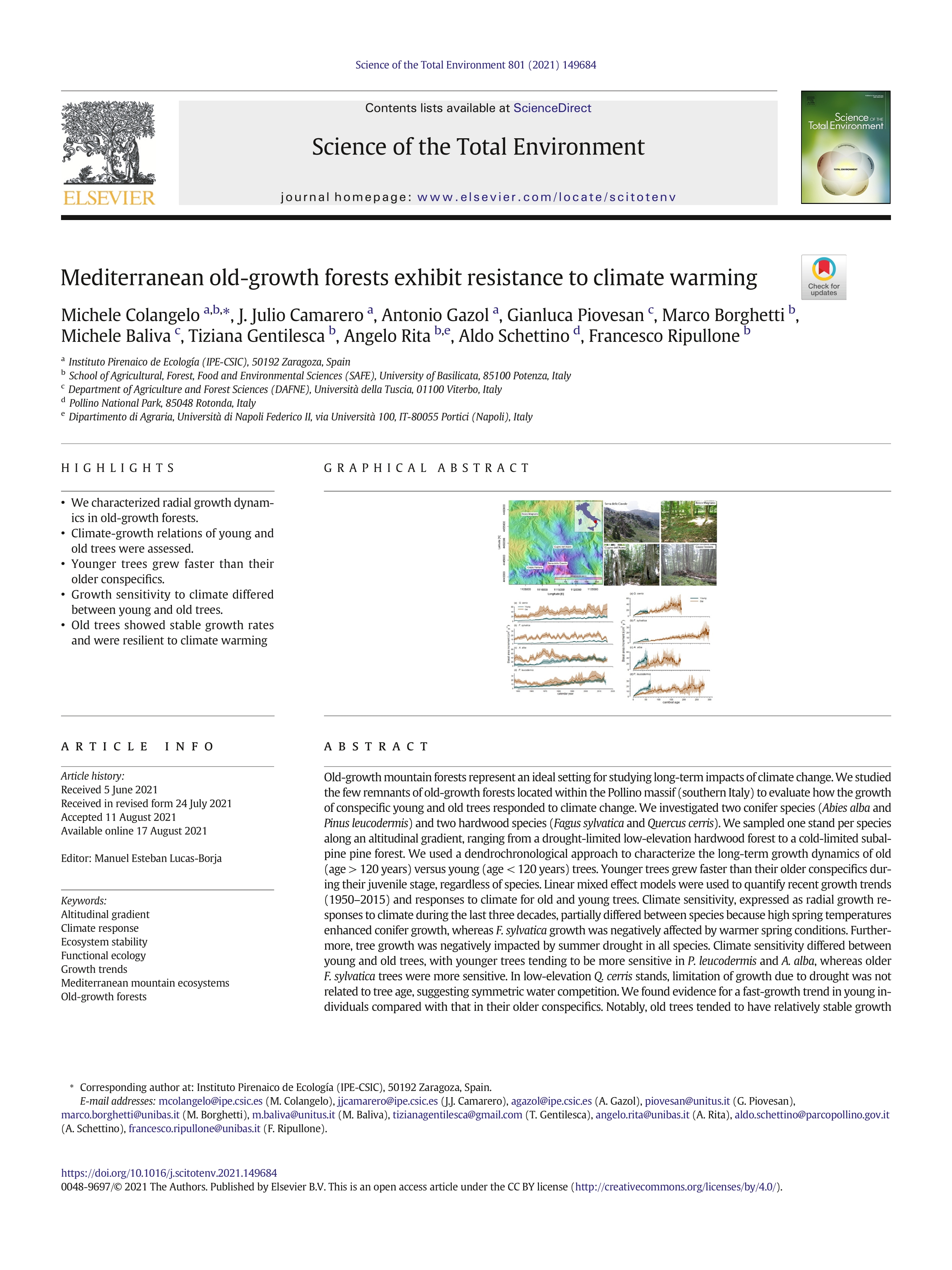
Resumen: Old-growth mountain forests represent an ideal setting for studying long-term impacts of climate change. We studied the few remnants of old-growth forests located within the Pollino massif (southern Italy) to evaluate how the growth of conspecific young and old trees responded to climate change. We investigated two conifer species (Abies alba and Pinus leucodermis) and two hardwood species (Fagus sylvatica and Quercus cerris). We sampled one stand per species along an altitudinal gradient, ranging from a drought-limited low-elevation hardwood forest to a cold-limited subalpine pine forest. We used a dendrochronological approach to characterize the long-term growth dynamics of old (age > 120 years) versus young (age < 120 years) trees. Younger trees grew faster than their older conspecifics during their juvenile stage, regardless of species. Linear mixed effect models were used to quantify recent growth trends (1950–2015) and responses to climate for old and young trees. Climate sensitivity, expressed as radial growth responses to climate during the last three decades, partially differed between species because high spring temperatures enhanced conifer growth, whereas F. sylvatica growth was negatively affected by warmer spring conditions. Furthermore, tree growth was negatively impacted by summer drought in all species. Climate sensitivity differed between young and old trees, with younger trees tending to be more sensitive in P. leucodermis and A. alba, whereas older F. sylvatica trees were more sensitive. In low-elevation Q. cerris stands, limitation of growth due to drought was not related to tree age, suggesting symmetric water competition. We found evidence for a fast-growth trend in young individuals compared with that in their older conspecifics. Notably, old trees tended to have relatively stable growth rates, showing remarkable resistance to climate warming. These responses to climate change should be recognized when forecasting the future dynamics of old-growth forests for their sustainable management. © 2021 The Authors
Idioma: Inglés
DOI: 10.1016/j.scitotenv.2021.149684
Año: 2021
Publicado en: SCIENCE OF THE TOTAL ENVIRONMENT 801 (2021), 149684 [13 pp.]
ISSN: 0048-9697
Factor impacto JCR: 10.754 (2021)
Categ. JCR: ENVIRONMENTAL SCIENCES rank: 26 / 279 = 0.093 (2021) - Q1 - T1
Factor impacto CITESCORE: 14.1 - Environmental Science (Q1)
Factor impacto SCIMAGO: 1.806 - Environmental Chemistry (Q1) - Waste Management and Disposal (Q1) - Environmental Engineering (Q1)
Financiación: info:eu-repo/grantAgreement/ES/MCIU/RTI2018-096884-B-C31
Tipo y forma: Article (Published version)
Exportado de SIDERAL (2023-05-18-15:21:02)
Visitas y descargas
Idioma: Inglés
DOI: 10.1016/j.scitotenv.2021.149684
Año: 2021
Publicado en: SCIENCE OF THE TOTAL ENVIRONMENT 801 (2021), 149684 [13 pp.]
ISSN: 0048-9697
Factor impacto JCR: 10.754 (2021)
Categ. JCR: ENVIRONMENTAL SCIENCES rank: 26 / 279 = 0.093 (2021) - Q1 - T1
Factor impacto CITESCORE: 14.1 - Environmental Science (Q1)
Factor impacto SCIMAGO: 1.806 - Environmental Chemistry (Q1) - Waste Management and Disposal (Q1) - Environmental Engineering (Q1)
Financiación: info:eu-repo/grantAgreement/ES/MCIU/RTI2018-096884-B-C31
Tipo y forma: Article (Published version)
Exportado de SIDERAL (2023-05-18-15:21:02)
Permalink:
Visitas y descargas
Este artículo se encuentra en las siguientes colecciones:
articulos
Notice créée le 2022-03-22, modifiée le 2023-05-19