Testosterone recovery after androgen deprivation therapy in prostate cancer: building a predictive model
Borque Fernando, Á. (Universidad de Zaragoza) ; Estrada-Domínguez, F. ; Esteban, L. M. ; Gil Sanz, M. J. (Universidad de Zaragoza) ; Sanz, G. (Universidad de Zaragoza)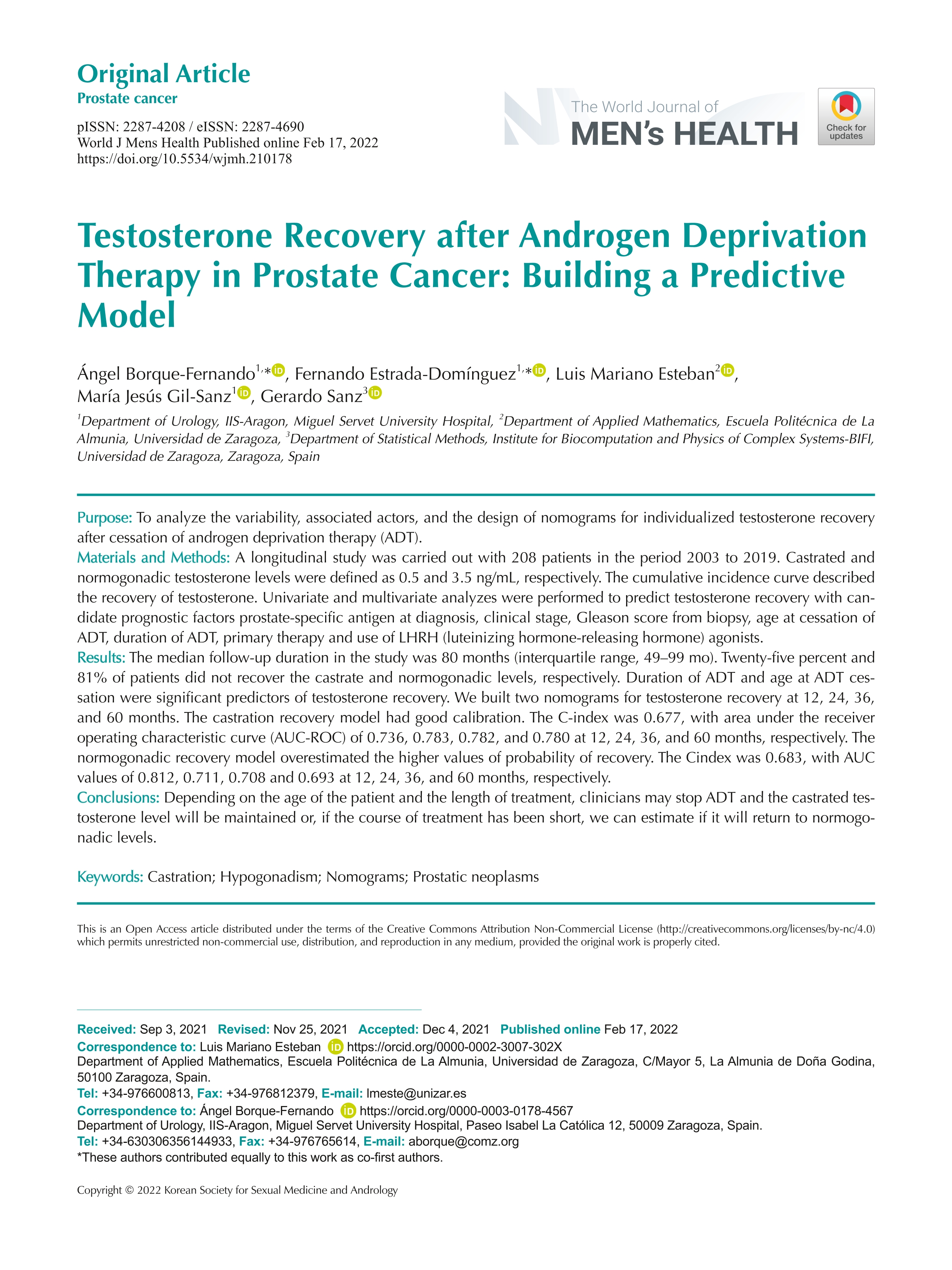
Resumen: Purpose: To analyze the variability, associated actors, and the design of nomograms for individualized testosterone recovery after cessation of androgen deprivation therapy (ADT). Materials and Methods: A longitudinal study was carried out with 208 patients in the period 2003 to 2019. Castrated and normogonadic testosterone levels were defined as 0.5 and 3.5 ng/mL, respectively. The cumulative incidence curve described the recovery of testosterone. Univariate and multivariate analyzes were performed to predict testosterone recovery with candidate prognostic factors prostate-specific antigen at diagnosis, clinical stage, Gleason score from biopsy, age at cessation of ADT, duration of ADT, primary therapy and use of LHRH (luteinizing hormone-releasing hormone) agonists. Results: The median follow-up duration in the study was 80 months (interquartile range, 49–99 mo). Twenty-five percent and 81% of patients did not recover the castrate and normogonadic levels, respectively. Duration of ADT and age at ADT cessation were significant predictors of testosterone recovery. We built two nomograms for testosterone recovery at 12, 24, 36, and 60 months. The castration recovery model had good calibration. The C-index was 0.677, with area under the receiver operating characteristic curve (AUC-ROC) of 0.736, 0.783, 0.782, and 0.780 at 12, 24, 36, and 60 months, respectively. The normogonadic recovery model overestimated the higher values of probability of recovery. The Cindex was 0.683, with AUC values of 0.812, 0.711, 0.708 and 0.693 at 12, 24, 36, and 60 months, respectively. Conclusions: Depending on the age of the patient and the length of treatment, clinicians may stop ADT and the castrated testosterone level will be maintained or, if the course of treatment has been short, we can estimate if it will return to normogonadic levels.
Idioma: Inglés
DOI: 10.5534/wjmh.210178
Año: 2022
Publicado en: The world journal of men's health 40 (2022), e33 [13 pp.]
ISSN: 2287-4208
Factor impacto JCR: 4.8 (2022)
Categ. JCR: UROLOGY & NEPHROLOGY rank: 15 / 88 = 0.17 (2022) - Q1 - T1
Categ. JCR: ANDROLOGY rank: 1 / 8 = 0.125 (2022) - Q1 - T1
Factor impacto CITESCORE: 8.8 - Medicine (Q1) - Biochemistry, Genetics and Molecular Biology (Q1)
Financiación: info:eu-repo/grantAgreement/ES/DGA/E46-20R
Financiación: info:eu-repo/grantAgreement/ES/MCIN/AEI/10.13039/501100011033
Financiación: info:eu-repo/grantAgreement/ES/MICINN/PID2020-116873GB-I00
Financiación: info:eu-repo/grantAgreement/ES/MINECO/MTM2017-83812-P
Tipo y forma: Article (Published version)
Área (Departamento): Área Estadís. Investig. Opera. (Dpto. Métodos Estadísticos)
Área (Departamento): Área Urología (Dpto. Cirugía)
Exportado de SIDERAL (2024-03-18-14:08:40)
Visitas y descargas
Idioma: Inglés
DOI: 10.5534/wjmh.210178
Año: 2022
Publicado en: The world journal of men's health 40 (2022), e33 [13 pp.]
ISSN: 2287-4208
Factor impacto JCR: 4.8 (2022)
Categ. JCR: UROLOGY & NEPHROLOGY rank: 15 / 88 = 0.17 (2022) - Q1 - T1
Categ. JCR: ANDROLOGY rank: 1 / 8 = 0.125 (2022) - Q1 - T1
Factor impacto CITESCORE: 8.8 - Medicine (Q1) - Biochemistry, Genetics and Molecular Biology (Q1)
Financiación: info:eu-repo/grantAgreement/ES/DGA/E46-20R
Financiación: info:eu-repo/grantAgreement/ES/MCIN/AEI/10.13039/501100011033
Financiación: info:eu-repo/grantAgreement/ES/MICINN/PID2020-116873GB-I00
Financiación: info:eu-repo/grantAgreement/ES/MINECO/MTM2017-83812-P
Tipo y forma: Article (Published version)
Área (Departamento): Área Estadís. Investig. Opera. (Dpto. Métodos Estadísticos)
Área (Departamento): Área Urología (Dpto. Cirugía)
Exportado de SIDERAL (2024-03-18-14:08:40)
Permalink:
Visitas y descargas
Este artículo se encuentra en las siguientes colecciones:
articulos > articulos-por-area > estadistica_e_investigacion_operativa
articulos > articulos-por-area > urologia
Notice créée le 2022-04-05, modifiée le 2024-03-19