Strained Ruthenium Complexes Bearing Tridentate Guanidine-Derived Ligands
Wilkinson, Eden-Taylor ; Viguri, Fernando (Universidad de Zaragoza) ; Rodríguez, Ricardo (Universidad de Zaragoza) ; López, José A. (Universidad de Zaragoza) ; García-Orduña, Pilar ; Lahoz, Fernando J. ; Lamata, Pilar (Universidad de Zaragoza) ; Carmona, Daniel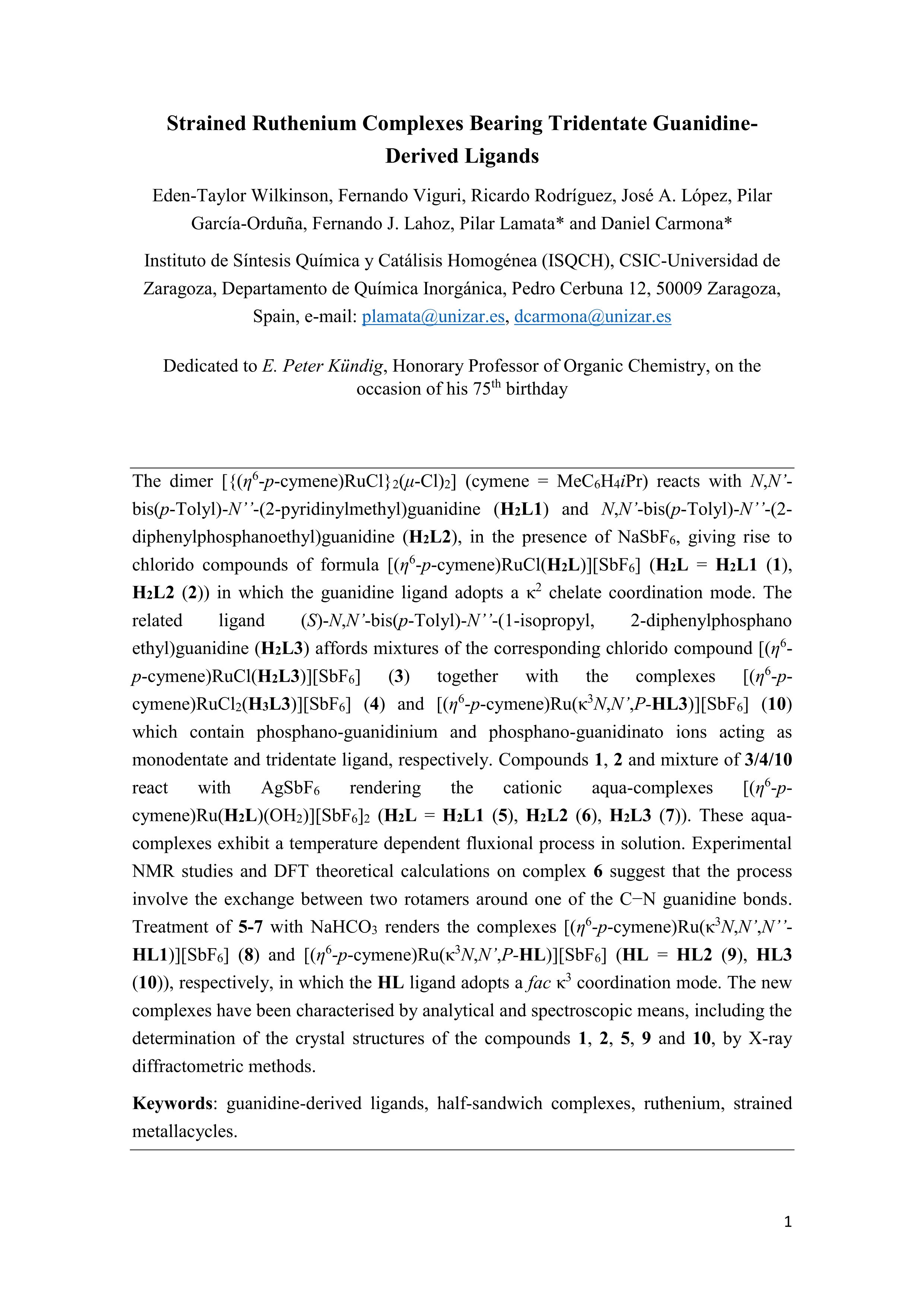
Resumen: The dimer [{(η6-p-cymene)RuCl}2(μ-Cl)2] (cymene=MeC6H4iPr) reacts with N,N′-bis(p-tolyl)-N′′-(2-pyridinylmethyl)guanidine (H2L1) and N,N′-bis(p-tolyl)-N′′-(2-diphenylphosphanoethyl)guanidine (H2L2), in the presence of NaSbF6, giving rise to chlorido compounds of formula [(η6-p-cymene)RuCl(H2L)][SbF6] (H2L=H2L1 (1), H2L2 (2)) in which the guanidine ligand adopts a κ2 chelate coordination mode. The related ligand (S)-N,N′-bis(p-tolyl)-N′′-(1-isopropyl, 2-diphenylphosphano ethyl)guanidine (H2L3) affords mixtures of the corresponding chlorido compound [(η6-p-cymene)RuCl(H2L3)][SbF6] (3) together with the complexes [(η6-p-cymene)RuCl2(H3L3)][SbF6] (4) and [(η6-p-cymene)Ru(κ3N,N′,P-HL3)][SbF6] (10) which contain phosphano-guanidinium and phosphano-guanidinate ions acting as monodentate and tridentate ligand, respectively. Compounds 1, 2 and mixture of 3/4/10 react with AgSbF6 rendering the cationic aqua-complexes [(η6-p-cymene)Ru(H2L)(OH2)][SbF6]2 (H2L=H2L1 (5), H2L2 (6), H2L3 (7)). These aqua-complexes exhibit a temperature-dependent fluxional process in solution. Experimental NMR studies and DFT theoretical calculations on complex 6 suggest that the process involves the exchange between two rotamers around one of the C−N guanidine bonds. Treatment of 5–7 with NaHCO3 renders the complexes [(η6-p-cymene)Ru(κ3N,N′,N′′-HL1)][SbF6] (8) and [(η6-p-cymene)Ru(κ3N,N′,P-HL)][SbF6] (HL=HL2 (9), HL3 (10)), respectively, in which the HL ligand adopts a fac κ3 coordination mode. The new complexes have been characterized by analytical and spectroscopic means, including the determination of the crystal structures of the compounds 1, 2, 5, 9 and 10, by X-ray diffractometric methods.
Idioma: Inglés
DOI: 10.1002/hlca.202100044
Año: 2021
Publicado en: HELVETICA CHIMICA ACTA 104, 6 (2021), e2100044 [17 pp.]
ISSN: 0018-019X
Factor impacto JCR: 2.201 (2021)
Categ. JCR: CHEMISTRY, MULTIDISCIPLINARY rank: 122 / 180 = 0.678 (2021) - Q3 - T3
Factor impacto CITESCORE: 3.4 - Biochemistry, Genetics and Molecular Biology (Q3) - Chemical Engineering (Q3) - Pharmacology, Toxicology and Pharmaceutics (Q3)
Factor impacto SCIMAGO: 0.595 - Biochemistry (Q2) - Catalysis (Q2) - Physical and Theoretical Chemistry (Q2) - Inorganic Chemistry (Q2) - Drug Discovery (Q2)
Financiación: info:eu-repo/grantAgreement/ES/MICINN/CTQ2017-83421-P
Financiación: info:eu-repo/grantAgreement/ES/MICINN/CTQ2018-095561-BI00
Financiación: info:eu-repo/grantAgreement/ES/MINECO/RYC-2013-13800
Tipo y forma: Article (PostPrint)
Área (Departamento): Área Química Inorgánica (Dpto. Química Inorgánica)
 You must give appropriate credit, provide a link to the license, and indicate if changes were made. You may do so in any reasonable manner, but not in any way that suggests the licensor endorses you or your use. You may not use the material for commercial purposes. If you remix, transform, or build upon the material, you may not distribute the modified material.
Exportado de SIDERAL (2023-05-18-14:06:46)
Visitas y descargas
Idioma: Inglés
DOI: 10.1002/hlca.202100044
Año: 2021
Publicado en: HELVETICA CHIMICA ACTA 104, 6 (2021), e2100044 [17 pp.]
ISSN: 0018-019X
Factor impacto JCR: 2.201 (2021)
Categ. JCR: CHEMISTRY, MULTIDISCIPLINARY rank: 122 / 180 = 0.678 (2021) - Q3 - T3
Factor impacto CITESCORE: 3.4 - Biochemistry, Genetics and Molecular Biology (Q3) - Chemical Engineering (Q3) - Pharmacology, Toxicology and Pharmaceutics (Q3)
Factor impacto SCIMAGO: 0.595 - Biochemistry (Q2) - Catalysis (Q2) - Physical and Theoretical Chemistry (Q2) - Inorganic Chemistry (Q2) - Drug Discovery (Q2)
Financiación: info:eu-repo/grantAgreement/ES/MICINN/CTQ2017-83421-P
Financiación: info:eu-repo/grantAgreement/ES/MICINN/CTQ2018-095561-BI00
Financiación: info:eu-repo/grantAgreement/ES/MINECO/RYC-2013-13800
Tipo y forma: Article (PostPrint)
Área (Departamento): Área Química Inorgánica (Dpto. Química Inorgánica)
You must give appropriate credit, provide a link to the license, and indicate if changes were made. You may do so in any reasonable manner, but not in any way that suggests the licensor endorses you or your use. You may not use the material for commercial purposes. If you remix, transform, or build upon the material, you may not distribute the modified material. Exportado de SIDERAL (2023-05-18-14:06:46)
Permalink:
Visitas y descargas
Este artículo se encuentra en las siguientes colecciones:
Articles > Artículos por área > Química Inorgánica
Record created 2022-05-11, last modified 2023-05-19