Luminescent gold-thallium derivatives with a pyridine-containing 12-membered aza-thioether macrocycle
Caddeo F. ; Fernández-Moreira V. (Universidad de Zaragoza) ; Arca M. ; Pintus A. ; Laguna A. (Universidad de Zaragoza) ; Lippolis V. ; Gimeno M.C.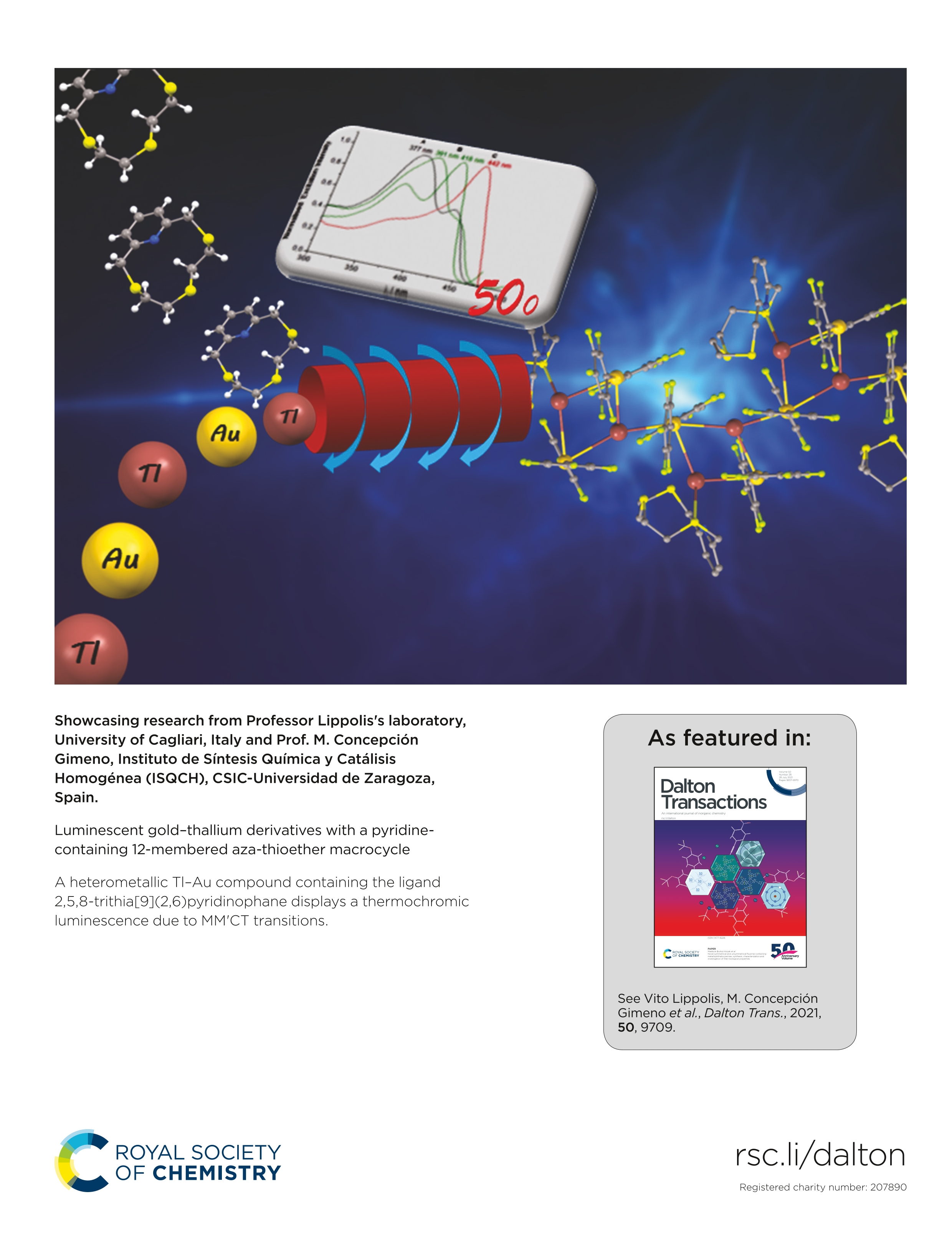
Resumen: The coordination modes of the ligand 2, 5, 8-trithia[9](2, 6)pyridinophane (L) to thallium(i), gold(iii) and gold(i) have been studied. Thallium(i) is coordinated by the macrocyclic ligand in [Tl(L)](PF6) (1) through all the sulfur and nitrogen atoms, in a distorted square-pyramidal geometry with the thallium(i) ion in the apical position and with the presence of an inert lone pair. Gold(iii) is bonded by the ligand only through the nitrogen of the pyridine group in [AuCl3(L)] (2), whereas two AuI-C6F5fragments coordinate the sulfur atoms next to the pyridine moiety of the ligand in [{Au(C6F5)}2(µ-L)] (3), which form a linear polymer through intermolecular aurophilic contacts. The heterometallic TlI/AuIcomplex {[Au(C6F5)2Tl]2(L)}n(4) features a polymeric structural nature with a metallic pseudo-rhombic Au2Tl2core, which repeats itself forming a zig-zag polymer. In each Au2Tl2unit only one thallium atom is bonded by the NS3donor set of the macrocyclic ligand and also forms two unsupported Au-Tl bonds with two [Au(C6F5)2]-units in an overall pseudo-octahedral geometry. The other thallium atom similarly bridges the same [Au(C6F5)2]-units and links a neighbouring Au2Tl2moiety, thus exhibiting a distorted trigonal planar geometry being bonded only to three gold atoms with unsupported Au-Tl interactions. This complex displays an interesting thermochromic behaviour showing emissions mainly resulting from MM'CT transitions at room temperature. At 77 K a dual emission appears, probably arising from the two different thallium environments. DFT calculations have been carried out in the attempt to investigate the origin of the emissions of complex4. © The Royal Society of Chemistry 2021.
Idioma: Inglés
DOI: 10.1039/d1dt01599k
Año: 2021
Publicado en: Dalton Transactions 50, 28 (2021), 9709-9718
ISSN: 1477-9226
Factor impacto JCR: 4.569 (2021)
Categ. JCR: CHEMISTRY, INORGANIC & NUCLEAR rank: 7 / 46 = 0.152 (2021) - Q1 - T1
Factor impacto SCIMAGO: 0.864 - Inorganic Chemistry (Q1)
Financiación: info:eu-repo/grantAgreement/ES/MCIU/PID2019-104379RB-C21
Financiación: info:eu-repo/grantAgreement/ES/MCIU/RTI2018-097836-J-I00
Financiación: info:eu-repo/grantAgreement/ES/MCIU/RYC2018-025872
Tipo y forma: Article (Published version)
Área (Departamento): Área Química Inorgánica (Dpto. Química Inorgánica)
 You must give appropriate credit, provide a link to the license, and indicate if changes were made. You may do so in any reasonable manner, but not in any way that suggests the licensor endorses you or your use. You may not use the material for commercial purposes.
Exportado de SIDERAL (2023-05-18-15:31:46)
Visitas y descargas
Idioma: Inglés
DOI: 10.1039/d1dt01599k
Año: 2021
Publicado en: Dalton Transactions 50, 28 (2021), 9709-9718
ISSN: 1477-9226
Factor impacto JCR: 4.569 (2021)
Categ. JCR: CHEMISTRY, INORGANIC & NUCLEAR rank: 7 / 46 = 0.152 (2021) - Q1 - T1
Factor impacto SCIMAGO: 0.864 - Inorganic Chemistry (Q1)
Financiación: info:eu-repo/grantAgreement/ES/MCIU/PID2019-104379RB-C21
Financiación: info:eu-repo/grantAgreement/ES/MCIU/RTI2018-097836-J-I00
Financiación: info:eu-repo/grantAgreement/ES/MCIU/RYC2018-025872
Tipo y forma: Article (Published version)
Área (Departamento): Área Química Inorgánica (Dpto. Química Inorgánica)
You must give appropriate credit, provide a link to the license, and indicate if changes were made. You may do so in any reasonable manner, but not in any way that suggests the licensor endorses you or your use. You may not use the material for commercial purposes. Exportado de SIDERAL (2023-05-18-15:31:46)
Permalink:
Visitas y descargas
Este artículo se encuentra en las siguientes colecciones:
Articles > Artículos por área > Química Inorgánica
Record created 2022-07-05, last modified 2023-05-19