Are Steroids Still Useful in Immunosuppressed Patients With Inflammatory Bowel Disease? A Retrospective, Population-Based Study
Sicilia B. ; Arias L. ; Hontoria G. ; García N. ; Badia E. ; Gomollón F. (Universidad de Zaragoza)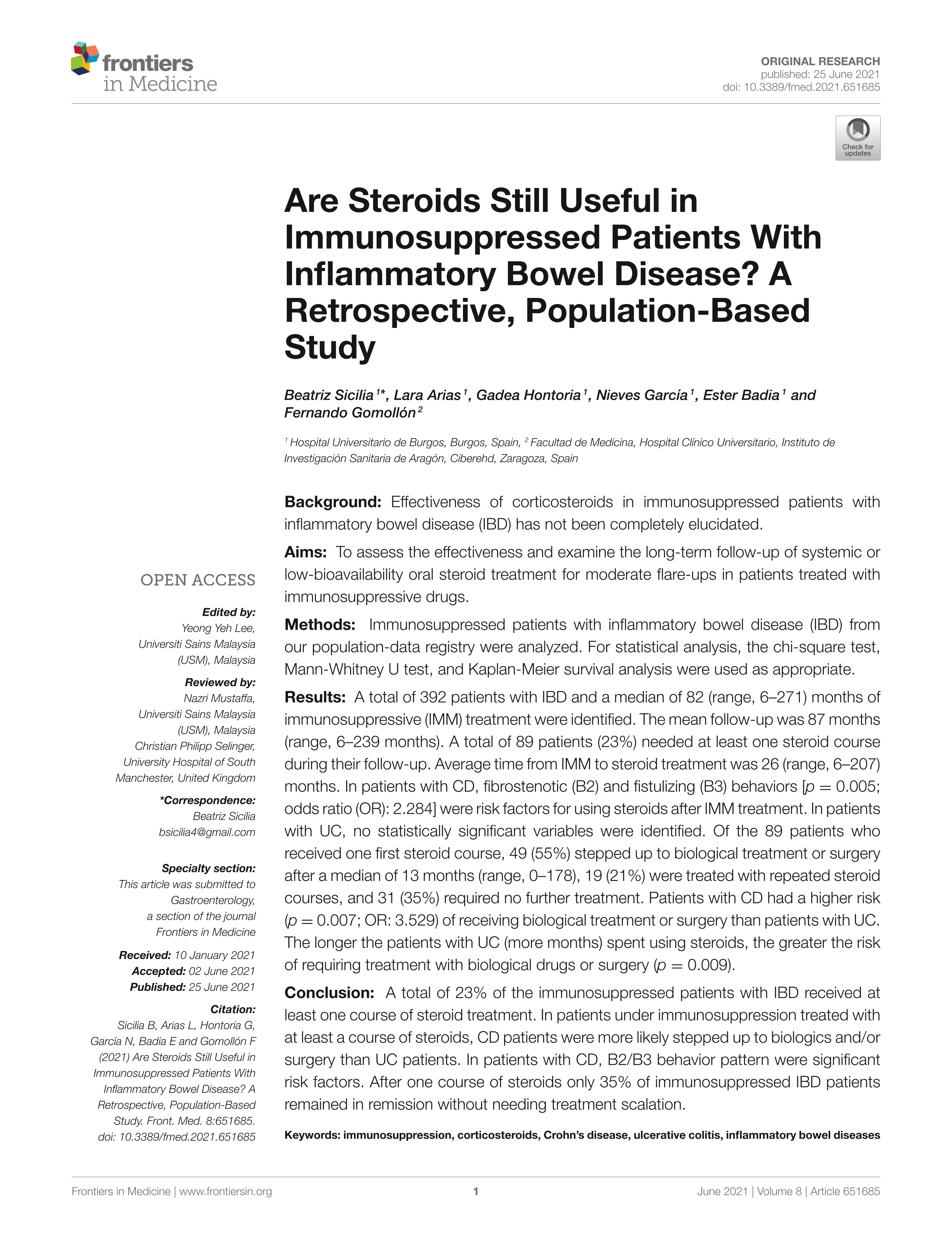
Resumen: Background: Effectiveness of corticosteroids in immunosuppressed patients with inflammatory bowel disease (IBD) has not been completely elucidated. Aims: To assess the effectiveness and examine the long-term follow-up of systemic or low-bioavailability oral steroid treatment for moderate flare-ups in patients treated with immunosuppressive drugs. Methods: Immunosuppressed patients with inflammatory bowel disease (IBD) from our population-data registry were analyzed. For statistical analysis, the chi-square test, Mann-Whitney U test, and Kaplan-Meier survival analysis were used as appropriate. Results: A total of 392 patients with IBD and a median of 82 (range, 6–271) months of immunosuppressive (IMM) treatment were identified. The mean follow-up was 87 months (range, 6–239 months). A total of 89 patients (23%) needed at least one steroid course during their follow-up. Average time from IMM to steroid treatment was 26 (range, 6–207) months. In patients with CD, fibrostenotic (B2) and fistulizing (B3) behaviors [p = 0.005; odds ratio (OR): 2.284] were risk factors for using steroids after IMM treatment. In patients with UC, no statistically significant variables were identified. Of the 89 patients who received one first steroid course, 49 (55%) stepped up to biological treatment or surgery after a median of 13 months (range, 0–178), 19 (21%) were treated with repeated steroid courses, and 31 (35%) required no further treatment. Patients with CD had a higher risk (p = 0.007; OR: 3.529) of receiving biological treatment or surgery than patients with UC. The longer the patients with UC (more months) spent using steroids, the greater the risk of requiring treatment with biological drugs or surgery (p = 0.009). Conclusion: A total of 23% of the immunosuppressed patients with IBD received at least one course of steroid treatment. In patients under immunosuppression treated with at least a course of steroids, CD patients were more likely stepped up to biologics and/or surgery than UC patients. In patients with CD, B2/B3 behavior pattern were significant risk factors. After one course of steroids only 35% of immunosuppressed IBD patients remained in remission without needing treatment scalation. © Copyright © 2021 Sicilia, Arias, Hontoria, García, Badia and Gomollón.
Idioma: Inglés
DOI: 10.3389/fmed.2021.651685
Año: 2021
Publicado en: Frontiers in Medicine 8 (2021), 651685 [10 pp]
ISSN: 2296-858X
Factor impacto JCR: 5.058 (2021)
Categ. JCR: MEDICINE, GENERAL & INTERNAL rank: 53 / 172 = 0.308 (2021) - Q2 - T1
Factor impacto CITESCORE: 3.4 - Medicine (Q2)
Factor impacto SCIMAGO: 1.179 - Medicine (miscellaneous) (Q1)
Tipo y forma: Article (Published version)
Área (Departamento): Area Medicina (Dpto. Medicina, Psiqu. y Derm.)
 You must give appropriate credit, provide a link to the license, and indicate if changes were made. You may do so in any reasonable manner, but not in any way that suggests the licensor endorses you or your use.
Exportado de SIDERAL (2023-05-18-16:06:55)
Visitas y descargas
Idioma: Inglés
DOI: 10.3389/fmed.2021.651685
Año: 2021
Publicado en: Frontiers in Medicine 8 (2021), 651685 [10 pp]
ISSN: 2296-858X
Factor impacto JCR: 5.058 (2021)
Categ. JCR: MEDICINE, GENERAL & INTERNAL rank: 53 / 172 = 0.308 (2021) - Q2 - T1
Factor impacto CITESCORE: 3.4 - Medicine (Q2)
Factor impacto SCIMAGO: 1.179 - Medicine (miscellaneous) (Q1)
Tipo y forma: Article (Published version)
Área (Departamento): Area Medicina (Dpto. Medicina, Psiqu. y Derm.)
You must give appropriate credit, provide a link to the license, and indicate if changes were made. You may do so in any reasonable manner, but not in any way that suggests the licensor endorses you or your use. Exportado de SIDERAL (2023-05-18-16:06:55)
Permalink:
Visitas y descargas
Este artículo se encuentra en las siguientes colecciones:
Articles > Artículos por área > Medicina
Record created 2022-07-05, last modified 2023-05-19