The impact of sodium alginate hydrogel on exogenous glucose oxidation rate and gastrointestinal comfort in well-trained runners
Sutehall, S. ; Muñiz Pardos, B. (Universidad de Zaragoza) ; Bosch, A. N. ; Galloway, S. D. ; Pitsiladis, Y.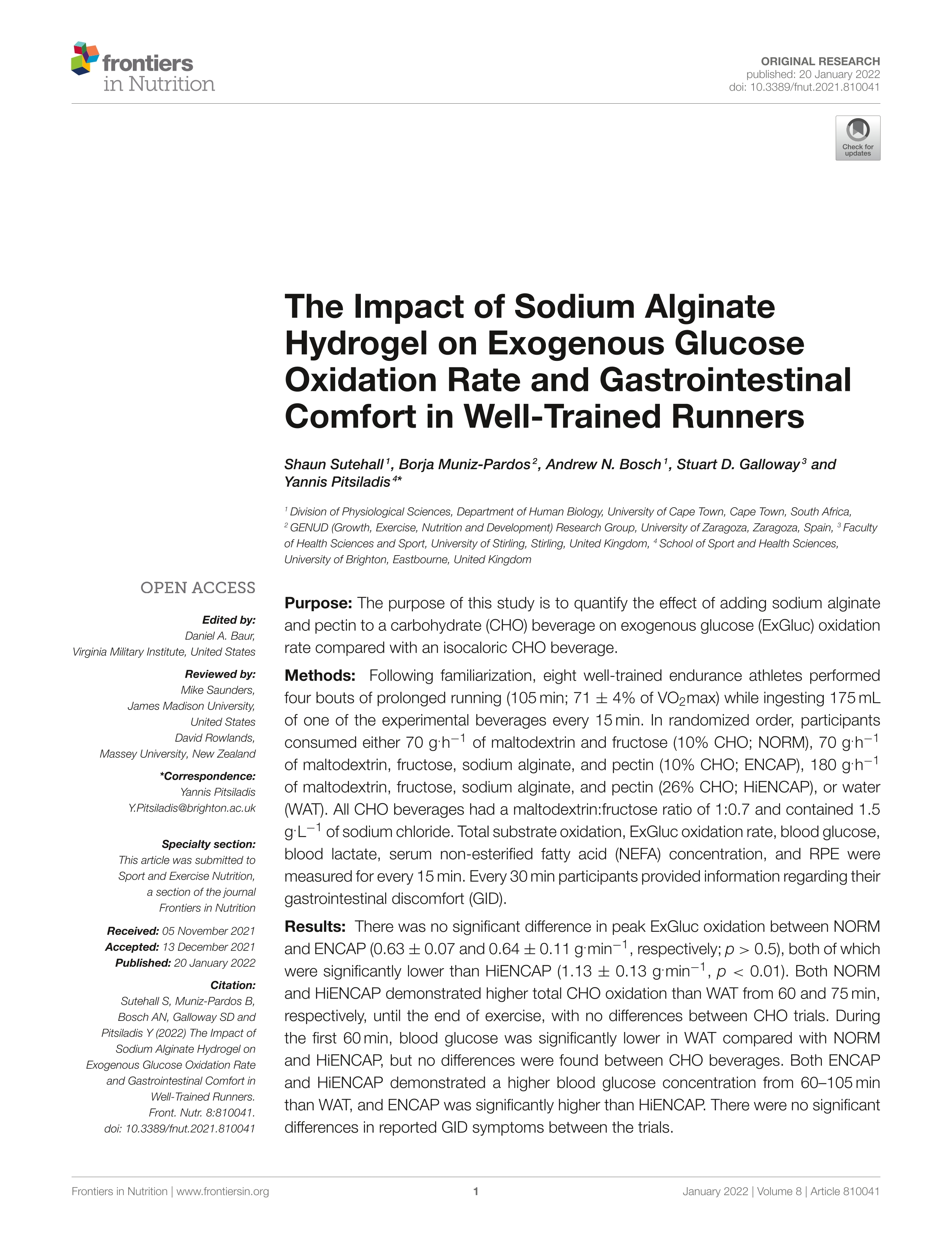
Resumen: Purpose: The purpose of this study is to quantify the effect of adding sodium alginate and pectin to a carbohydrate (CHO) beverage on exogenous glucose (ExGluc) oxidation rate compared with an isocaloric CHO beverage. Methods: Following familiarization, eight well-trained endurance athletes performed four bouts of prolonged running (105 min; 71 ± 4% of VO2max) while ingesting 175 mL of one of the experimental beverages every 15 min. In randomized order, participants consumed either 70 g.h-1 of maltodextrin and fructose (10% CHO; NORM), 70 g.h-1 of maltodextrin, fructose, sodium alginate, and pectin (10% CHO; ENCAP), 180 g.h-1 of maltodextrin, fructose, sodium alginate, and pectin (26% CHO; HiENCAP), or water (WAT). All CHO beverages had a maltodextrin:fructose ratio of 1:0.7 and contained 1.5 g.L-1 of sodium chloride. Total substrate oxidation, ExGluc oxidation rate, blood glucose, blood lactate, serum non-esterified fatty acid (NEFA) concentration, and RPE were measured for every 15 min. Every 30 min participants provided information regarding their gastrointestinal discomfort (GID). Results: There was no significant difference in peak ExGluc oxidation between NORM and ENCAP (0.63 ± 0.07 and 0.64 ± 0.11 g.min-1, respectively; p > 0.5), both of which were significantly lower than HiENCAP (1.13 ± 0.13 g.min-1, p < 0.01). Both NORM and HiENCAP demonstrated higher total CHO oxidation than WAT from 60 and 75 min, respectively, until the end of exercise, with no differences between CHO trials. During the first 60 min, blood glucose was significantly lower in WAT compared with NORM and HiENCAP, but no differences were found between CHO beverages. Both ENCAP and HiENCAP demonstrated a higher blood glucose concentration from 60–105 min than WAT, and ENCAP was significantly higher than HiENCAP. There were no significant differences in reported GID symptoms between the trials. Conclusions: At moderate ingestion rates (i.e., 70 g.h-1), the addition of sodium alginate and pectin did not influence the ExGluc oxidation rate compared with an isocaloric CHO beverage. At very high ingestion rates (i.e., 180 g.h-1), high rates of ExGluc oxidation were achieved in line with the literature. Copyright © 2022 Sutehall, Muniz-Pardos, Bosch, Galloway and Pitsiladis.
Idioma: Inglés
DOI: 10.3389/fnut.2021.810041
Año: 2022
Publicado en: Frontiers in Nutrition 8, 810041 (2022), [12 pp]
ISSN: 2296-861X
Factor impacto JCR: 5.0 (2022)
Categ. JCR: NUTRITION & DIETETICS rank: 28 / 87 = 0.322 (2022) - Q2 - T1
Factor impacto CITESCORE: 3.5 - Agricultural and Biological Sciences (Q2) - Nursing (Q2) - Medicine (Q2)
Factor impacto SCIMAGO: 0.875 - Food Science (Q1) - Nutrition and Dietetics (Q2) - Endocrinology, Diabetes and Metabolism (Q2)
Tipo y forma: Artículo (Versión definitiva)
Área (Departamento): Área Educación Física y Depor. (Dpto. Fisiatría y Enfermería)
 Debe reconocer adecuadamente la autoría, proporcionar un enlace a la licencia e indicar si se han realizado cambios. Puede hacerlo de cualquier manera razonable, pero no de una manera que sugiera que tiene el apoyo del licenciador o lo recibe por el uso que hace.
Exportado de SIDERAL (2024-03-18-13:32:18)
Visitas y descargas
Idioma: Inglés
DOI: 10.3389/fnut.2021.810041
Año: 2022
Publicado en: Frontiers in Nutrition 8, 810041 (2022), [12 pp]
ISSN: 2296-861X
Factor impacto JCR: 5.0 (2022)
Categ. JCR: NUTRITION & DIETETICS rank: 28 / 87 = 0.322 (2022) - Q2 - T1
Factor impacto CITESCORE: 3.5 - Agricultural and Biological Sciences (Q2) - Nursing (Q2) - Medicine (Q2)
Factor impacto SCIMAGO: 0.875 - Food Science (Q1) - Nutrition and Dietetics (Q2) - Endocrinology, Diabetes and Metabolism (Q2)
Tipo y forma: Artículo (Versión definitiva)
Área (Departamento): Área Educación Física y Depor. (Dpto. Fisiatría y Enfermería)
Debe reconocer adecuadamente la autoría, proporcionar un enlace a la licencia e indicar si se han realizado cambios. Puede hacerlo de cualquier manera razonable, pero no de una manera que sugiera que tiene el apoyo del licenciador o lo recibe por el uso que hace. Exportado de SIDERAL (2024-03-18-13:32:18)
Enlace permanente:
Visitas y descargas
Este artículo se encuentra en las siguientes colecciones:
Artículos > Artículos por área > Educación Física y Deportiva
Registro creado el 2022-07-05, última modificación el 2024-03-19