Disambiguating a disambiguation tool: Babelfy from a linguistic point of view
López Cortés, Natalia (Universidad de Zaragoza)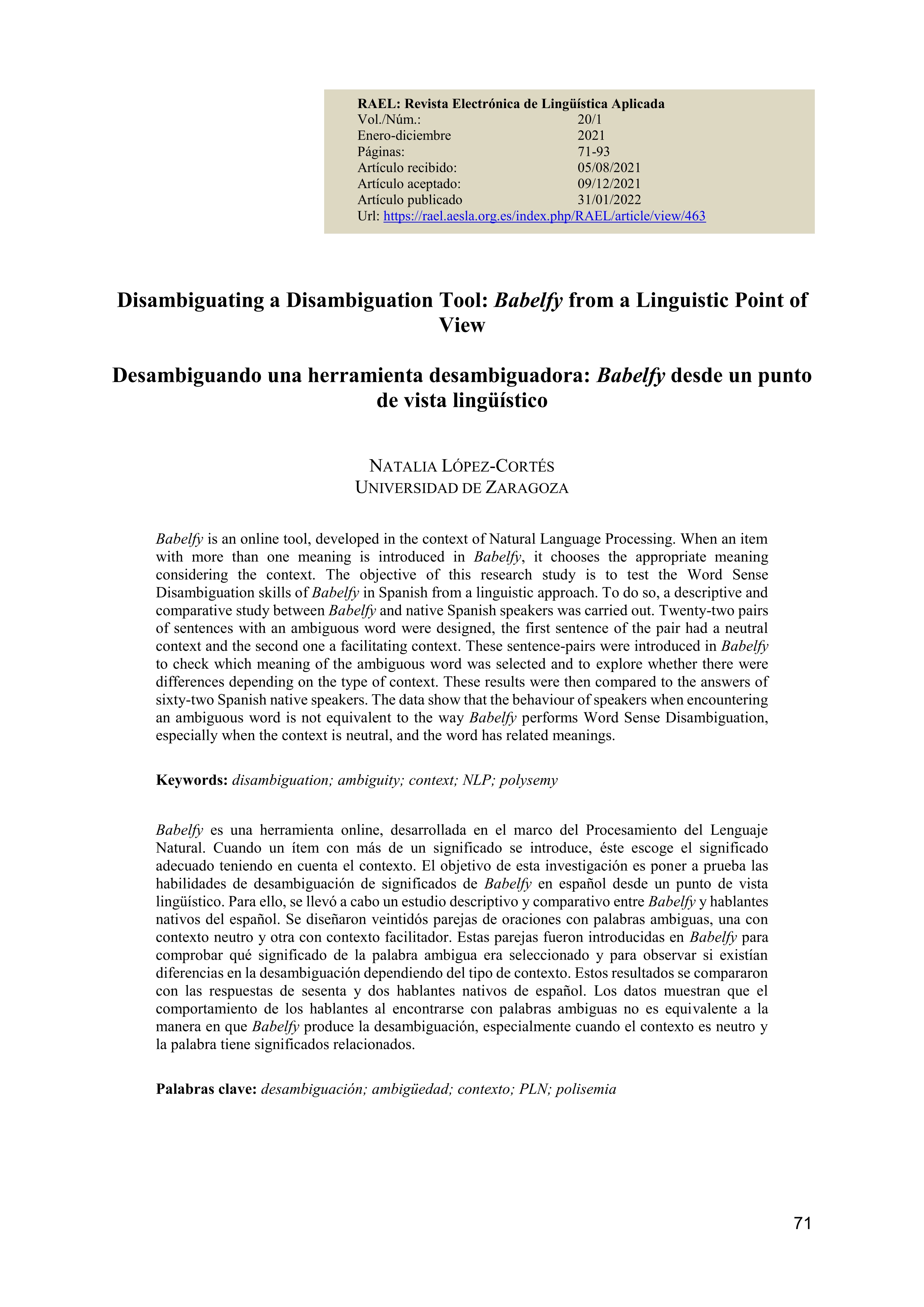
Resumen: Babelfy es una herramienta online, desarrollada en el marco del Procesamiento del Lenguaje Natural. Cuando un ítem con más de un significado se introduce, éste escoge el significado adecuado teniendo en cuenta el contexto. El objetivo de esta investigación es poner a prueba las habilidades de desambiguación de significados de Babelfy en español desde un punto de vista lingüístico. Para ello, se llevó a cabo un estudio descriptivo y comparativo entre Babelfy y hablantes nativos del español. Se diseñaron veintidós parejas de oraciones con palabras ambiguas, una con contexto neutro y otra con contexto facilitador. Estas parejas fueron introducidas en Babelfy para comprobar qué significado de la palabra ambigua era seleccionado y para observar si existían diferencias en la desambiguación dependiendo del tipo de contexto. Estos resultados se compararon con las respuestas de sesenta y dos hablantes nativos de español. Los datos muestran que el comportamiento de los hablantes al encontrarse con palabras ambiguas no es equivalente a la manera en que Babelfy produce la desambiguación, especialmente cuando el contexto es neutro y la palabra tiene significados relacionados.
Babelfy is an online tool, developed in the context of Natural Language Processing. When an item with more than one meaning is introduced in Babelfy, it chooses the appropriate meaning considering the context. The objective of this research study is to test the Word Sense Disambiguation skills of Babelfy in Spanish from a linguistic approach. To do so, a descriptive and comparative study between Babelfy and native Spanish speakers was carried out. Twenty-two pairs of sentences with an ambiguous word were designed, the first sentence of the pair had a neutral context and the second one a facilitating context. These sentence-pairs were introduced in Babelfy to check which meaning of the ambiguous word was selected and to explore whether there were differences depending on the type of context. These results were then compared to the answers of sixty-two Spanish native speakers. The data show that the behaviour of speakers when encountering an ambiguous word is not equivalent to the way Babelfy performs Word Sense Disambiguation, especially when the context is neutral, and the word has related meanings.
Idioma: Inglés
Año: 2022
Publicado en: Revista electrónica de lingüística aplicada 20, 1 (2022), 71-93
ISSN: 1885-9089
Originalmente disponible en: Texto completo de la revista
Financiación: info:eu-repo/grantAgreement/ES/AEI-FEDER/FFI2017-82460-P
Tipo y forma: Article (Published version)
Área (Departamento): Área Lengua Española (Dpto. Lingüíst.y Liter.Hispán.)
 You must give appropriate credit, provide a link to the license, and indicate if changes were made. You may do so in any reasonable manner, but not in any way that suggests the licensor endorses you or your use. You may not use the material for commercial purposes.
Exportado de SIDERAL (2025-07-10-20:57:01)
Visitas y descargas
Babelfy is an online tool, developed in the context of Natural Language Processing. When an item with more than one meaning is introduced in Babelfy, it chooses the appropriate meaning considering the context. The objective of this research study is to test the Word Sense Disambiguation skills of Babelfy in Spanish from a linguistic approach. To do so, a descriptive and comparative study between Babelfy and native Spanish speakers was carried out. Twenty-two pairs of sentences with an ambiguous word were designed, the first sentence of the pair had a neutral context and the second one a facilitating context. These sentence-pairs were introduced in Babelfy to check which meaning of the ambiguous word was selected and to explore whether there were differences depending on the type of context. These results were then compared to the answers of sixty-two Spanish native speakers. The data show that the behaviour of speakers when encountering an ambiguous word is not equivalent to the way Babelfy performs Word Sense Disambiguation, especially when the context is neutral, and the word has related meanings.
Idioma: Inglés
Año: 2022
Publicado en: Revista electrónica de lingüística aplicada 20, 1 (2022), 71-93
ISSN: 1885-9089
Originalmente disponible en: Texto completo de la revista
Financiación: info:eu-repo/grantAgreement/ES/AEI-FEDER/FFI2017-82460-P
Tipo y forma: Article (Published version)
Área (Departamento): Área Lengua Española (Dpto. Lingüíst.y Liter.Hispán.)
You must give appropriate credit, provide a link to the license, and indicate if changes were made. You may do so in any reasonable manner, but not in any way that suggests the licensor endorses you or your use. You may not use the material for commercial purposes. Exportado de SIDERAL (2025-07-10-20:57:01)
Permalink:
Visitas y descargas
Este artículo se encuentra en las siguientes colecciones:
Articles > Artículos por área > Lengua Española
Record created 2022-09-30, last modified 2025-07-10