Activation of H-H, HO-H, C(sp2)-H, C(sp3)-H, and RO-H bonds by transition-metal frustrated lewis pairs based onon M/N (M = Rh, Ir) couples
Carmona, M. ; Pérez, R. ; Ferrer, J. (Universidad de Zaragoza) ; Rodríguez, R. ; Passarelli, V. ; Lahoz, F. J. ; García-Orduña, P. ; Carmona, D.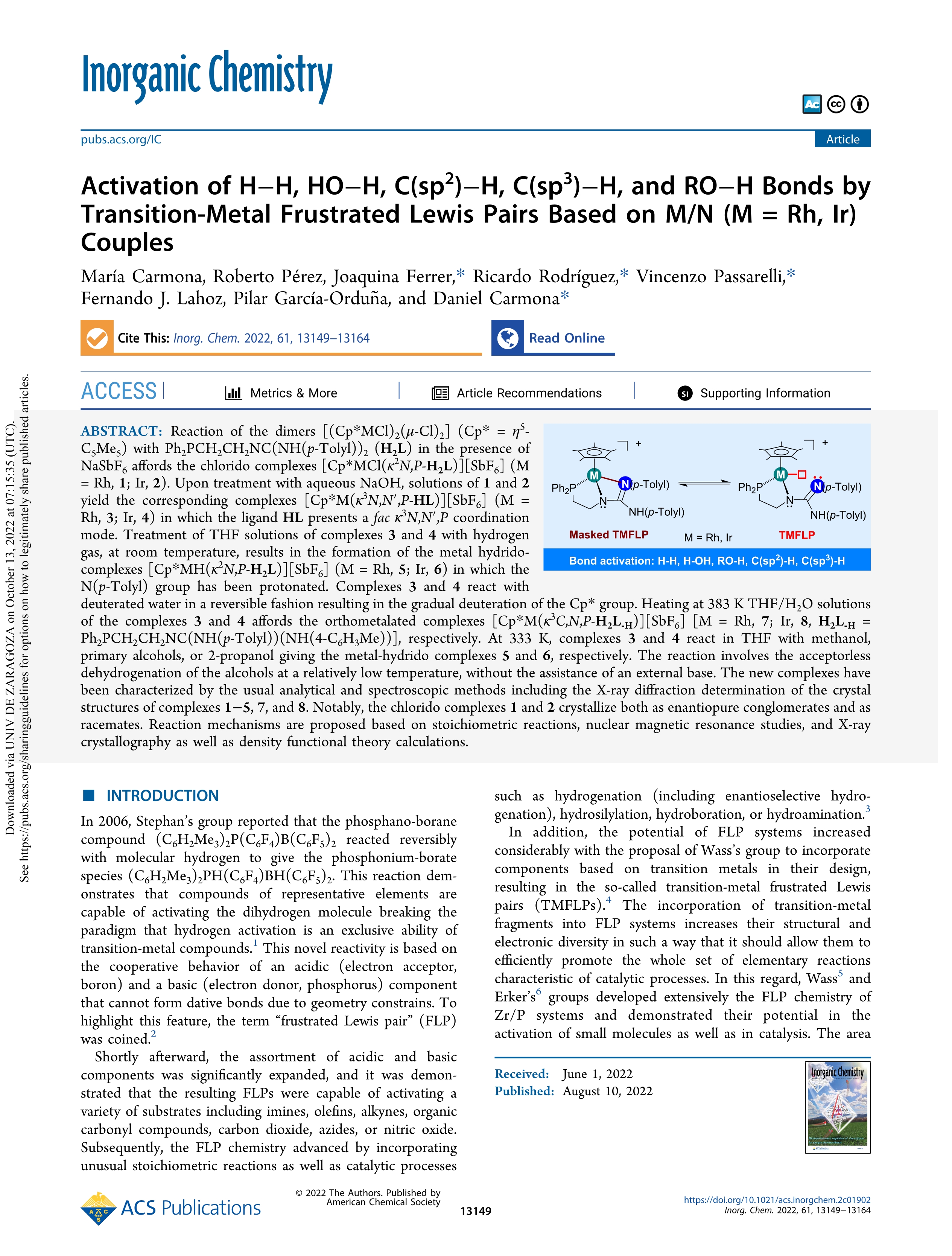
Resumen: Reaction of the dimers (Cp*MCl)2(µ-Cl)2] (Cp* = 5-C5Me5) with Ph2PCH2CH2NC(NH(p-Tolyl))2 (H2L) in the presence of NaSbF6 affords the chlorido complexes Cp*MCl(¿2N, P-H2L)]SbF6] (M = Rh, 1; Ir, 2). Upon treatment with aqueous NaOH, solutions of 1 and 2 yield the corresponding complexes Cp*M(¿3N, N', P-HL)]SbF6] (M = Rh, 3; Ir, 4) in which the ligand HL presents a fac ¿3N, N', P coordination mode. Treatment of THF solutions of complexes 3 and 4 with hydrogen gas, at room temperature, results in the formation of the metal hydrido-complexes Cp*MH(¿2N, P-H2L)]SbF6] (M = Rh, 5; Ir, 6) in which the N(p-Tolyl) group has been protonated. Complexes 3 and 4 react with deuterated water in a reversible fashion resulting in the gradual deuteration of the Cp* group. Heating at 383 K THF/H2O solutions of the complexes 3 and 4 affords the orthometalated complexes Cp*M(¿3C, N, P-H2L-H)]SbF6] M = Rh, 7; Ir, 8, H2L-H = Ph2PCH2CH2NC(NH(p-Tolyl))(NH(4-C6H3Me))], respectively. At 333 K, complexes 3 and 4 react in THF with methanol, primary alcohols, or 2-propanol giving the metal-hydrido complexes 5 and 6, respectively. The reaction involves the acceptorless dehydrogenation of the alcohols at a relatively low temperature, without the assistance of an external base. The new complexes have been characterized by the usual analytical and spectroscopic methods including the X-ray diffraction determination of the crystal structures of complexes 1-5, 7, and 8. Notably, the chlorido complexes 1 and 2 crystallize both as enantiopure conglomerates and as racemates. Reaction mechanisms are proposed based on stoichiometric reactions, nuclear magnetic resonance studies, and X-ray crystallography as well as density functional theory calculations. © 2022 The Authors. Published by American Chemical Society.
Idioma: Inglés
DOI: 10.1021/acs.inorgchem.2c01902
Año: 2022
Publicado en: Inorganic Chemistry 61, 33 (2022), 13149 - 13164
ISSN: 0020-1669
Factor impacto JCR: 4.6 (2022)
Categ. JCR: CHEMISTRY, INORGANIC & NUCLEAR rank: 5 / 42 = 0.119 (2022) - Q1 - T1
Factor impacto CITESCORE: 8.0 - Chemistry (Q1)
Factor impacto SCIMAGO: 0.997 - Chemistry (miscellaneous) (Q1) - Physical and Theoretical Chemistry (Q1) - Inorganic Chemistry (Q1)
Financiación: info:eu-repo/grantAgreement/ES/DGA/E05-20R
Financiación: info:eu-repo/grantAgreement/ES/MCIU/RED2018-102574-T
Financiación: info:eu-repo/grantAgreement/ES/MICINN/CTQ2018-095561-BI00
Tipo y forma: Artículo (Versión definitiva)
Área (Departamento): Área Química Inorgánica (Dpto. Química Inorgánica)
 Debe reconocer adecuadamente la autoría, proporcionar un enlace a la licencia e indicar si se han realizado cambios. Puede hacerlo de cualquier manera razonable, pero no de una manera que sugiera que tiene el apoyo del licenciador o lo recibe por el uso que hace.
Exportado de SIDERAL (2024-03-18-15:04:35)
Visitas y descargas
Idioma: Inglés
DOI: 10.1021/acs.inorgchem.2c01902
Año: 2022
Publicado en: Inorganic Chemistry 61, 33 (2022), 13149 - 13164
ISSN: 0020-1669
Factor impacto JCR: 4.6 (2022)
Categ. JCR: CHEMISTRY, INORGANIC & NUCLEAR rank: 5 / 42 = 0.119 (2022) - Q1 - T1
Factor impacto CITESCORE: 8.0 - Chemistry (Q1)
Factor impacto SCIMAGO: 0.997 - Chemistry (miscellaneous) (Q1) - Physical and Theoretical Chemistry (Q1) - Inorganic Chemistry (Q1)
Financiación: info:eu-repo/grantAgreement/ES/DGA/E05-20R
Financiación: info:eu-repo/grantAgreement/ES/MCIU/RED2018-102574-T
Financiación: info:eu-repo/grantAgreement/ES/MICINN/CTQ2018-095561-BI00
Tipo y forma: Artículo (Versión definitiva)
Área (Departamento): Área Química Inorgánica (Dpto. Química Inorgánica)
Debe reconocer adecuadamente la autoría, proporcionar un enlace a la licencia e indicar si se han realizado cambios. Puede hacerlo de cualquier manera razonable, pero no de una manera que sugiera que tiene el apoyo del licenciador o lo recibe por el uso que hace. Exportado de SIDERAL (2024-03-18-15:04:35)
Enlace permanente:
Visitas y descargas
Este artículo se encuentra en las siguientes colecciones:
Artículos > Artículos por área > Química Inorgánica
Registro creado el 2022-10-20, última modificación el 2024-03-19