Activation of H-H, HO-H, C(sp2)-H, C(sp3)-H, and RO-H bonds by transition-metal frustrated lewis pairs based onon M/N (M = Rh, Ir) couples
Carmona, M. ; Pérez, R. ; Ferrer, J. (Universidad de Zaragoza) ; Rodríguez, R. ; Passarelli, V. ; Lahoz, F. J. ; García-Orduña, P. ; Carmona, D.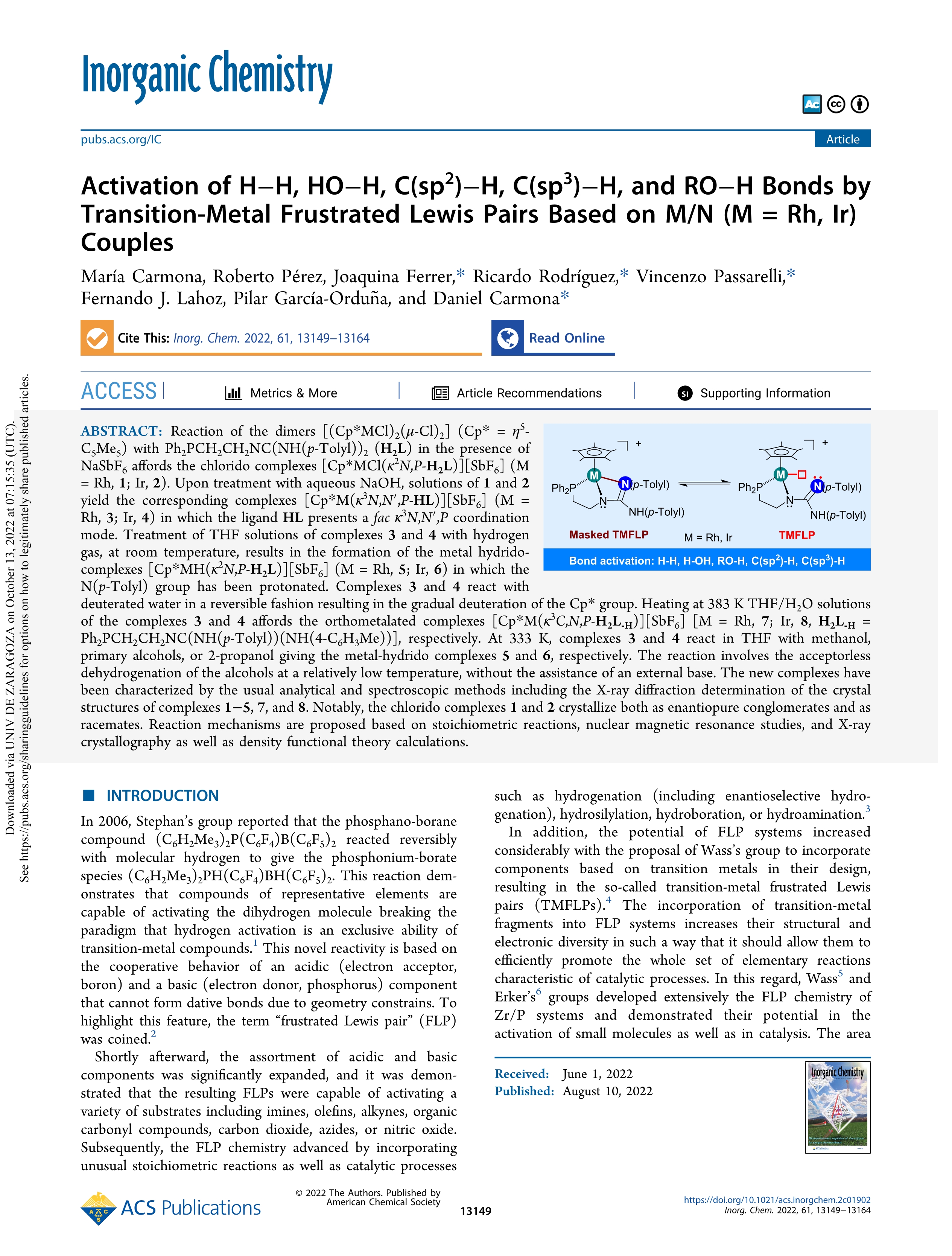
Resumen: Reaction of the dimers (Cp*MCl)2(µ-Cl)2] (Cp* = 5-C5Me5) with Ph2PCH2CH2NC(NH(p-Tolyl))2 (H2L) in the presence of NaSbF6 affords the chlorido complexes Cp*MCl(¿2N, P-H2L)]SbF6] (M = Rh, 1; Ir, 2). Upon treatment with aqueous NaOH, solutions of 1 and 2 yield the corresponding complexes Cp*M(¿3N, N', P-HL)]SbF6] (M = Rh, 3; Ir, 4) in which the ligand HL presents a fac ¿3N, N', P coordination mode. Treatment of THF solutions of complexes 3 and 4 with hydrogen gas, at room temperature, results in the formation of the metal hydrido-complexes Cp*MH(¿2N, P-H2L)]SbF6] (M = Rh, 5; Ir, 6) in which the N(p-Tolyl) group has been protonated. Complexes 3 and 4 react with deuterated water in a reversible fashion resulting in the gradual deuteration of the Cp* group. Heating at 383 K THF/H2O solutions of the complexes 3 and 4 affords the orthometalated complexes Cp*M(¿3C, N, P-H2L-H)]SbF6] M = Rh, 7; Ir, 8, H2L-H = Ph2PCH2CH2NC(NH(p-Tolyl))(NH(4-C6H3Me))], respectively. At 333 K, complexes 3 and 4 react in THF with methanol, primary alcohols, or 2-propanol giving the metal-hydrido complexes 5 and 6, respectively. The reaction involves the acceptorless dehydrogenation of the alcohols at a relatively low temperature, without the assistance of an external base. The new complexes have been characterized by the usual analytical and spectroscopic methods including the X-ray diffraction determination of the crystal structures of complexes 1-5, 7, and 8. Notably, the chlorido complexes 1 and 2 crystallize both as enantiopure conglomerates and as racemates. Reaction mechanisms are proposed based on stoichiometric reactions, nuclear magnetic resonance studies, and X-ray crystallography as well as density functional theory calculations. © 2022 The Authors. Published by American Chemical Society.
Idioma: Inglés
DOI: 10.1021/acs.inorgchem.2c01902
Año: 2022
Publicado en: Inorganic Chemistry 61, 33 (2022), 13149 - 13164
ISSN: 0020-1669
Factor impacto JCR: 4.6 (2022)
Categ. JCR: CHEMISTRY, INORGANIC & NUCLEAR rank: 5 / 42 = 0.119 (2022) - Q1 - T1
Factor impacto CITESCORE: 8.0 - Chemistry (Q1)
Factor impacto SCIMAGO: 0.997 - Chemistry (miscellaneous) (Q1) - Physical and Theoretical Chemistry (Q1) - Inorganic Chemistry (Q1)
Financiación: info:eu-repo/grantAgreement/ES/DGA/E05-20R
Financiación: info:eu-repo/grantAgreement/ES/MCIU/RED2018-102574-T
Financiación: info:eu-repo/grantAgreement/ES/MICINN/CTQ2018-095561-BI00
Tipo y forma: Article (Published version)
Área (Departamento): Área Química Inorgánica (Dpto. Química Inorgánica)
 You must give appropriate credit, provide a link to the license, and indicate if changes were made. You may do so in any reasonable manner, but not in any way that suggests the licensor endorses you or your use.
Exportado de SIDERAL (2024-03-18-15:04:35)
Visitas y descargas
Idioma: Inglés
DOI: 10.1021/acs.inorgchem.2c01902
Año: 2022
Publicado en: Inorganic Chemistry 61, 33 (2022), 13149 - 13164
ISSN: 0020-1669
Factor impacto JCR: 4.6 (2022)
Categ. JCR: CHEMISTRY, INORGANIC & NUCLEAR rank: 5 / 42 = 0.119 (2022) - Q1 - T1
Factor impacto CITESCORE: 8.0 - Chemistry (Q1)
Factor impacto SCIMAGO: 0.997 - Chemistry (miscellaneous) (Q1) - Physical and Theoretical Chemistry (Q1) - Inorganic Chemistry (Q1)
Financiación: info:eu-repo/grantAgreement/ES/DGA/E05-20R
Financiación: info:eu-repo/grantAgreement/ES/MCIU/RED2018-102574-T
Financiación: info:eu-repo/grantAgreement/ES/MICINN/CTQ2018-095561-BI00
Tipo y forma: Article (Published version)
Área (Departamento): Área Química Inorgánica (Dpto. Química Inorgánica)
You must give appropriate credit, provide a link to the license, and indicate if changes were made. You may do so in any reasonable manner, but not in any way that suggests the licensor endorses you or your use. Exportado de SIDERAL (2024-03-18-15:04:35)
Permalink:
Visitas y descargas
Este artículo se encuentra en las siguientes colecciones:
Articles > Artículos por área > Química Inorgánica
Record created 2022-10-20, last modified 2024-03-19