Executive function assessment: Adaptation of the Amsterdam executive function inventory using Spanish first-year university students from two knowledge areas
Escolano-Pérez, Elena (Universidad de Zaragoza) ; Romero-Galisteo, Rita Pilar ; Rodríguez-Medina, Jairo ; Gálvez-Ruiz, Pablo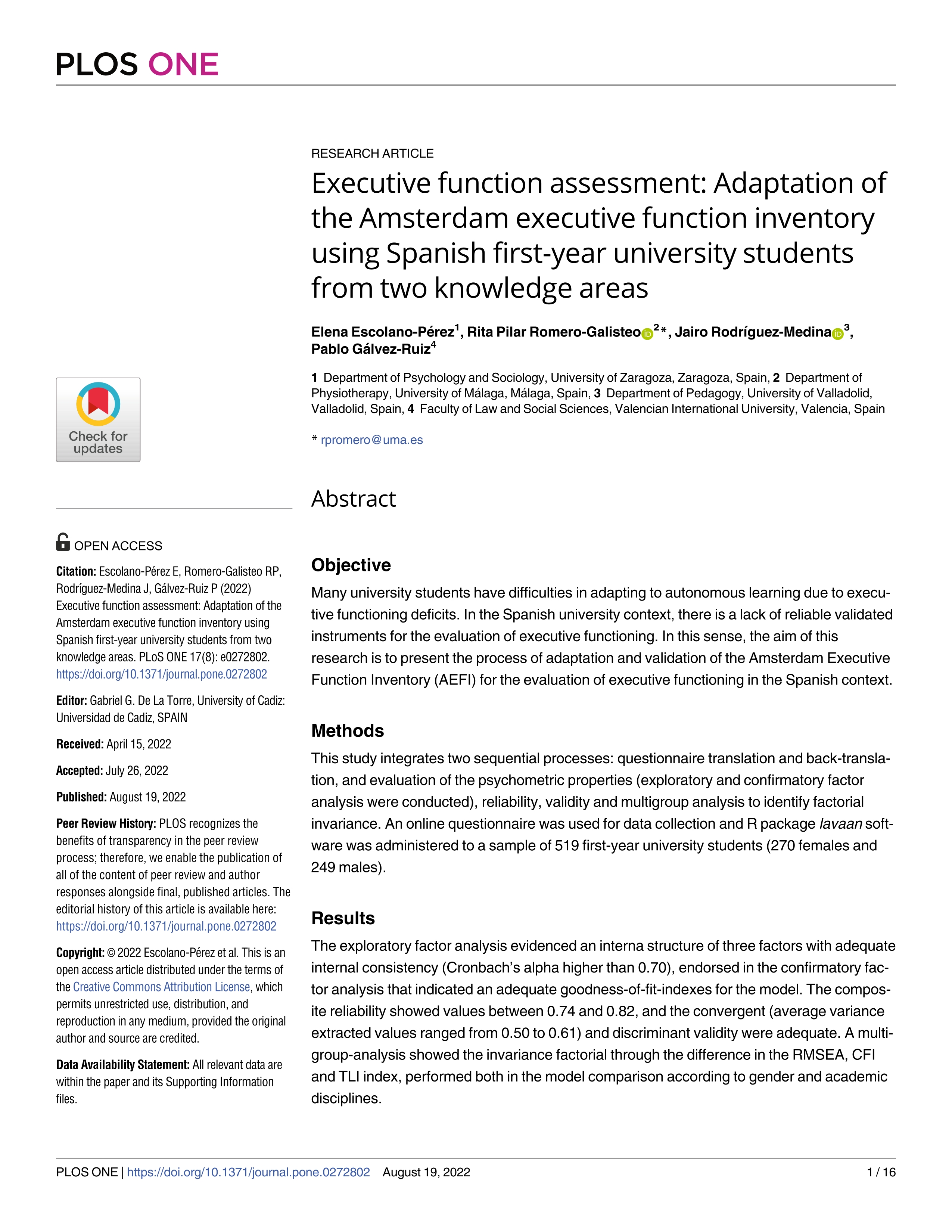
Resumen: Objective
Many university students have difficulties in adapting to autonomous learning due to executive functioning deficits. In the Spanish university context, there is a lack of reliable validated instruments for the evaluation of executive functioning. In this sense, the aim of this research is to present the process of adaptation and validation of the Amsterdam Executive Function Inventory (AEFI) for the evaluation of executive functioning in the Spanish context.
Methods
This study integrates two sequential processes: questionnaire translation and back-translation, and evaluation of the psychometric properties (exploratory and confirmatory factor analysis were conducted), reliability, validity and multigroup analysis to identify factorial invariance. An online questionnaire was used for data collection and R package lavaan software was administered to a sample of 519 first-year university students (270 females and 249 males).
Results
The exploratory factor analysis evidenced an interna structure of three factors with adequate internal consistency (Cronbach’s alpha higher than 0.70), endorsed in the confirmatory factor analysis that indicated an adequate goodness-of-fit-indexes for the model. The composite reliability showed values between 0.74 and 0.82, and the convergent (average variance extracted values ranged from 0.50 to 0.61) and discriminant validity were adequate. A multigroup-analysis showed the invariance factorial through the difference in the RMSEA, CFI and TLI index, performed both in the model comparison according to gender and academic disciplines.
Conclusion
The AEFI adapted for Spanish has practical implications for the management of university students, as it can facilitate the improvement of university policies designed to foster the development of executive functions, specifically in first-year students.
Idioma: Inglés
DOI: 10.1371/journal.pone.0272802
Año: 2022
Publicado en: PLoS ONE 17, 8 (2022), e0272802 [16 pp.]
ISSN: 1932-6203
Factor impacto JCR: 3.7 (2022)
Categ. JCR: MULTIDISCIPLINARY SCIENCES rank: 26 / 73 = 0.356 (2022) - Q2 - T2
Factor impacto CITESCORE: 6.0 - General (Q1)
Factor impacto SCIMAGO: 0.885 - Multidisciplinary (Q1)
Financiación: info:eu-repo/grantAgreement/ES/UZ/PIIDUZ-17-006
Tipo y forma: Artículo (Versión definitiva)
Área (Departamento): Área Psicolog.Evolut.Educac (Dpto. Psicología y Sociología)
 Debe reconocer adecuadamente la autoría, proporcionar un enlace a la licencia e indicar si se han realizado cambios. Puede hacerlo de cualquier manera razonable, pero no de una manera que sugiera que tiene el apoyo del licenciador o lo recibe por el uso que hace.
Exportado de SIDERAL (2024-03-18-15:25:07)
Visitas y descargas
Many university students have difficulties in adapting to autonomous learning due to executive functioning deficits. In the Spanish university context, there is a lack of reliable validated instruments for the evaluation of executive functioning. In this sense, the aim of this research is to present the process of adaptation and validation of the Amsterdam Executive Function Inventory (AEFI) for the evaluation of executive functioning in the Spanish context.
Methods
This study integrates two sequential processes: questionnaire translation and back-translation, and evaluation of the psychometric properties (exploratory and confirmatory factor analysis were conducted), reliability, validity and multigroup analysis to identify factorial invariance. An online questionnaire was used for data collection and R package lavaan software was administered to a sample of 519 first-year university students (270 females and 249 males).
Results
The exploratory factor analysis evidenced an interna structure of three factors with adequate internal consistency (Cronbach’s alpha higher than 0.70), endorsed in the confirmatory factor analysis that indicated an adequate goodness-of-fit-indexes for the model. The composite reliability showed values between 0.74 and 0.82, and the convergent (average variance extracted values ranged from 0.50 to 0.61) and discriminant validity were adequate. A multigroup-analysis showed the invariance factorial through the difference in the RMSEA, CFI and TLI index, performed both in the model comparison according to gender and academic disciplines.
Conclusion
The AEFI adapted for Spanish has practical implications for the management of university students, as it can facilitate the improvement of university policies designed to foster the development of executive functions, specifically in first-year students.
Idioma: Inglés
DOI: 10.1371/journal.pone.0272802
Año: 2022
Publicado en: PLoS ONE 17, 8 (2022), e0272802 [16 pp.]
ISSN: 1932-6203
Factor impacto JCR: 3.7 (2022)
Categ. JCR: MULTIDISCIPLINARY SCIENCES rank: 26 / 73 = 0.356 (2022) - Q2 - T2
Factor impacto CITESCORE: 6.0 - General (Q1)
Factor impacto SCIMAGO: 0.885 - Multidisciplinary (Q1)
Financiación: info:eu-repo/grantAgreement/ES/UZ/PIIDUZ-17-006
Tipo y forma: Artículo (Versión definitiva)
Área (Departamento): Área Psicolog.Evolut.Educac (Dpto. Psicología y Sociología)
Debe reconocer adecuadamente la autoría, proporcionar un enlace a la licencia e indicar si se han realizado cambios. Puede hacerlo de cualquier manera razonable, pero no de una manera que sugiera que tiene el apoyo del licenciador o lo recibe por el uso que hace. Exportado de SIDERAL (2024-03-18-15:25:07)
Enlace permanente:
Visitas y descargas
Este artículo se encuentra en las siguientes colecciones:
Artículos > Artículos por área > Psicología Evolutiva y de la Educación
Registro creado el 2022-11-15, última modificación el 2024-03-19