Nursing students' care of and attitudes towards lesbian, gay, bisexual, trans, and intersex people in times of COVID-19 in Spain: A cross-sectional study
Torrente-Jimenez, Ramon-Sebastián ; Gasch-Gallén, Angel (Universidad de Zaragoza) ; Graells Sans, Ariadna ; Fernàndez Lamelas, Eva ; Feijoo-Cid, Maria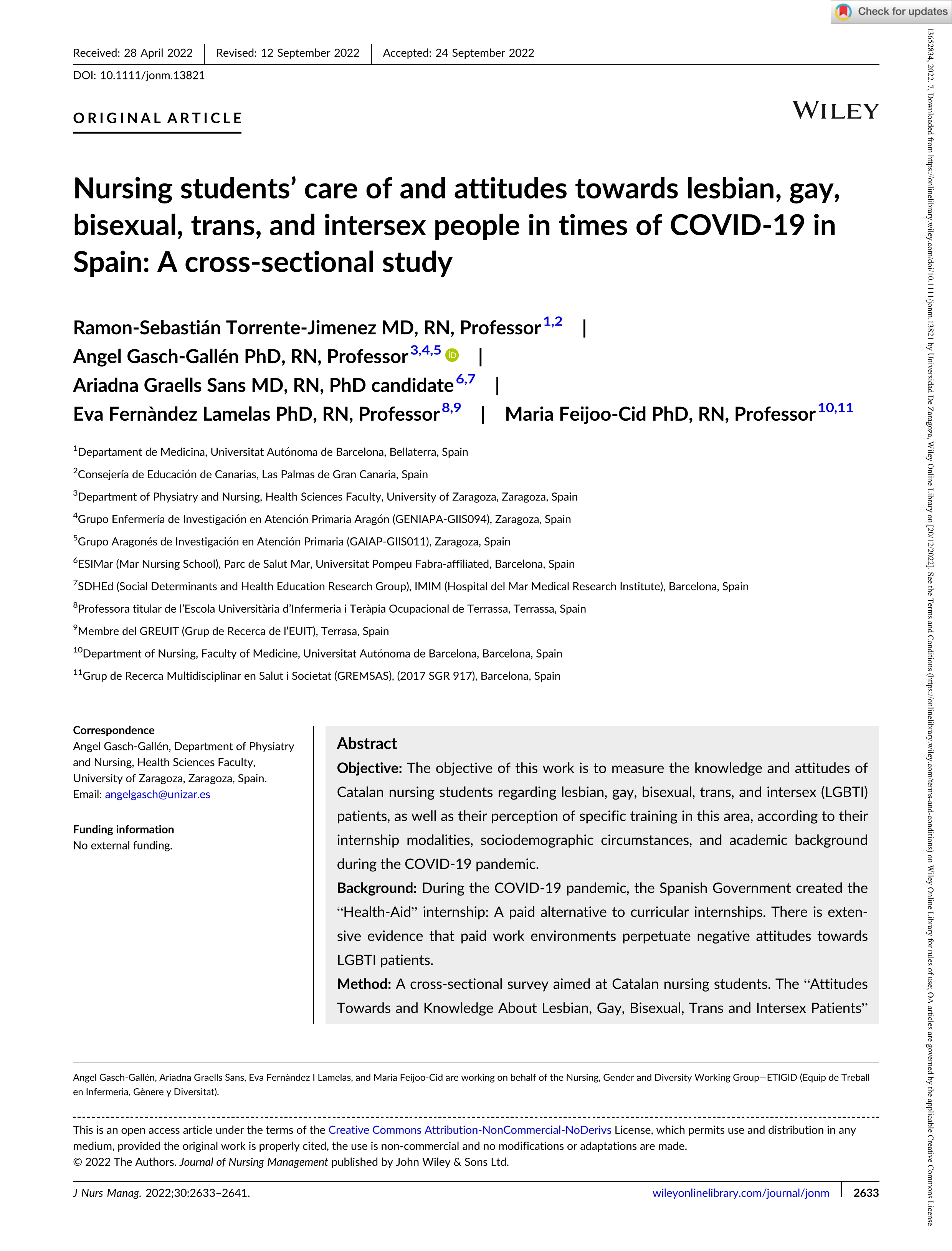
Resumen: Objective. The objective of this work is to measure the knowledge and attitudes of Catalan nursing students regarding lesbian, gay, bisexual, trans, and intersex (LGBTI) patients, as well as their perception of specific training in this area, according to their internship modalities, sociodemographic circumstances, and academic background during the COVID-19 pandemic.
Background. During the COVID-19 pandemic, the Spanish Government created the “Health-Aid” internship: A paid alternative to curricular internships. There is extensive evidence that paid work environments perpetuate negative attitudes towards LGBTI patients.
Method. A cross-sectional survey aimed at Catalan nursing students. The “Attitudes Towards and Knowledge About Lesbian, Gay, Bisexual, Trans and Intersex Patients” questionnaire was adapted. A descriptive study and backward regression models were constructed.
Results. Three hundred thirty-seven students, mean age 23.80 years (SD: 5.17) participated; 85% women and 54 (16%) completing the Health Aid internship modality. More than 50% did not attend specific training on the care of the lesbian, gay, bisexual, trans, and intersex population. Differences between internship modalities showed higher values in the curricular internship group: Attitudes (U = 6526.50, p = .031) and training perception (U = 5926.50, p = .008).
Conclusions. Nursing students' attitudes towards lesbian, gay, bisexual, trans, and intersex patients and their perception of specific training on care for this population were negatively influenced by the paid Health Aid internship during the pandemic.
Implications for Nursing Management. Even under dire circumstances, clinical training must be properly managed to address the specific health needs of vulnerable populations, such as lesbian, gay, bisexual, trans, and intersex patients. Paid internships in emergency scenarios may impede these objectives.
Idioma: Inglés
DOI: 10.1111/jonm.13821
Año: 2022
Publicado en: JOURNAL OF NURSING MANAGEMENT 30, 7 (2022), 2633-2641
ISSN: 0966-0429
Factor impacto JCR: 5.5 (2022)
Categ. JCR: NURSING rank: 3 / 125 = 0.024 (2022) - Q1 - T1
Categ. JCR: NURSING rank: 3 / 123 = 0.024 (2022) - Q1 - T1
Categ. JCR: MANAGEMENT rank: 89 / 227 = 0.392 (2022) - Q2 - T2
Factor impacto CITESCORE: 6.8 - Nursing (Q1)
Factor impacto SCIMAGO: 1.341 - Leadership and Management (Q1)
Tipo y forma: Article (Published version)
Área (Departamento): Área Enfermería (Dpto. Fisiatría y Enfermería)
 You must give appropriate credit, provide a link to the license, and indicate if changes were made. You may do so in any reasonable manner, but not in any way that suggests the licensor endorses you or your use. You may not use the material for commercial purposes. If you remix, transform, or build upon the material, you may not distribute the modified material.
Exportado de SIDERAL (2024-03-18-15:28:17)
Visitas y descargas
Background. During the COVID-19 pandemic, the Spanish Government created the “Health-Aid” internship: A paid alternative to curricular internships. There is extensive evidence that paid work environments perpetuate negative attitudes towards LGBTI patients.
Method. A cross-sectional survey aimed at Catalan nursing students. The “Attitudes Towards and Knowledge About Lesbian, Gay, Bisexual, Trans and Intersex Patients” questionnaire was adapted. A descriptive study and backward regression models were constructed.
Results. Three hundred thirty-seven students, mean age 23.80 years (SD: 5.17) participated; 85% women and 54 (16%) completing the Health Aid internship modality. More than 50% did not attend specific training on the care of the lesbian, gay, bisexual, trans, and intersex population. Differences between internship modalities showed higher values in the curricular internship group: Attitudes (U = 6526.50, p = .031) and training perception (U = 5926.50, p = .008).
Conclusions. Nursing students' attitudes towards lesbian, gay, bisexual, trans, and intersex patients and their perception of specific training on care for this population were negatively influenced by the paid Health Aid internship during the pandemic.
Implications for Nursing Management. Even under dire circumstances, clinical training must be properly managed to address the specific health needs of vulnerable populations, such as lesbian, gay, bisexual, trans, and intersex patients. Paid internships in emergency scenarios may impede these objectives.
Idioma: Inglés
DOI: 10.1111/jonm.13821
Año: 2022
Publicado en: JOURNAL OF NURSING MANAGEMENT 30, 7 (2022), 2633-2641
ISSN: 0966-0429
Factor impacto JCR: 5.5 (2022)
Categ. JCR: NURSING rank: 3 / 125 = 0.024 (2022) - Q1 - T1
Categ. JCR: NURSING rank: 3 / 123 = 0.024 (2022) - Q1 - T1
Categ. JCR: MANAGEMENT rank: 89 / 227 = 0.392 (2022) - Q2 - T2
Factor impacto CITESCORE: 6.8 - Nursing (Q1)
Factor impacto SCIMAGO: 1.341 - Leadership and Management (Q1)
Tipo y forma: Article (Published version)
Área (Departamento): Área Enfermería (Dpto. Fisiatría y Enfermería)
You must give appropriate credit, provide a link to the license, and indicate if changes were made. You may do so in any reasonable manner, but not in any way that suggests the licensor endorses you or your use. You may not use the material for commercial purposes. If you remix, transform, or build upon the material, you may not distribute the modified material. Exportado de SIDERAL (2024-03-18-15:28:17)
Permalink:
Visitas y descargas
Este artículo se encuentra en las siguientes colecciones:
Articles > Artículos por área > Enfermería
Record created 2022-12-21, last modified 2024-03-19