Evaluation of protein and amino acid intake estimates from the EPIC dietary questionnaires and 24-h dietary recalls using different food composition databases
Iguacel, Isabel (Universidad de Zaragoza) ; Perez-Cornago, Aurora ; Schmidt, Julie A. ; Van Puyvelde, Heleen ; Travis, Ruth ; Casagrande, Corinne ; Nicolas, Genevieve ; Riboli, Elio ; Weiderpass, Elisabete ; Ardanaz, Eva ; Barricarte, Aurelio ; Bodén, Stina ; Bruno, Eleonora ; Ching-López, Ana ; Aune, Dagfinn ; Jensen, Torill E. ; Ericson, Ulrika ; Johansson, Ingergerd ; Ma Huerta, José ; Katzke, Verena ; Kühn, Tilman ; Sacerdote, Carlotta ; Schulze, Matthias B. ; Skeie, Guri ; Ramne, Stina ; Ward, Heather ; Gunter, Marc J. ; Huybrechts, Inge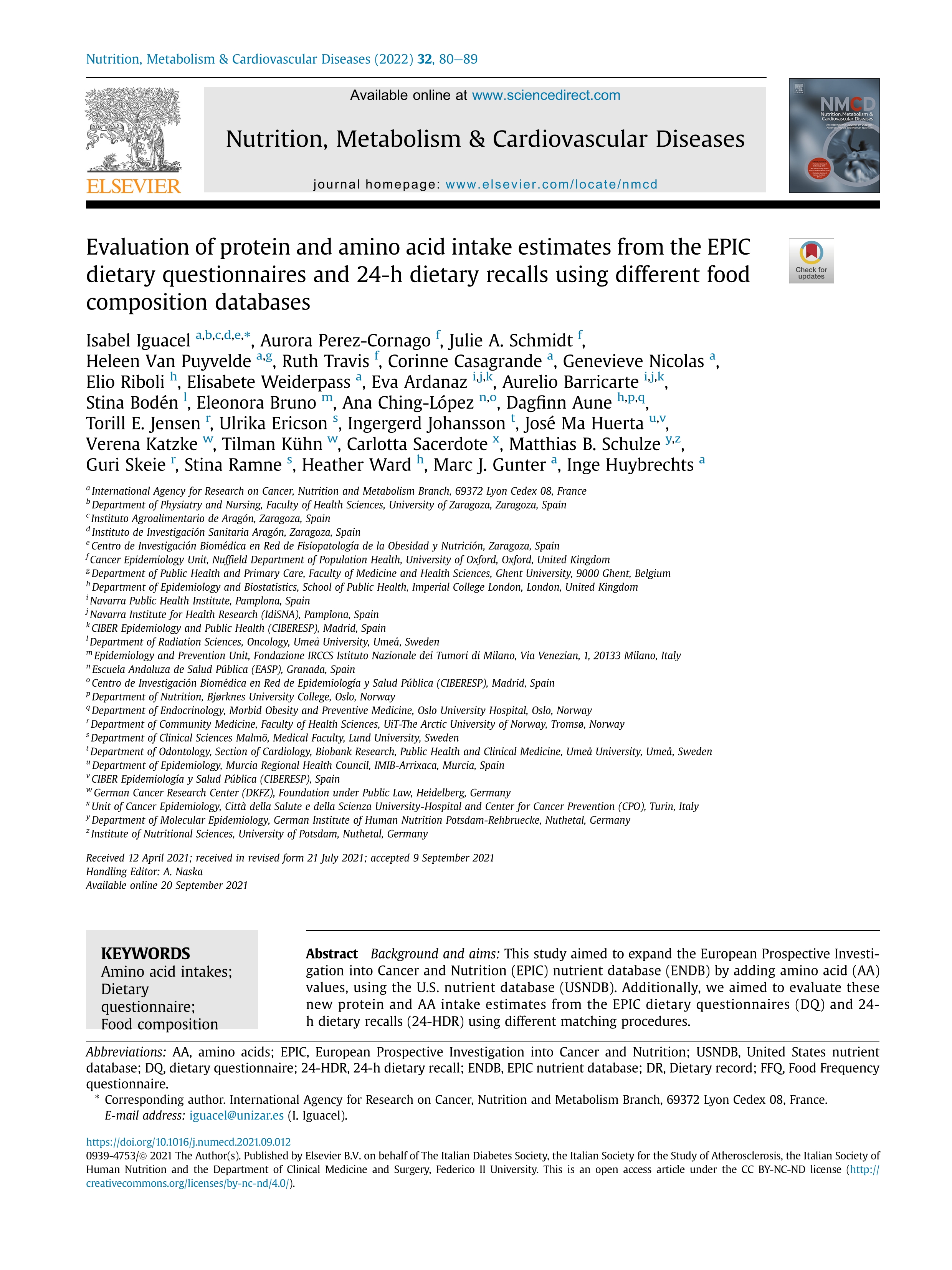
Resumen: Background and aims
This study aimed to expand the European Prospective Investigation into Cancer and Nutrition (EPIC) nutrient database (ENDB) by adding amino acid (AA) values, using the U.S. nutrient database (USNDB). Additionally, we aimed to evaluate these new protein and AA intake estimates from the EPIC dietary questionnaires (DQ) and 24-h dietary recalls (24-HDR) using different matching procedures.
Methods and results
Dietary energy, protein and AA intakes were assessed via DQ and 24-HDR by matching with the USNDB food composition table. Energy and protein intakes calculated using USNDB matching were compared with those calculated using ENDB, that uses country specific food composition tables. Pearson correlations, Cohen's weighted kappa statistic and Bland–Altman plots were used to compare data resulting from USNDB matching with our reference from ENDB matching.
Very high correlations were found when comparing daily energy (r = 0.99) and dietary protein intakes (r = 0.97) assessed via USNDB with those obtained via ENDB (matching for DQ and 24-HDR). Significant positive correlations were also found with energy and protein intakes acquired via 24-HDRs in the EPIC calibration sample.
Conclusion
Very high correlations between total energy and protein intake obtained via the USDA matching and those available in ENDB suggest accuracy in the food matching. Individual AA have been included in the extended EPIC Nutrient database that will allow important analyses on AA disease prospective associations in the EPIC study.
Idioma: Inglés
DOI: 10.1016/j.numecd.2021.09.012
Año: 2022
Publicado en: Nutrition, Metabolism and Cardiovascular Diseases 32, 1 (2022), 80-89
ISSN: 0939-4753
Factor impacto JCR: 3.9 (2022)
Categ. JCR: CARDIAC & CARDIOVASCULAR SYSTEMS rank: 54 / 143 = 0.378 (2022) - Q2 - T2
Categ. JCR: NUTRITION & DIETETICS rank: 42 / 87 = 0.483 (2022) - Q2 - T2
Categ. JCR: ENDOCRINOLOGY & METABOLISM rank: 64 / 144 = 0.444 (2022) - Q2 - T2
Factor impacto CITESCORE: 5.9 - Nursing (Q1) - Medicine (Q1)
Factor impacto SCIMAGO: 0.997 - Cardiology and Cardiovascular Medicine (Q1) - Nutrition and Dietetics (Q1) - Medicine (miscellaneous) (Q1) - Endocrinology, Diabetes and Metabolism (Q2)
Tipo y forma: Article (Published version)
Área (Departamento): Área Enfermería (Dpto. Fisiatría y Enfermería)
 You must give appropriate credit, provide a link to the license, and indicate if changes were made. You may do so in any reasonable manner, but not in any way that suggests the licensor endorses you or your use. You may not use the material for commercial purposes. If you remix, transform, or build upon the material, you may not distribute the modified material.
Exportado de SIDERAL (2024-03-18-16:24:44)
Visitas y descargas
This study aimed to expand the European Prospective Investigation into Cancer and Nutrition (EPIC) nutrient database (ENDB) by adding amino acid (AA) values, using the U.S. nutrient database (USNDB). Additionally, we aimed to evaluate these new protein and AA intake estimates from the EPIC dietary questionnaires (DQ) and 24-h dietary recalls (24-HDR) using different matching procedures.
Methods and results
Dietary energy, protein and AA intakes were assessed via DQ and 24-HDR by matching with the USNDB food composition table. Energy and protein intakes calculated using USNDB matching were compared with those calculated using ENDB, that uses country specific food composition tables. Pearson correlations, Cohen's weighted kappa statistic and Bland–Altman plots were used to compare data resulting from USNDB matching with our reference from ENDB matching.
Very high correlations were found when comparing daily energy (r = 0.99) and dietary protein intakes (r = 0.97) assessed via USNDB with those obtained via ENDB (matching for DQ and 24-HDR). Significant positive correlations were also found with energy and protein intakes acquired via 24-HDRs in the EPIC calibration sample.
Conclusion
Very high correlations between total energy and protein intake obtained via the USDA matching and those available in ENDB suggest accuracy in the food matching. Individual AA have been included in the extended EPIC Nutrient database that will allow important analyses on AA disease prospective associations in the EPIC study.
Idioma: Inglés
DOI: 10.1016/j.numecd.2021.09.012
Año: 2022
Publicado en: Nutrition, Metabolism and Cardiovascular Diseases 32, 1 (2022), 80-89
ISSN: 0939-4753
Factor impacto JCR: 3.9 (2022)
Categ. JCR: CARDIAC & CARDIOVASCULAR SYSTEMS rank: 54 / 143 = 0.378 (2022) - Q2 - T2
Categ. JCR: NUTRITION & DIETETICS rank: 42 / 87 = 0.483 (2022) - Q2 - T2
Categ. JCR: ENDOCRINOLOGY & METABOLISM rank: 64 / 144 = 0.444 (2022) - Q2 - T2
Factor impacto CITESCORE: 5.9 - Nursing (Q1) - Medicine (Q1)
Factor impacto SCIMAGO: 0.997 - Cardiology and Cardiovascular Medicine (Q1) - Nutrition and Dietetics (Q1) - Medicine (miscellaneous) (Q1) - Endocrinology, Diabetes and Metabolism (Q2)
Tipo y forma: Article (Published version)
Área (Departamento): Área Enfermería (Dpto. Fisiatría y Enfermería)
You must give appropriate credit, provide a link to the license, and indicate if changes were made. You may do so in any reasonable manner, but not in any way that suggests the licensor endorses you or your use. You may not use the material for commercial purposes. If you remix, transform, or build upon the material, you may not distribute the modified material. Exportado de SIDERAL (2024-03-18-16:24:44)
Permalink:
Visitas y descargas
Este artículo se encuentra en las siguientes colecciones:
Articles > Artículos por área > Enfermería
Record created 2022-12-22, last modified 2024-03-19