Self-Reported Hidradenitis Suppurativa Severity: Is It Useful for Clinical Practice?
Krajewski, Piotr K. ; Marrón, Servando E. (Universidad de Zaragoza) ; Tomas Aragones, Lucía ; Gilaberte-Calzada, Yolanda (Universidad de Zaragoza) ; Szepietowski, Jacek C.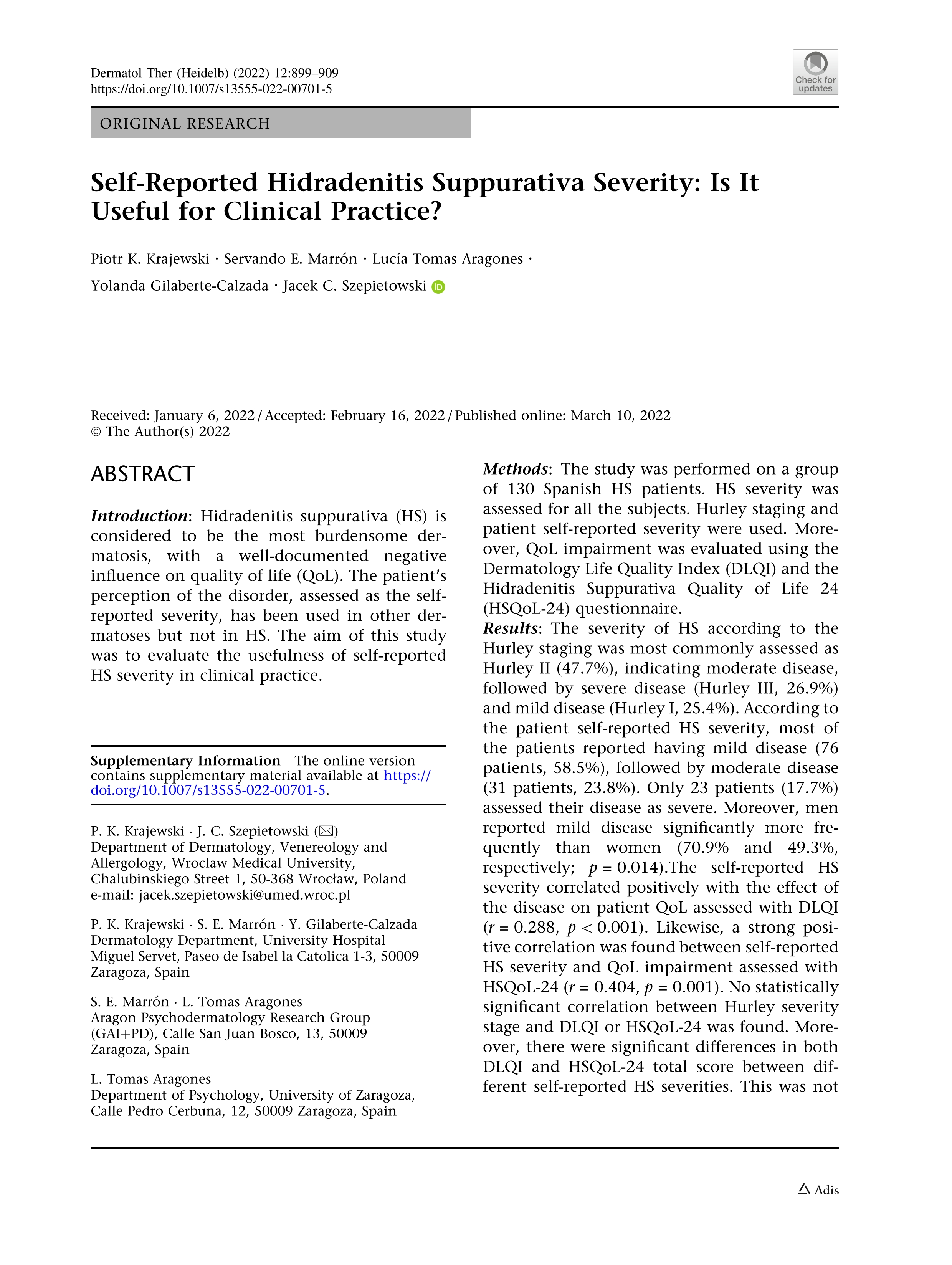
Resumen: Introduction. Hidradenitis suppurativa (HS) is considered to be the most burdensome dermatosis, with a well-documented negative influence on quality of life (QoL). The patient’s perception of the disorder, assessed as the self-reported severity, has been used in other dermatoses but not in HS. The aim of this study was to evaluate the usefulness of self-reported HS severity in clinical practice.
Methods. The study was performed on a group of 130 Spanish HS patients. HS severity was assessed for all the subjects. Hurley staging and patient self-reported severity were used. Moreover, QoL impairment was evaluated using the Dermatology Life Quality Index (DLQI) and the Hidradenitis Suppurativa Quality of Life 24 (HSQoL-24) questionnaire.
Results. The severity of HS according to the Hurley staging was most commonly assessed as Hurley II (47.7%), indicating moderate disease, followed by severe disease (Hurley III, 26.9%) and mild disease (Hurley I, 25.4%). According to the patient self-reported HS severity, most of the patients reported having mild disease (76 patients, 58.5%), followed by moderate disease (31 patients, 23.8%). Only 23 patients (17.7%) assessed their disease as severe. Moreover, men reported mild disease significantly more frequently than women (70.9% and 49.3%, respectively; p = 0.014).
The self-reported HS severity correlated positively with the effect of the disease on patient QoL assessed with DLQI (r = 0.288, p < 0.001). Likewise, a strong positive correlation was found between self-reported HS severity and QoL impairment assessed with HSQoL-24 (r = 0.404, p = 0.001). No statistically significant correlation between Hurley severity stage and DLQI or HSQoL-24 was found. Moreover, there were significant differences in both DLQI and HSQoL-24 total score between different self-reported HS severities. This was not seen for any of the QoL instruments or for Hurley severity staging.
Conclusion. The results show that self-assessment severity may reflect patients’ subjective feelings more adequately than popular objective instruments, and there should be a place for its use in daily clinical practice.
Idioma: Inglés
DOI: 10.1007/s13555-022-00701-5
Año: 2022
Publicado en: Dermatology and therapy 12 (2022), 899-909
ISSN: 2193-8210
Factor impacto JCR: 3.4 (2022)
Categ. JCR: DERMATOLOGY rank: 20 / 70 = 0.286 (2022) - Q2 - T1
Factor impacto CITESCORE: 4.9 - Medicine (Q2)
Factor impacto SCIMAGO: 1.034 - Dermatology (Q1)
Tipo y forma: Article (Published version)
Área (Departamento): Área Dermatología (Dpto. Medicina, Psiqu. y Derm.)
Exportado de SIDERAL (2024-03-18-13:00:53)
Visitas y descargas
Methods. The study was performed on a group of 130 Spanish HS patients. HS severity was assessed for all the subjects. Hurley staging and patient self-reported severity were used. Moreover, QoL impairment was evaluated using the Dermatology Life Quality Index (DLQI) and the Hidradenitis Suppurativa Quality of Life 24 (HSQoL-24) questionnaire.
Results. The severity of HS according to the Hurley staging was most commonly assessed as Hurley II (47.7%), indicating moderate disease, followed by severe disease (Hurley III, 26.9%) and mild disease (Hurley I, 25.4%). According to the patient self-reported HS severity, most of the patients reported having mild disease (76 patients, 58.5%), followed by moderate disease (31 patients, 23.8%). Only 23 patients (17.7%) assessed their disease as severe. Moreover, men reported mild disease significantly more frequently than women (70.9% and 49.3%, respectively; p = 0.014).
The self-reported HS severity correlated positively with the effect of the disease on patient QoL assessed with DLQI (r = 0.288, p < 0.001). Likewise, a strong positive correlation was found between self-reported HS severity and QoL impairment assessed with HSQoL-24 (r = 0.404, p = 0.001). No statistically significant correlation between Hurley severity stage and DLQI or HSQoL-24 was found. Moreover, there were significant differences in both DLQI and HSQoL-24 total score between different self-reported HS severities. This was not seen for any of the QoL instruments or for Hurley severity staging.
Conclusion. The results show that self-assessment severity may reflect patients’ subjective feelings more adequately than popular objective instruments, and there should be a place for its use in daily clinical practice.
Idioma: Inglés
DOI: 10.1007/s13555-022-00701-5
Año: 2022
Publicado en: Dermatology and therapy 12 (2022), 899-909
ISSN: 2193-8210
Factor impacto JCR: 3.4 (2022)
Categ. JCR: DERMATOLOGY rank: 20 / 70 = 0.286 (2022) - Q2 - T1
Factor impacto CITESCORE: 4.9 - Medicine (Q2)
Factor impacto SCIMAGO: 1.034 - Dermatology (Q1)
Tipo y forma: Article (Published version)
Área (Departamento): Área Dermatología (Dpto. Medicina, Psiqu. y Derm.)
Exportado de SIDERAL (2024-03-18-13:00:53)
Permalink:
Visitas y descargas
Este artículo se encuentra en las siguientes colecciones:
articulos > articulos-por-area > dermatologia
Notice créée le 2023-01-11, modifiée le 2024-03-19