Efficacy of a between-session homework component delivered digitally for the treatment of adjustment disorders: Results from a pilot randomized clinical trial
Quero, Soledad ; Díaz-García, Amanda (Universidad de Zaragoza) ; Fernández-Buendía, Sara ; Molés, Mar ; Tur, Cintia ; Castilla, Diana ; Cuijpers, Pim ; Botella, Cristina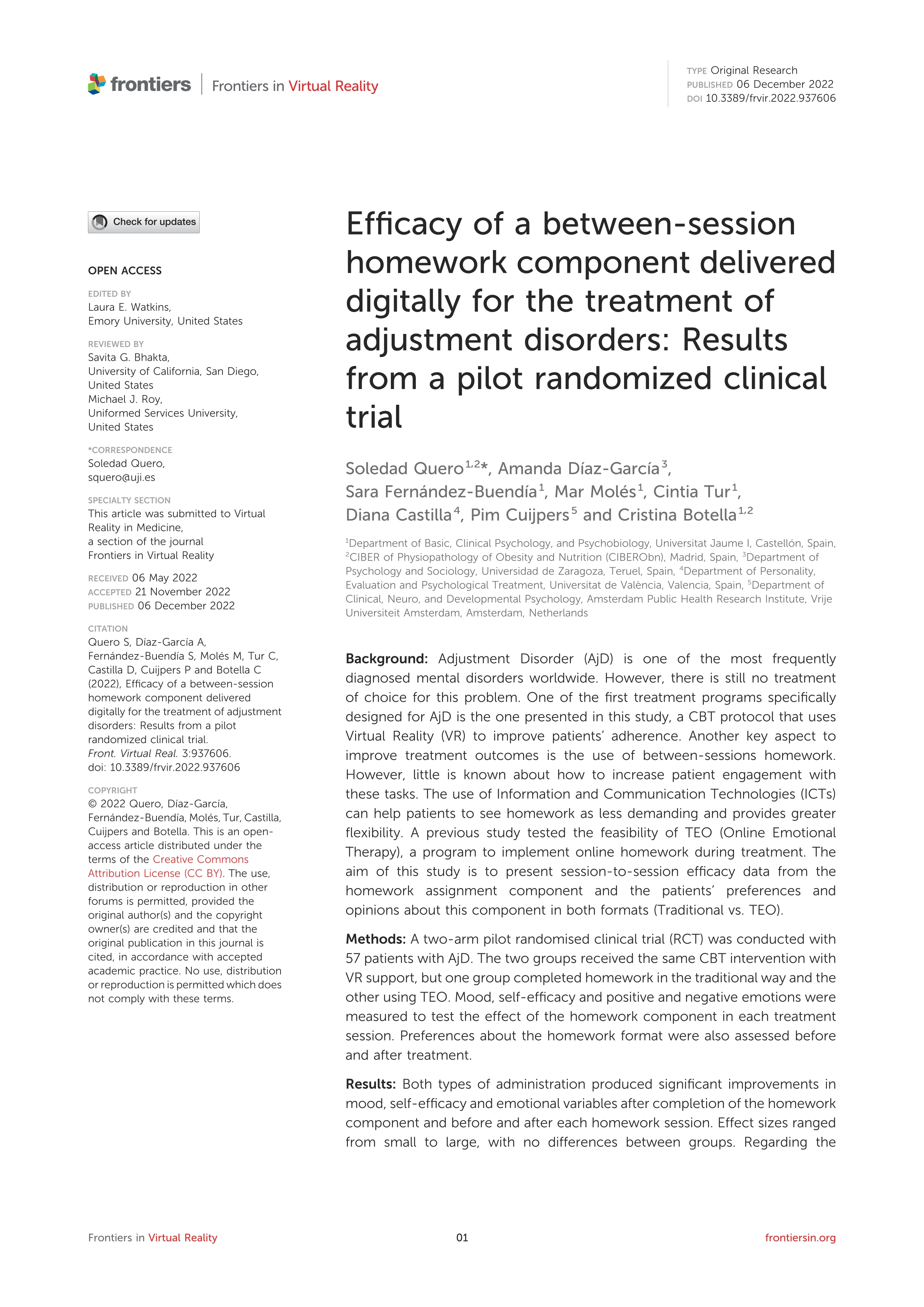
Resumen: Background: Adjustment Disorder (AjD) is one of the most frequently diagnosed mental disorders worldwide. However, there is still no treatment of choice for this problem. One of the first treatment programs specifically designed for AjD is the one presented in this study, a CBT protocol that uses Virtual Reality (VR) to improve patients’ adherence. Another key aspect to improve treatment outcomes is the use of between-sessions homework. However, little is known about how to increase patient engagement with these tasks. The use of Information and Communication Technologies (ICTs) can help patients to see homework as less demanding and provides greater flexibility. A previous study tested the feasibility of TEO (Online Emotional Therapy), a program to implement online homework during treatment. The aim of this study is to present session-to-session efficacy data from the homework assignment component and the patients’ preferences and opinions about this component in both formats (Traditional vs. TEO).
Methods: A two-arm pilot randomised clinical trial (RCT) was conducted with 57 patients with AjD. The two groups received the same CBT intervention with VR support, but one group completed homework in the traditional way and the other using TEO. Mood, self-efficacy and positive and negative emotions were measured to test the effect of the homework component in each treatment session. Preferences about the homework format were also assessed before and after treatment.
Results: Both types of administration produced significant improvements in mood, self-efficacy and emotional variables after completion of the homework component and before and after each homework session. Effect sizes ranged from small to large, with no differences between groups. Regarding the acceptability of the program, most participants preferred the TEO condition both before starting the treatment and after completing the homework assignment. Overall, participants were satisfied with all homework sessions and found them useful. Again, no significant differences were found between groups.
Conclusion: This is the first time that the effect of an online homework program during AjD treatment has been tested. It is proposed that this way of implementing homework could be as effective as the traditional format, but would be preferred by patients.
Clinical Trial Registration:clinicaltrials.gov, identifier NCT02452411
Idioma: Inglés
DOI: 10.3389/frvir.2022.937606
Año: 2022
Publicado en: Frontiers in Virtual Reality 3 (2022), [14 pp.]
ISSN: 2673-4192
Factor impacto CITESCORE: 2.9 - Computer Science (Q3)
Financiación: info:eu-repo/grantAgreement/ES/ISCIII-CIBERObn/CB06-03-0052
Financiación: info:eu-repo/grantAgreement/ES/MCIU/RTI2018-100993-B-100
Tipo y forma: Artículo (Versión definitiva)
Área (Departamento): Área Person.Eval.Trat.Psicoló. (Dpto. Psicología y Sociología)
 Debe reconocer adecuadamente la autoría, proporcionar un enlace a la licencia e indicar si se han realizado cambios. Puede hacerlo de cualquier manera razonable, pero no de una manera que sugiera que tiene el apoyo del licenciador o lo recibe por el uso que hace.
Exportado de SIDERAL (2023-09-13-15:28:07)
Visitas y descargas
Methods: A two-arm pilot randomised clinical trial (RCT) was conducted with 57 patients with AjD. The two groups received the same CBT intervention with VR support, but one group completed homework in the traditional way and the other using TEO. Mood, self-efficacy and positive and negative emotions were measured to test the effect of the homework component in each treatment session. Preferences about the homework format were also assessed before and after treatment.
Results: Both types of administration produced significant improvements in mood, self-efficacy and emotional variables after completion of the homework component and before and after each homework session. Effect sizes ranged from small to large, with no differences between groups. Regarding the acceptability of the program, most participants preferred the TEO condition both before starting the treatment and after completing the homework assignment. Overall, participants were satisfied with all homework sessions and found them useful. Again, no significant differences were found between groups.
Conclusion: This is the first time that the effect of an online homework program during AjD treatment has been tested. It is proposed that this way of implementing homework could be as effective as the traditional format, but would be preferred by patients.
Clinical Trial Registration:clinicaltrials.gov, identifier NCT02452411
Idioma: Inglés
DOI: 10.3389/frvir.2022.937606
Año: 2022
Publicado en: Frontiers in Virtual Reality 3 (2022), [14 pp.]
ISSN: 2673-4192
Factor impacto CITESCORE: 2.9 - Computer Science (Q3)
Financiación: info:eu-repo/grantAgreement/ES/ISCIII-CIBERObn/CB06-03-0052
Financiación: info:eu-repo/grantAgreement/ES/MCIU/RTI2018-100993-B-100
Tipo y forma: Artículo (Versión definitiva)
Área (Departamento): Área Person.Eval.Trat.Psicoló. (Dpto. Psicología y Sociología)
Debe reconocer adecuadamente la autoría, proporcionar un enlace a la licencia e indicar si se han realizado cambios. Puede hacerlo de cualquier manera razonable, pero no de una manera que sugiera que tiene el apoyo del licenciador o lo recibe por el uso que hace. Exportado de SIDERAL (2023-09-13-15:28:07)
Enlace permanente:
Visitas y descargas
Este artículo se encuentra en las siguientes colecciones:
Artículos > Artículos por área > Personalidad,Evaluación y Tratamiento Psicológicos
Registro creado el 2023-02-16, última modificación el 2023-09-14