Joint analysis of the epidemic evolution and human mobility during the first wave of Covid-19 in Spain: retrospective study
Steinegger, Benjamin ; Granell, Clara ; Rapisardi, Giacomo ; Gómez, Sergio ; Matamalas, Joan ; Soriano-Paños, David ; Gómez-Gardeñes, Jesús (Universidad de Zaragoza) ; Arenas, Alex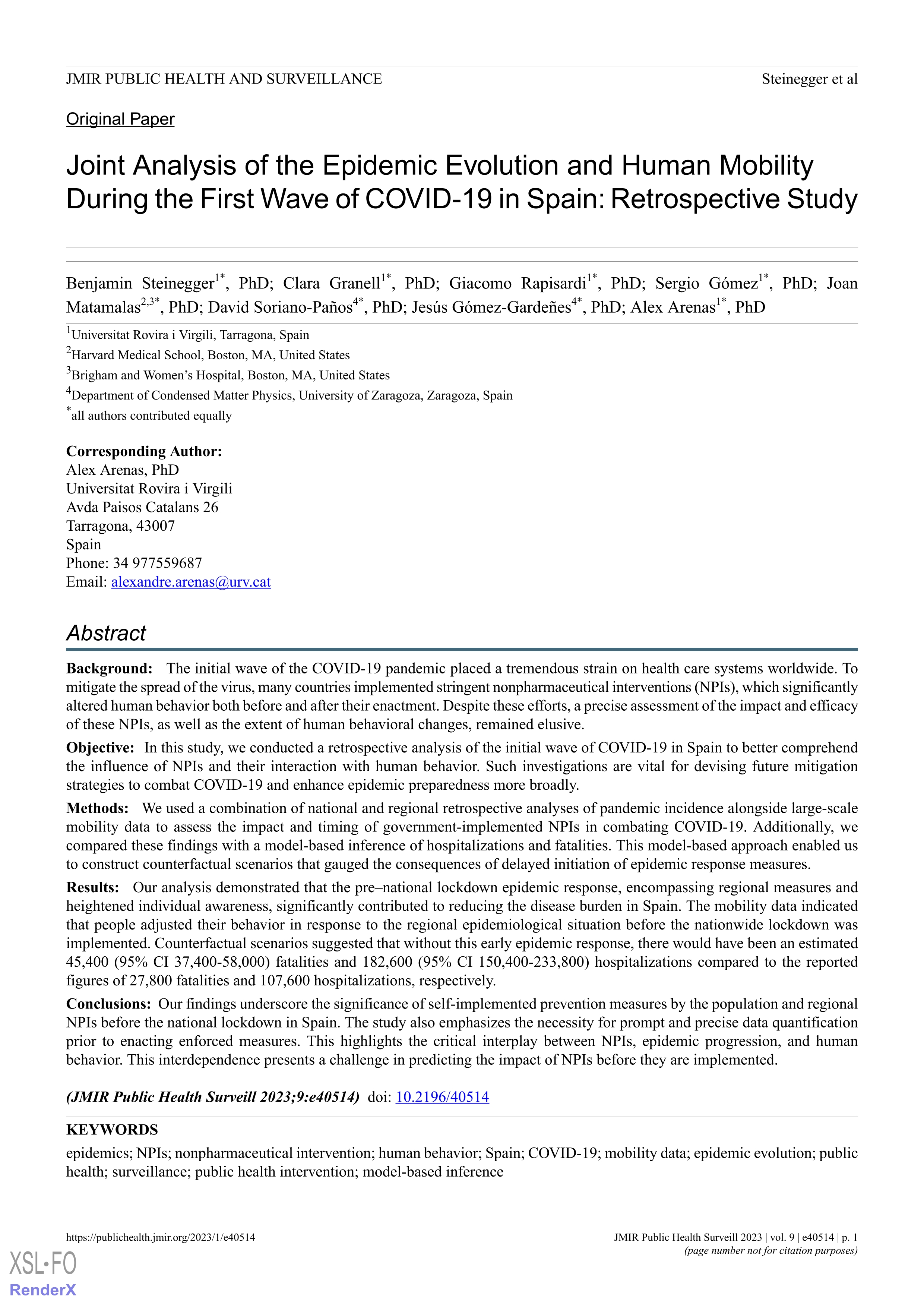
Resumen: Background
The initial wave of the COVID-19 pandemic placed a tremendous strain on health care systems worldwide. To mitigate the spread of the virus, many countries implemented stringent nonpharmaceutical interventions (NPIs), which significantly altered human behavior both before and after their enactment. Despite these efforts, a precise assessment of the impact and efficacy of these NPIs, as well as the extent of human behavioral changes, remained elusive.
Objective
In this study, we conducted a retrospective analysis of the initial wave of COVID-19 in Spain to better comprehend the influence of NPIs and their interaction with human behavior. Such investigations are vital for devising future mitigation strategies to combat COVID-19 and enhance epidemic preparedness more broadly.
Methods
We used a combination of national and regional retrospective analyses of pandemic incidence alongside large-scale mobility data to assess the impact and timing of government-implemented NPIs in combating COVID-19. Additionally, we compared these findings with a model-based inference of hospitalizations and fatalities. This model-based approach enabled us to construct counterfactual scenarios that gauged the consequences of delayed initiation of epidemic response measures.
Results
Our analysis demonstrated that the pre–national lockdown epidemic response, encompassing regional measures and heightened individual awareness, significantly contributed to reducing the disease burden in Spain. The mobility data indicated that people adjusted their behavior in response to the regional epidemiological situation before the nationwide lockdown was implemented. Counterfactual scenarios suggested that without this early epidemic response, there would have been an estimated 45,400 (95% CI 37,400-58,000) fatalities and 182,600 (95% CI 150,400-233,800) hospitalizations compared to the reported figures of 27,800 fatalities and 107,600 hospitalizations, respectively.
Conclusions
Our findings underscore the significance of self-implemented prevention measures by the population and regional NPIs before the national lockdown in Spain. The study also emphasizes the necessity for prompt and precise data quantification prior to enacting enforced measures. This highlights the critical interplay between NPIs, epidemic progression, and human behavior. This interdependence presents a challenge in predicting the impact of NPIs before they are implemented.
Idioma: Inglés
DOI: 10.2196/40514
Año: 2023
Publicado en: JMIR public health and surveillance 9 (2023), e40514 [12 pp.]
ISSN: 2369-2960
Factor impacto JCR: 3.5 (2023)
Categ. JCR: PUBLIC, ENVIRONMENTAL & OCCUPATIONAL HEALTH rank: 85 / 408 = 0.208 (2023) - Q1 - T1
Categ. JCR: PUBLIC, ENVIRONMENTAL & OCCUPATIONAL HEALTH rank: 85 / 408 = 0.208 (2023) - Q1 - T1
Factor impacto CITESCORE: 13.7 - Public Health, Environmental and Occupational Health (Q1) - Health Informatics (Q1)
Factor impacto SCIMAGO: 1.421 - Public Health, Environmental and Occupational Health (Q1) - Health Informatics (Q1)
Financiación: info:eu-repo/grantAgreement/ES/DGA/E19-FENOL Group
Financiación: info:eu-repo/grantAgreement/ES/MINECO/FIS2017-87519-P
Financiación: info:eu-repo/grantAgreement/ES/UZ-IBERCAJA/224220
Tipo y forma: Artículo (Versión definitiva)
Área (Departamento): Área Física Materia Condensada (Dpto. Física Materia Condensa.)
 Debe reconocer adecuadamente la autoría, proporcionar un enlace a la licencia e indicar si se han realizado cambios. Puede hacerlo de cualquier manera razonable, pero no de una manera que sugiera que tiene el apoyo del licenciador o lo recibe por el uso que hace.
Exportado de SIDERAL (2025-06-19-08:41:29)
Visitas y descargas
The initial wave of the COVID-19 pandemic placed a tremendous strain on health care systems worldwide. To mitigate the spread of the virus, many countries implemented stringent nonpharmaceutical interventions (NPIs), which significantly altered human behavior both before and after their enactment. Despite these efforts, a precise assessment of the impact and efficacy of these NPIs, as well as the extent of human behavioral changes, remained elusive.
Objective
In this study, we conducted a retrospective analysis of the initial wave of COVID-19 in Spain to better comprehend the influence of NPIs and their interaction with human behavior. Such investigations are vital for devising future mitigation strategies to combat COVID-19 and enhance epidemic preparedness more broadly.
Methods
We used a combination of national and regional retrospective analyses of pandemic incidence alongside large-scale mobility data to assess the impact and timing of government-implemented NPIs in combating COVID-19. Additionally, we compared these findings with a model-based inference of hospitalizations and fatalities. This model-based approach enabled us to construct counterfactual scenarios that gauged the consequences of delayed initiation of epidemic response measures.
Results
Our analysis demonstrated that the pre–national lockdown epidemic response, encompassing regional measures and heightened individual awareness, significantly contributed to reducing the disease burden in Spain. The mobility data indicated that people adjusted their behavior in response to the regional epidemiological situation before the nationwide lockdown was implemented. Counterfactual scenarios suggested that without this early epidemic response, there would have been an estimated 45,400 (95% CI 37,400-58,000) fatalities and 182,600 (95% CI 150,400-233,800) hospitalizations compared to the reported figures of 27,800 fatalities and 107,600 hospitalizations, respectively.
Conclusions
Our findings underscore the significance of self-implemented prevention measures by the population and regional NPIs before the national lockdown in Spain. The study also emphasizes the necessity for prompt and precise data quantification prior to enacting enforced measures. This highlights the critical interplay between NPIs, epidemic progression, and human behavior. This interdependence presents a challenge in predicting the impact of NPIs before they are implemented.
Idioma: Inglés
DOI: 10.2196/40514
Año: 2023
Publicado en: JMIR public health and surveillance 9 (2023), e40514 [12 pp.]
ISSN: 2369-2960
Factor impacto JCR: 3.5 (2023)
Categ. JCR: PUBLIC, ENVIRONMENTAL & OCCUPATIONAL HEALTH rank: 85 / 408 = 0.208 (2023) - Q1 - T1
Categ. JCR: PUBLIC, ENVIRONMENTAL & OCCUPATIONAL HEALTH rank: 85 / 408 = 0.208 (2023) - Q1 - T1
Factor impacto CITESCORE: 13.7 - Public Health, Environmental and Occupational Health (Q1) - Health Informatics (Q1)
Factor impacto SCIMAGO: 1.421 - Public Health, Environmental and Occupational Health (Q1) - Health Informatics (Q1)
Financiación: info:eu-repo/grantAgreement/ES/DGA/E19-FENOL Group
Financiación: info:eu-repo/grantAgreement/ES/MINECO/FIS2017-87519-P
Financiación: info:eu-repo/grantAgreement/ES/UZ-IBERCAJA/224220
Tipo y forma: Artículo (Versión definitiva)
Área (Departamento): Área Física Materia Condensada (Dpto. Física Materia Condensa.)
Debe reconocer adecuadamente la autoría, proporcionar un enlace a la licencia e indicar si se han realizado cambios. Puede hacerlo de cualquier manera razonable, pero no de una manera que sugiera que tiene el apoyo del licenciador o lo recibe por el uso que hace. Exportado de SIDERAL (2025-06-19-08:41:29)
Enlace permanente:
Visitas y descargas
Este artículo se encuentra en las siguientes colecciones:
Artículos > Artículos por área > Física de la Materia Condensada
Registro creado el 2023-08-30, última modificación el 2025-06-19