The Toronto mindfulness scale and the state mindfulness scale: psychometric properties of the spanish versions
Navarrete, Jaime ; Fontana-McNally, Marta ; Colomer-Carbonell, Ariadna ; Sanabria-Mazo, Juan P. ; Pinazo, Daniel ; Silvestre-López, Antonio-José ; Lau, Mark ; Tanay, Galia ; García-Campayo, Javier (Universidad de Zaragoza) ; Demarzo, Marcelo ; Soler, Joaquim ; Cebolla, Ausiàs ; Feliu-Soler, Albert ; Luciano, Juan V.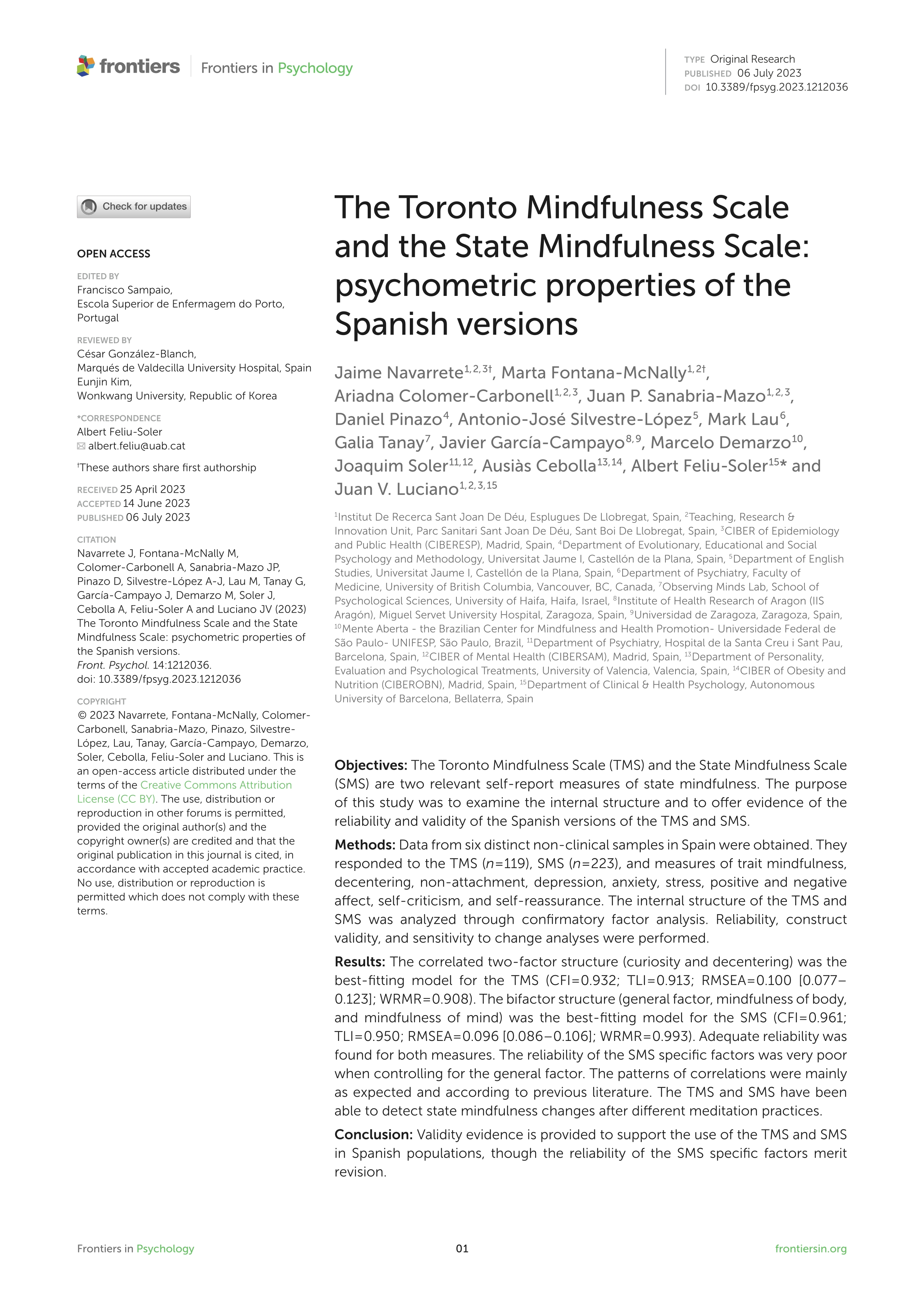
Resumen: Objectives The Toronto Mindfulness Scale (TMS) and the State Mindfulness Scale (SMS) are two relevant self-report measures of state mindfulness. The purpose of this study was to examine the internal structure and to offer evidence of the reliability and validity of the Spanish versions of the TMS and SMS.MethodsData from six distinct non-clinical samples in Spain were obtained. They responded to the TMS (n = 119), SMS (n = 223), and measures of trait mindfulness, decentering, non-attachment, depression, anxiety, stress, positive and negative affect, self-criticism, and self-reassurance. The internal structure of the TMS and SMS was analyzed through confirmatory factor analysis. Reliability, construct validity, and sensitivity to change analyses were performed.ResultsThe correlated two-factor structure (curiosity and decentering) was the best-fitting model for the TMS (CFI = 0.932; TLI = 0.913; RMSEA = 0.100 [0.077–0.123]; WRMR = 0.908). The bifactor structure (general factor, mindfulness of body, and mindfulness of mind) was the best-fitting model for the SMS (CFI = 0.961; TLI = 0.950; RMSEA = 0.096 [0.086–0.106]; WRMR = 0.993). Adequate reliability was found for both measures. The reliability of the SMS specific factors was very poor when controlling for the general factor. The patterns of correlations were mainly as expected and according to previous literature. The TMS and SMS have been able to detect state mindfulness changes after different meditation practices.ConclusionValidity evidence is provided to support the use of the TMS and SMS in Spanish populations, though the reliability of the SMS specific factors merit revision.
Idioma: Inglés
DOI: 10.3389/fpsyg.2023.1212036
Año: 2023
Publicado en: Frontiers in Psychology 14 (2023), [14 pp.]
ISSN: 1664-1078
Factor impacto JCR: 2.6 (2023)
Categ. JCR: PSYCHOLOGY, MULTIDISCIPLINARY rank: 56 / 219 = 0.256 (2023) - Q2 - T1
Factor impacto CITESCORE: 5.3 - Psychology (all) (Q1)
Factor impacto SCIMAGO: 0.8 - Psychology (miscellaneous) (Q2)
Financiación: info:eu-repo/grantAgreement/ES/ISCIII/CIBERESP/CB22-02-00052
Financiación: info:eu-repo/grantAgreement/ES/ISCIII/CIBERObn
Financiación: info:eu-repo/grantAgreement/ES/MINECO-ISCIII/CIBERSAM
Tipo y forma: Article (Published version)
Área (Departamento): Area Psiquiatría (Dpto. Medicina, Psiqu. y Derm.)
 You must give appropriate credit, provide a link to the license, and indicate if changes were made. You may do so in any reasonable manner, but not in any way that suggests the licensor endorses you or your use.
Exportado de SIDERAL (2024-11-22-12:05:50)
Visitas y descargas
Idioma: Inglés
DOI: 10.3389/fpsyg.2023.1212036
Año: 2023
Publicado en: Frontiers in Psychology 14 (2023), [14 pp.]
ISSN: 1664-1078
Factor impacto JCR: 2.6 (2023)
Categ. JCR: PSYCHOLOGY, MULTIDISCIPLINARY rank: 56 / 219 = 0.256 (2023) - Q2 - T1
Factor impacto CITESCORE: 5.3 - Psychology (all) (Q1)
Factor impacto SCIMAGO: 0.8 - Psychology (miscellaneous) (Q2)
Financiación: info:eu-repo/grantAgreement/ES/ISCIII/CIBERESP/CB22-02-00052
Financiación: info:eu-repo/grantAgreement/ES/ISCIII/CIBERObn
Financiación: info:eu-repo/grantAgreement/ES/MINECO-ISCIII/CIBERSAM
Tipo y forma: Article (Published version)
Área (Departamento): Area Psiquiatría (Dpto. Medicina, Psiqu. y Derm.)
You must give appropriate credit, provide a link to the license, and indicate if changes were made. You may do so in any reasonable manner, but not in any way that suggests the licensor endorses you or your use. Exportado de SIDERAL (2024-11-22-12:05:50)
Permalink:
Visitas y descargas
Este artículo se encuentra en las siguientes colecciones:
Articles > Artículos por área > Psiquiatría
Record created 2023-08-30, last modified 2024-11-25