Depolarization-repolarization synchrony after right ventricular and left bundle branch area pacing
Sales Belles, C (Universidad de Zaragoza) ; Melero Polo, J ; Cabrera Ramos, M ; Minchole Lapuente, A (Universidad de Zaragoza) ; Pueyo Paules, E (Universidad de Zaragoza) ; Ramos Maqueda, J (Universidad de Zaragoza)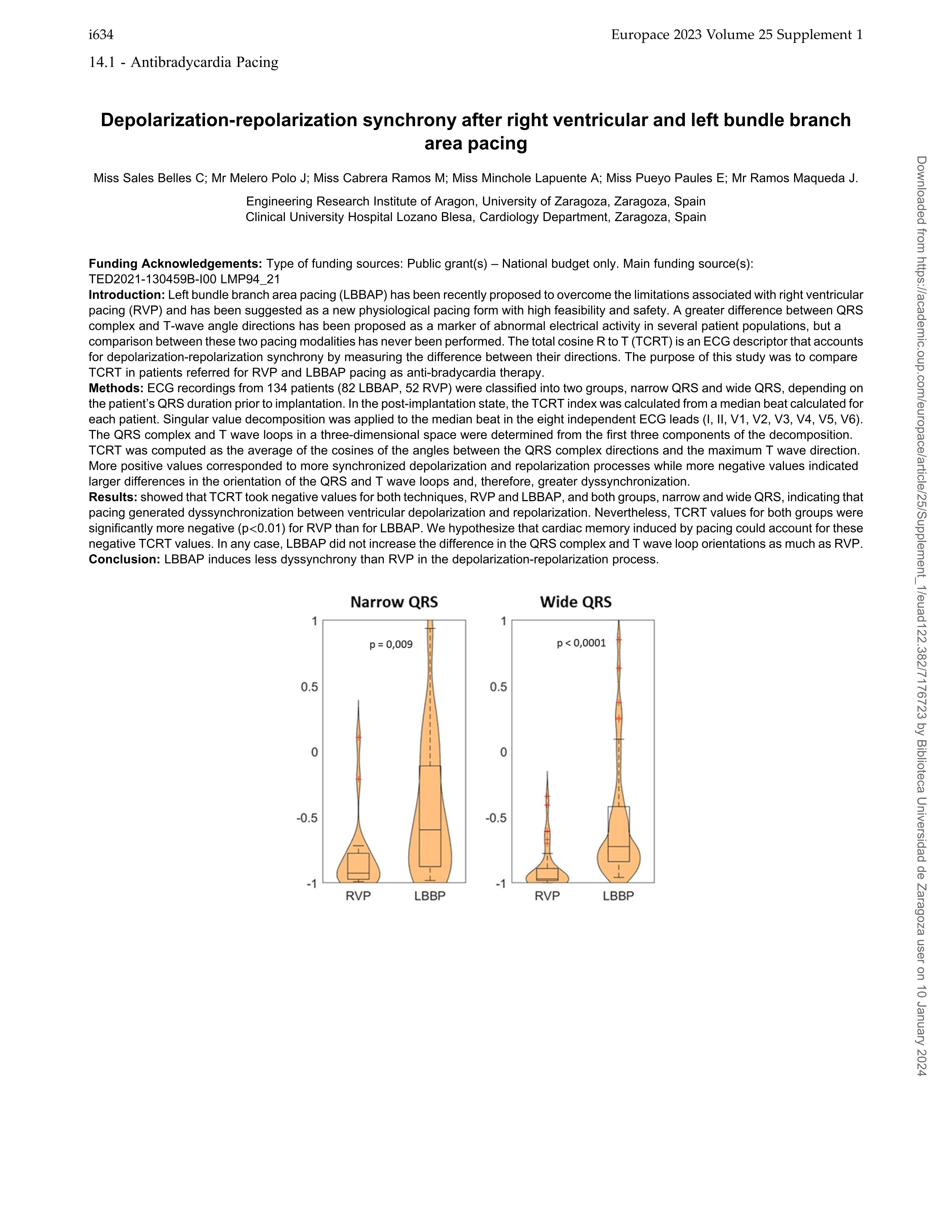
Resumen: Introduction: Left bundle branch area pacing (LBBAP) has been recently proposed to overcome the limitations associated with right ventricular pacing (RVP) and has been suggested as a new physiological pacing form with high feasibility and safety. A greater difference between QRS complex and T-wave angle directions has been proposed as a marker of abnormal electrical activity in several patient populations, but a comparison between these two pacing modalities has never been performed. The total cosine R to T (TCRT) is an ECG descriptor that accounts for depolarization-repolarization synchrony by measuring the difference between their directions. The purpose of this study was to compare TCRT in patients referred for RVP and LBBAP pacing as anti-bradycardia therapy.
Methods: ECG recordings from 134 patients (82 LBBAP, 52 RVP) were classified into two groups, narrow QRS and wide QRS, depending on the patient’s QRS duration prior to implantation. In the post-implantation state, the TCRT index was calculated from a median beat calculated for each patient. Singular value decomposition was applied to the median beat in the eight independent ECG leads (I, II, V1, V2, V3, V4, V5, V6). The QRS complex and T wave loops in a three-dimensional space were determined from the first three components of the decomposition. TCRT was computed as the average of the cosines of the angles between the QRS complex directions and the maximum T wave direction. More positive values corresponded to more synchronized depolarization and repolarization processes while more negative values indicated larger differences in the orientation of the QRS and T wave loops and, therefore, greater dyssynchronization.
Results: showed that TCRT took negative values for both techniques, RVP and LBBAP, and both groups, narrow and wide QRS, indicating that pacing generated dyssynchronization between ventricular depolarization and repolarization. Nevertheless, TCRT values for both groups were significantly more negative (p<0.01) for RVP than for LBBAP. We hypothesize that cardiac memory induced by pacing could account for these negative TCRT values. In any case, LBBAP did not increase the difference in the QRS complex and T wave loop orientations as much as RVP.
Conclusion: LBBAP induces less dyssynchrony than RVP in the depolarization-repolarization process.
Idioma: Inglés
DOI: 10.1093/europace/euad122.382
Año: 2023
Publicado en: Europace 25, Suppl. 1 (2023), i634-i635
ISSN: 1099-5129
Factor impacto JCR: 7.9 (2023)
Categ. JCR: CARDIAC & CARDIOVASCULAR SYSTEMS rank: 19 / 222 = 0.086 (2023) - Q1 - T1
Factor impacto CITESCORE: 10.3 - Cardiology and Cardiovascular Medicine (Q1) - Physiology (medical) (Q1)
Factor impacto SCIMAGO: 2.895 - Physiology (medical) (Q1) - Cardiology and Cardiovascular Medicine (Q1)
Financiación: info:eu-repo/grantAgreement/ES/DGA/LMP94_21
Financiación: info:eu-repo/grantAgreement/EUR/MICINN/TED2021-130459B-I00
Tipo y forma: Congress (Published version)
Área (Departamento): Area Medicina (Dpto. Medicina, Psiqu. y Derm.)
Área (Departamento): Área Teoría Señal y Comunicac. (Dpto. Ingeniería Electrón.Com.)
 You must give appropriate credit, provide a link to the license, and indicate if changes were made. You may do so in any reasonable manner, but not in any way that suggests the licensor endorses you or your use. You may not use the material for commercial purposes. If you remix, transform, or build upon the material, you may not distribute the modified material.
Exportado de SIDERAL (2024-11-22-12:05:13)
Visitas y descargas
Methods: ECG recordings from 134 patients (82 LBBAP, 52 RVP) were classified into two groups, narrow QRS and wide QRS, depending on the patient’s QRS duration prior to implantation. In the post-implantation state, the TCRT index was calculated from a median beat calculated for each patient. Singular value decomposition was applied to the median beat in the eight independent ECG leads (I, II, V1, V2, V3, V4, V5, V6). The QRS complex and T wave loops in a three-dimensional space were determined from the first three components of the decomposition. TCRT was computed as the average of the cosines of the angles between the QRS complex directions and the maximum T wave direction. More positive values corresponded to more synchronized depolarization and repolarization processes while more negative values indicated larger differences in the orientation of the QRS and T wave loops and, therefore, greater dyssynchronization.
Results: showed that TCRT took negative values for both techniques, RVP and LBBAP, and both groups, narrow and wide QRS, indicating that pacing generated dyssynchronization between ventricular depolarization and repolarization. Nevertheless, TCRT values for both groups were significantly more negative (p<0.01) for RVP than for LBBAP. We hypothesize that cardiac memory induced by pacing could account for these negative TCRT values. In any case, LBBAP did not increase the difference in the QRS complex and T wave loop orientations as much as RVP.
Conclusion: LBBAP induces less dyssynchrony than RVP in the depolarization-repolarization process.
Idioma: Inglés
DOI: 10.1093/europace/euad122.382
Año: 2023
Publicado en: Europace 25, Suppl. 1 (2023), i634-i635
ISSN: 1099-5129
Factor impacto JCR: 7.9 (2023)
Categ. JCR: CARDIAC & CARDIOVASCULAR SYSTEMS rank: 19 / 222 = 0.086 (2023) - Q1 - T1
Factor impacto CITESCORE: 10.3 - Cardiology and Cardiovascular Medicine (Q1) - Physiology (medical) (Q1)
Factor impacto SCIMAGO: 2.895 - Physiology (medical) (Q1) - Cardiology and Cardiovascular Medicine (Q1)
Financiación: info:eu-repo/grantAgreement/ES/DGA/LMP94_21
Financiación: info:eu-repo/grantAgreement/EUR/MICINN/TED2021-130459B-I00
Tipo y forma: Congress (Published version)
Área (Departamento): Area Medicina (Dpto. Medicina, Psiqu. y Derm.)
Área (Departamento): Área Teoría Señal y Comunicac. (Dpto. Ingeniería Electrón.Com.)
You must give appropriate credit, provide a link to the license, and indicate if changes were made. You may do so in any reasonable manner, but not in any way that suggests the licensor endorses you or your use. You may not use the material for commercial purposes. If you remix, transform, or build upon the material, you may not distribute the modified material. Exportado de SIDERAL (2024-11-22-12:05:13)
Permalink:
Visitas y descargas
Este artículo se encuentra en las siguientes colecciones:
Articles > Artículos por área > Teoría de la Señal y Comunicaciones
Articles > Artículos por área > Medicina
Record created 2024-01-11, last modified 2024-11-25