Temporality and temporal dislocation in Spanish and Modern Greek past tenses of the Indicative
Leontaridi, Eleni ; Gómez Laguna, Isaac (Universidad de Zaragoza)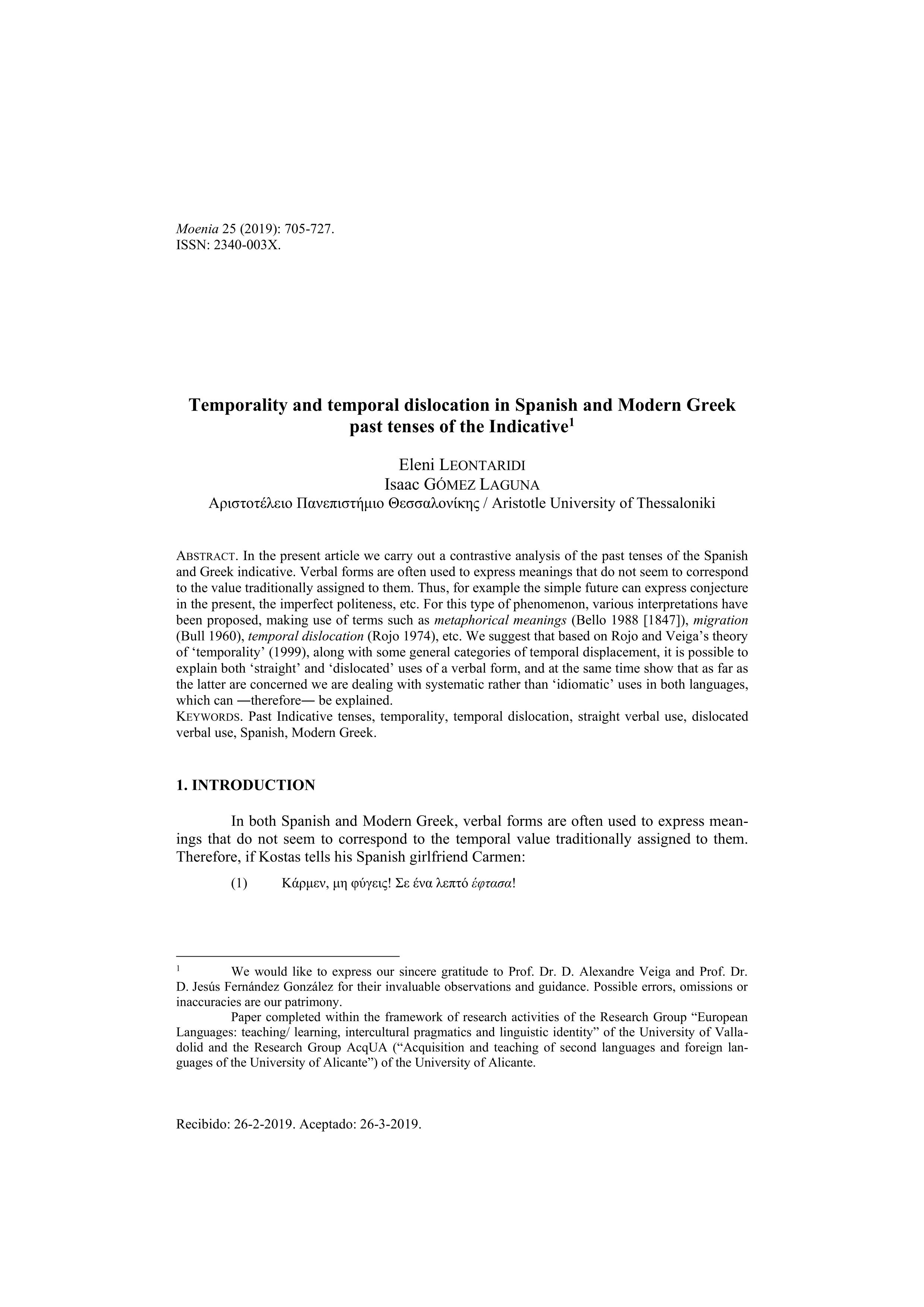
Resumen: In the present article we carry out a contrastive analysis of the past tenses of the Spanish and Greek indicative. Verbal forms are often used to express meanings that do not seem to correspond to the value traditionally assigned to them. Thus, for example the simple future can express conjecture in the present, the imperfect politeness, etc. For this type of phenomenon, various interpretations have been proposed, making use of terms such as metaphorical meanings (Bello 1988 [1847]), migration (Bull 1960), temporal dislocation (Rojo 1974), etc. We suggest that based on Rojo and Veiga’s theory of ‘temporality’ (1999), along with some general categories of temporal displacement, it is possible to explain both ‘straight’ and ‘dislocated’ uses of a verbal form, and at the same time show that as far as the latter are concerned we are dealing with systematic rather than ‘idiomatic’ uses in both languages, which can ―therefore― be explained.
Idioma: Inglés
Año: 2019
Publicado en: Moenia 25 (2019), 705-727
ISSN: 2340-003X
Tipo y forma: Article (PostPrint)
Área (Departamento): Área Lingüística General (Dpto. Lingüíst. Gral. e Hisp.)
 All rights reserved by journal editor
Exportado de SIDERAL (2024-02-09-14:45:15)
Visitas y descargas
Idioma: Inglés
Año: 2019
Publicado en: Moenia 25 (2019), 705-727
ISSN: 2340-003X
Tipo y forma: Article (PostPrint)
Área (Departamento): Área Lingüística General (Dpto. Lingüíst. Gral. e Hisp.)
All rights reserved by journal editorExportado de SIDERAL (2024-02-09-14:45:15)
Permalink:
Visitas y descargas
Este artículo se encuentra en las siguientes colecciones:
Articles > Artículos por área > Lingüística General
Record created 2024-01-31, last modified 2024-02-09