Effects of delayed recovery and nonuniform transmission on the spreading of diseases in complex networks
Xia, Cheng-yi ; Wang, Zhen ; Sanz, Joaquín (Universidad de Zaragoza) ; Meloni, Sandro ; Moreno, Yamir (Universidad de Zaragoza)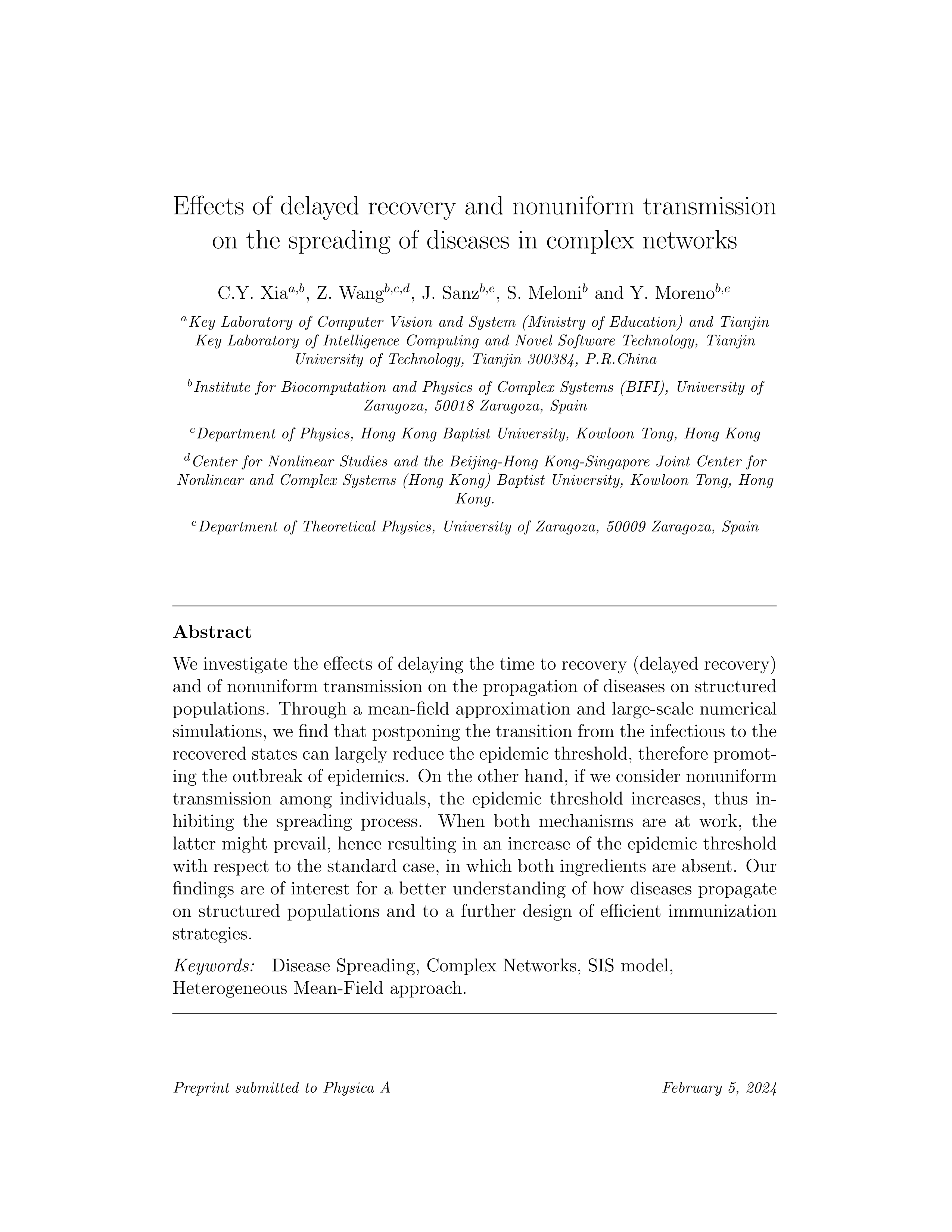
Resumen: We investigate the effects of delaying the time to recovery (delayed recovery) and of nonuniform transmission on the propagation of diseases on structured populations. Through a mean-field approximation and large-scale numerical simulations, we find that
postponing the transition from the infectious to the recovered states can largely reduce the epidemic threshold, therefore promoting the outbreak of epidemics. On the other hand, if we consider nonuniform transmission among individuals, the epidemic threshold increases, thus inhibiting the spreading process. When both mechanisms are at work, the latter might prevail, hence resulting in an increase of the epidemic threshold with respect to the standard case, in which both ingredients are absent. Our findings are of interest for a better understanding of how diseases propagate on structured populations and to a further design of efficient immunization strategies.
Idioma: Inglés
DOI: 10.1016/j.physa.2012.11.043
Año: 2012
Publicado en: Physica A: Statistical Mechanics and its Applications 392 (2012), 1577-1585
ISSN: 0378-4371
Factor impacto JCR: 1.676 (2012)
Categ. JCR: PHYSICS, MULTIDISCIPLINARY rank: 28 / 83 = 0.337 (2012) - Q2 - T2
Tipo y forma: Article (PostPrint)
Área (Departamento): Área Física Teórica (Dpto. Física Teórica)
Exportado de SIDERAL (2024-02-05-15:05:50)
Visitas y descargas
postponing the transition from the infectious to the recovered states can largely reduce the epidemic threshold, therefore promoting the outbreak of epidemics. On the other hand, if we consider nonuniform transmission among individuals, the epidemic threshold increases, thus inhibiting the spreading process. When both mechanisms are at work, the latter might prevail, hence resulting in an increase of the epidemic threshold with respect to the standard case, in which both ingredients are absent. Our findings are of interest for a better understanding of how diseases propagate on structured populations and to a further design of efficient immunization strategies.
Idioma: Inglés
DOI: 10.1016/j.physa.2012.11.043
Año: 2012
Publicado en: Physica A: Statistical Mechanics and its Applications 392 (2012), 1577-1585
ISSN: 0378-4371
Factor impacto JCR: 1.676 (2012)
Categ. JCR: PHYSICS, MULTIDISCIPLINARY rank: 28 / 83 = 0.337 (2012) - Q2 - T2
Tipo y forma: Article (PostPrint)
Área (Departamento): Área Física Teórica (Dpto. Física Teórica)
Exportado de SIDERAL (2024-02-05-15:05:50)
Permalink:
Visitas y descargas
Este artículo se encuentra en las siguientes colecciones:
articulos > articulos-por-area > fisica_teorica
Notice créée le 2024-02-05, modifiée le 2024-02-05