Epigrafía pública y defixiones. Paradigmas (y paradojas) del Occidente Latino
Sánchez Natalías, Celia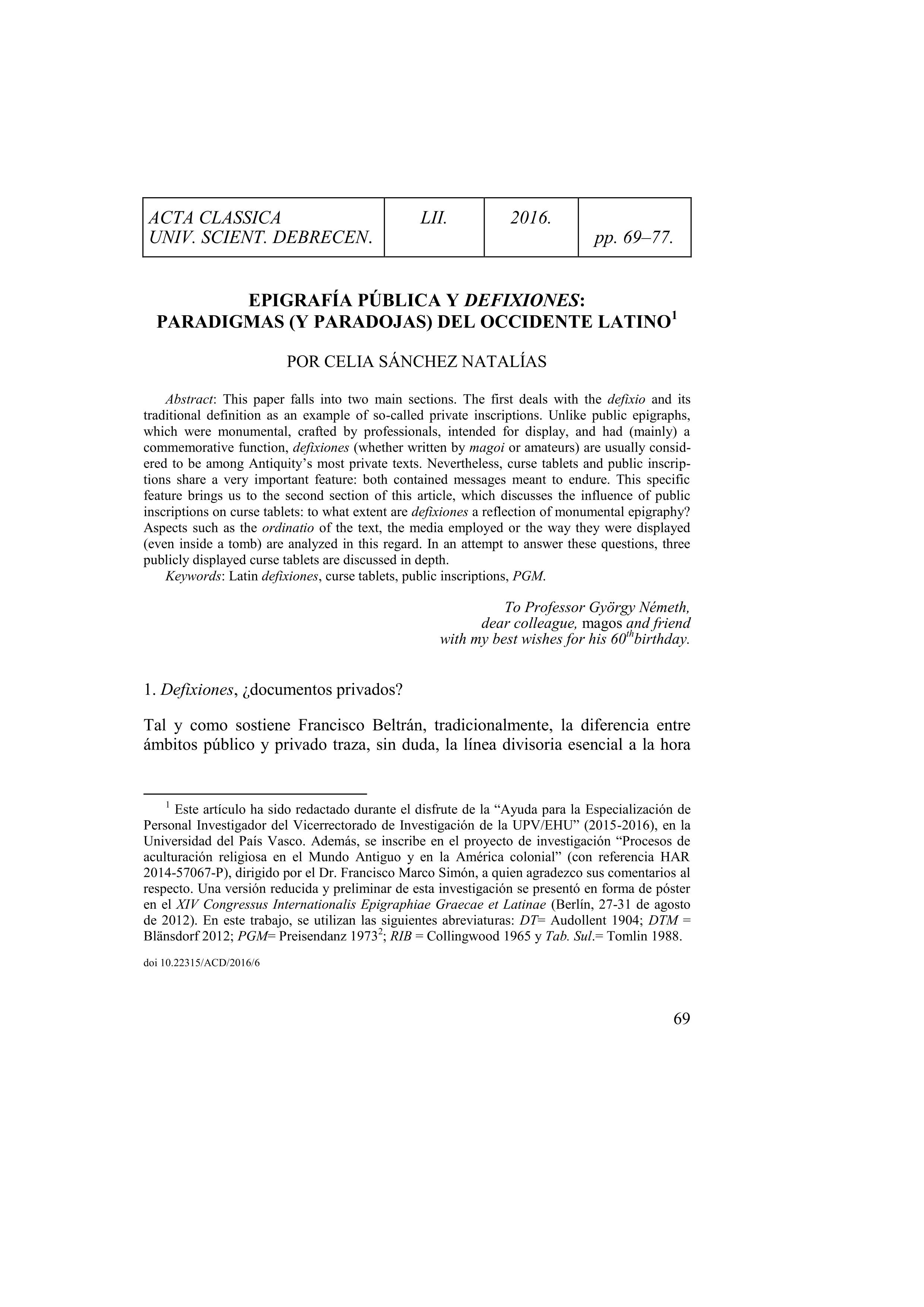
Resumen: This paper falls into two main sections. The first deals with the defixio and its traditional definition as an example of so-called private inscriptions. Unlike public epigraphs, which were monumental, crafted by professionals, intended for display, and had (mainly) a commemorative function, defixiones (whether written by magoi or amateurs) are usually considered to be among Antiquity’s most private texts. Nevertheless, curse tablets and public inscriptions share a very important feature: both contained messages meant to endure. This specific feature brings us to the second section of this article, which discusses the influence of public inscriptions on curse tablets: to what extent are defixiones a reflection of monumental epigraphy? Aspects such as the ordinatio of the text, the media employed or the way they were displayed (even inside a tomb) are analyzed in this regard. In an attempt to answer these questions, three publicly displayed curse tablets are discussed in depth.
Idioma: Español
DOI: 10.22315/ACD/2016/6
Año: 2016
Publicado en: Acta Classica Universitatis Scientiarum Debreceniensis 52, 1 (2016), 69-78
ISSN: 0418-453X
Tipo y forma: Article (Published version)
 You must give appropriate credit, provide a link to the license, and indicate if changes were made. You may do so in any reasonable manner, but not in any way that suggests the licensor endorses you or your use. You may not use the material for commercial purposes.
Exportado de SIDERAL (2026-02-20-14:58:08)
Visitas y descargas
Idioma: Español
DOI: 10.22315/ACD/2016/6
Año: 2016
Publicado en: Acta Classica Universitatis Scientiarum Debreceniensis 52, 1 (2016), 69-78
ISSN: 0418-453X
Tipo y forma: Article (Published version)
You must give appropriate credit, provide a link to the license, and indicate if changes were made. You may do so in any reasonable manner, but not in any way that suggests the licensor endorses you or your use. You may not use the material for commercial purposes. Exportado de SIDERAL (2026-02-20-14:58:08)
Permalink:
Visitas y descargas
Este artículo se encuentra en las siguientes colecciones:
Articles
Record created 2024-02-12, last modified 2026-02-20