Responsiveness and minimal clinically important difference of the infants and toddlers dermatology quality of life questionnaire
Chernyshov, Pavel V. ; Marron, Servando E. (Universidad de Zaragoza) ; Koumaki, Dimitra ; Pustišek, Nives ; Manolache, Liana ; Salavastru, Carmen ; Suru, Alina ; Sendrea, Adelina ; Svyatenko, Tetiana ; Statkevych, Olha ; Boffa, Michael J. ; Grech, Sara Borg ; Zemskov, Sergii ; Kuts, Volodymyr V. ; Lishchynskyi, Pavlo ; Chernyshov, Andrii V. ; Tomás-Aragonés, Lucía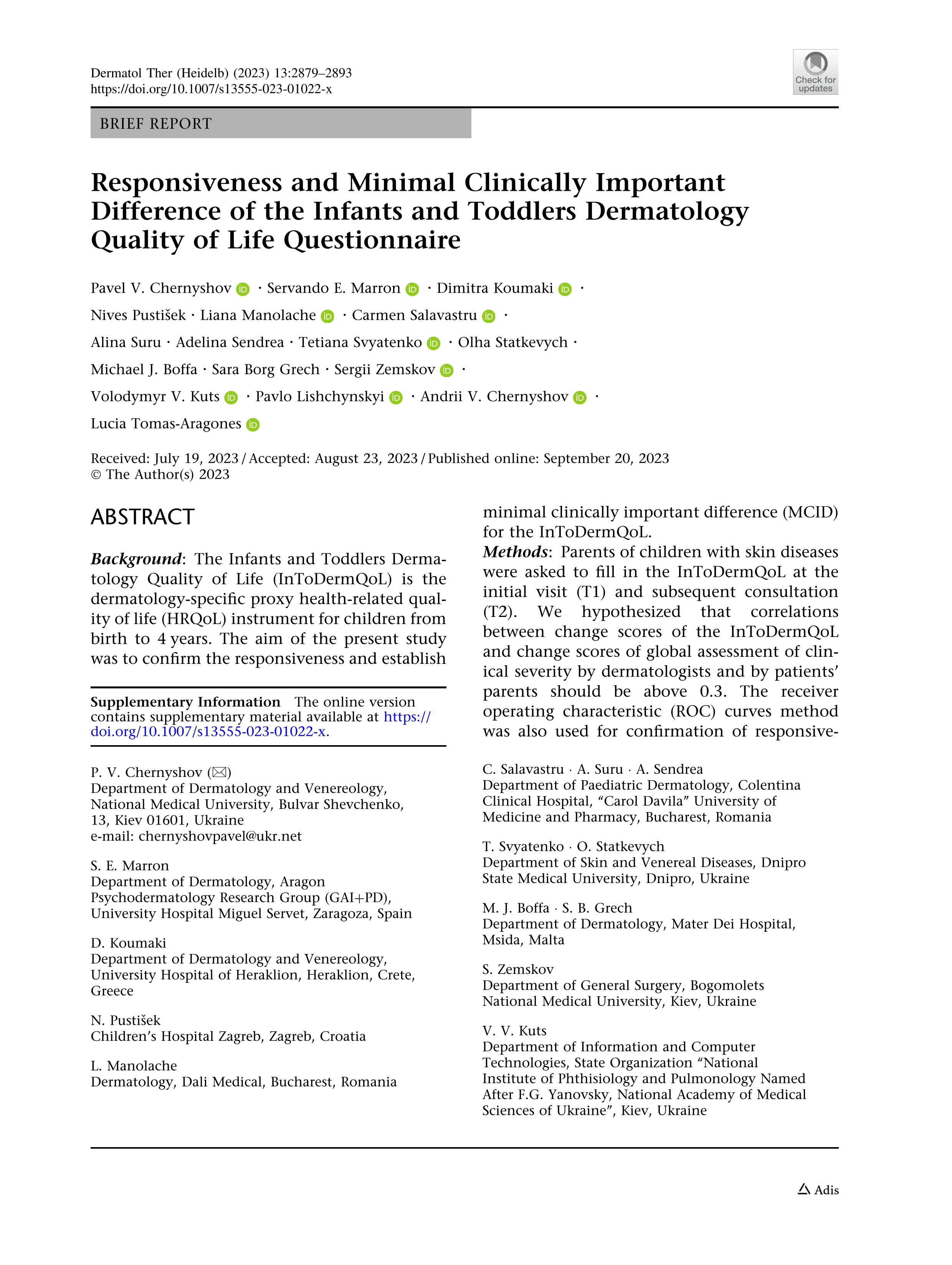
Resumen: Background: The Infants and Toddlers Dermatology Quality of Life (InToDermQoL) is the dermatology-specific proxy health-related quality of life (HRQoL) instrument for children from birth to 4 years. The aim of the present study was to confirm the responsiveness and establish minimal clinically important difference (MCID) for the InToDermQoL. Methods: Parents of children with skin diseases were asked to fill in the InToDermQoL at the initial visit (T1) and subsequent consultation (T2). We hypothesized that correlations between change scores of the InToDermQoL and change scores of global assessment of clinical severity by dermatologists and by patients’ parents should be above 0.3. The receiver operating characteristic (ROC) curves method was also used for confirmation of responsiveness and determination of MCIDs of the InToDermQoL. The area under the ROC curve (AUC) was used as an indicator of responsiveness. Results: Results of 442 patients were included. Correlations between change scores of age-specific versions of the InToDermQoL and change scores of global assessment of clinical severity by dermatologists and by patients’ parents were above 0.3 (0.46-0.74). AUCs for age-specific versions of the InToDermQoL were acceptable (above 0.7) or excellent (above 0.8). Estimated MCIDs for the InToDermQoL were as follows: 3 points of total score change for 0–11 months, 5 for 1–2 years and 3 or 4 for 3–4 years version. Estimated MCIDs for the InToDermQoL version for 1–2-year-old children was higher than MCIDs for the 3–4-year-old version despite the higher number of items in the latter. Therefore a MCID of 5 was recommended for both these versions. Conclusions: Responsiveness for all age-specific versions of the InToDermQoL questionnaire was confirmed. MCIDs for the InToDermQoL are proposed as follows: 3-point change of the total score for age version 0–11 months and 5-point for the age versions 1–2 years and 3–4 years.
Idioma: Inglés
DOI: 10.1007/s13555-023-01022-x
Año: 2023
Publicado en: Dermatology and therapy 13 (2023), 2879-2893
ISSN: 2193-8210
Factor impacto JCR: 3.5 (2023)
Categ. JCR: DERMATOLOGY rank: 20 / 94 = 0.213 (2023) - Q1 - T1
Factor impacto CITESCORE: 6.0 - Dermatology (Q1)
Factor impacto SCIMAGO: 1.424 - Dermatology (Q1)
Tipo y forma: Article (Published version)
Área (Departamento): Área Dermatología (Dpto. Medicina, Psiqu. y Derm.)
 You must give appropriate credit, provide a link to the license, and indicate if changes were made. You may do so in any reasonable manner, but not in any way that suggests the licensor endorses you or your use. You may not use the material for commercial purposes.
Exportado de SIDERAL (2024-11-22-11:57:10)
Visitas y descargas
Idioma: Inglés
DOI: 10.1007/s13555-023-01022-x
Año: 2023
Publicado en: Dermatology and therapy 13 (2023), 2879-2893
ISSN: 2193-8210
Factor impacto JCR: 3.5 (2023)
Categ. JCR: DERMATOLOGY rank: 20 / 94 = 0.213 (2023) - Q1 - T1
Factor impacto CITESCORE: 6.0 - Dermatology (Q1)
Factor impacto SCIMAGO: 1.424 - Dermatology (Q1)
Tipo y forma: Article (Published version)
Área (Departamento): Área Dermatología (Dpto. Medicina, Psiqu. y Derm.)
You must give appropriate credit, provide a link to the license, and indicate if changes were made. You may do so in any reasonable manner, but not in any way that suggests the licensor endorses you or your use. You may not use the material for commercial purposes. Exportado de SIDERAL (2024-11-22-11:57:10)
Permalink:
Visitas y descargas
Este artículo se encuentra en las siguientes colecciones:
Articles > Artículos por área > Dermatología
Record created 2024-02-12, last modified 2024-11-25