An Implicit Neural Representation for the Image Stack: Depth, All in Focus, and High Dynamic Range
Wang, Chao ; Serrano, Ana (Universidad de Zaragoza) ; Pan, Xingang ; Wolski, Krzysztof ; Chen, Bin ; Myszkowski, Karol ; Seidel, Hans-Peter ; Theobalt, Christian ; Leimkühler, Thomas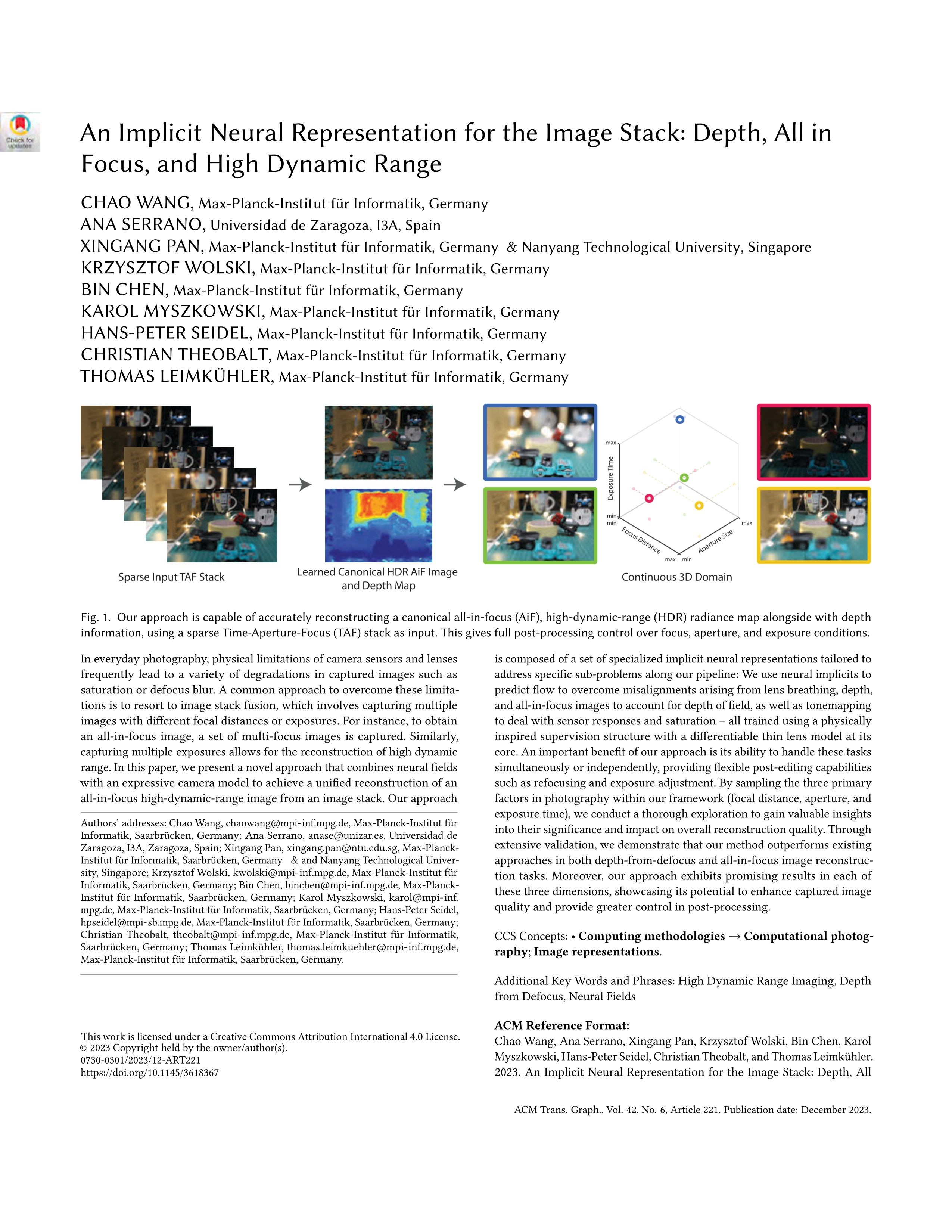
Resumen: In everyday photography, physical limitations of camera sensors and lenses frequently lead to a variety of degradations in captured images such as saturation or defocus blur. A common approach to overcome these limitations is to resort to image stack fusion, which involves capturing multiple images with different focal distances or exposures. For instance, to obtain an all-in-focus image, a set of multi-focus images is captured. Similarly, capturing multiple exposures allows for the reconstruction of high dynamic range. In this paper, we present a novel approach that combines neural fields with an expressive camera model to achieve a unified reconstruction of an all-in-focus high-dynamic-range image from an image stack. Our approach is composed of a set of specialized implicit neural representations tailored to address specific sub-problems along our pipeline: We use neural implicits to predict flow to overcome misalignments arising from lens breathing, depth, and all-in-focus images to account for depth of field, as well as tonemapping to deal with sensor responses and saturation - all trained using a physically inspired supervision structure with a differentiable thin lens model at its core. An important benefit of our approach is its ability to handle these tasks simultaneously or independently, providing flexible post-editing capabilities such as refocusing and exposure adjustment. By sampling the three primary factors in photography within our framework (focal distance, aperture, and exposure time), we conduct a thorough exploration to gain valuable insights into their significance and impact on overall reconstruction quality. Through extensive validation, we demonstrate that our method outperforms existing approaches in both depth-from-defocus and all-in-focus image reconstruction tasks. Moreover, our approach exhibits promising results in each of these three dimensions, showcasing its potential to enhance captured image quality and provide greater control in post-processing.
Idioma: Inglés
DOI: 10.1145/3618367
Año: 2023
Publicado en: ACM TRANSACTIONS ON GRAPHICS 42, 6 (2023), 1-11
ISSN: 0730-0301
Factor impacto JCR: 7.8 (2023)
Categ. JCR: COMPUTER SCIENCE, SOFTWARE ENGINEERING rank: 5 / 132 = 0.038 (2023) - Q1 - T1
Factor impacto CITESCORE: 14.3 - Computer Graphics and Computer-Aided Design (Q1)
Factor impacto SCIMAGO: 7.766 - Computer Graphics and Computer-Aided Design (Q1)
Financiación: info:eu-repo/grantAgreement/ES/AEI/PID2022-141539NB-I00
Tipo y forma: Article (Published version)
Área (Departamento): Área Lenguajes y Sistemas Inf. (Dpto. Informát.Ingenie.Sistms.)
Exportado de SIDERAL (2024-11-22-12:02:37)
Visitas y descargas
Idioma: Inglés
DOI: 10.1145/3618367
Año: 2023
Publicado en: ACM TRANSACTIONS ON GRAPHICS 42, 6 (2023), 1-11
ISSN: 0730-0301
Factor impacto JCR: 7.8 (2023)
Categ. JCR: COMPUTER SCIENCE, SOFTWARE ENGINEERING rank: 5 / 132 = 0.038 (2023) - Q1 - T1
Factor impacto CITESCORE: 14.3 - Computer Graphics and Computer-Aided Design (Q1)
Factor impacto SCIMAGO: 7.766 - Computer Graphics and Computer-Aided Design (Q1)
Financiación: info:eu-repo/grantAgreement/ES/AEI/PID2022-141539NB-I00
Tipo y forma: Article (Published version)
Área (Departamento): Área Lenguajes y Sistemas Inf. (Dpto. Informát.Ingenie.Sistms.)
Exportado de SIDERAL (2024-11-22-12:02:37)
Permalink:
Visitas y descargas
Este artículo se encuentra en las siguientes colecciones:
articulos > articulos-por-area > lenguajes_y_sistemas_informaticos
Notice créée le 2024-02-19, modifiée le 2024-11-25