Clustering of lifestyle behaviors and adiposity in early adolescents in Spain: findings from the SI! Program for Secondary Schools
Bodega, Patricia ; Santos-Beneit, Gloria ; Cos-Gandoy, Amaya de ; Moreno, Luis A. (Universidad de Zaragoza) ; Miguel, Mercedes de ; Orrit, Xavier ; Tresserra-Rimbau, Anna ; Martínez-Gómez, Jesús ; Ramírez-Garza, Sonia L. ; Laveriano-Santos, Emily P. ; Arancibia-Riveros, Camila ; Estruch, Ramón ; Lamuela-Raventós, Rosa M. ; Fernández-Jiménez, Rodrigo ; Fernández-Alvira, Juan M..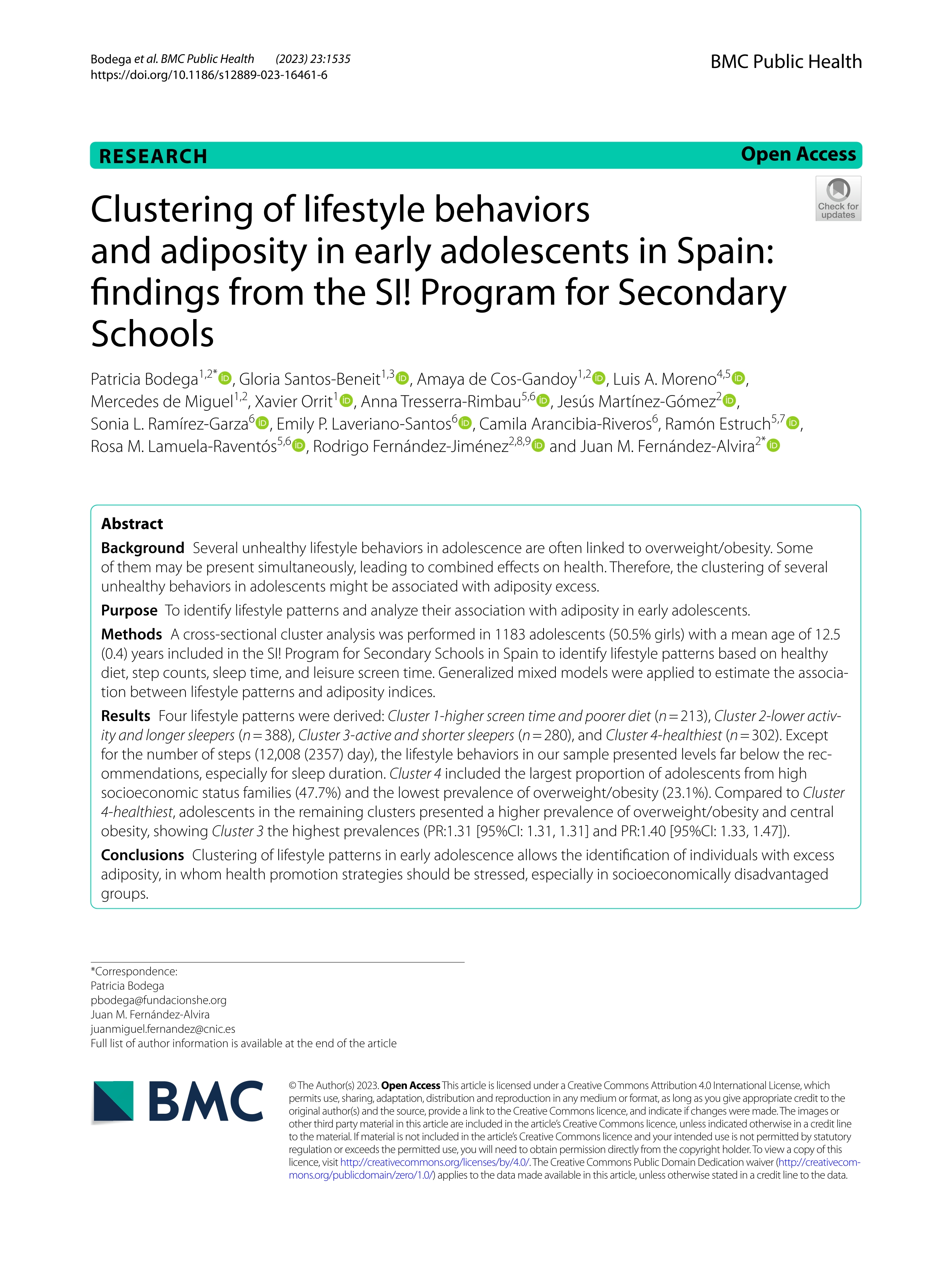
Resumen: Background
Several unhealthy lifestyle behaviors in adolescence are often linked to overweight/obesity. Some of them may be present simultaneously, leading to combined effects on health. Therefore, the clustering of several unhealthy behaviors in adolescents might be associated with adiposity excess.
Purpose
To identify lifestyle patterns and analyze their association with adiposity in early adolescents.
Methods
A cross-sectional cluster analysis was performed in 1183 adolescents (50.5% girls) with a mean age of 12.5 (0.4) years included in the SI! Program for Secondary Schools in Spain to identify lifestyle patterns based on healthy diet, step counts, sleep time, and leisure screen time. Generalized mixed models were applied to estimate the association between lifestyle patterns and adiposity indices.
Results
Four lifestyle patterns were derived: Cluster 1-higher screen time and poorer diet (n = 213), Cluster 2-lower activity and longer sleepers (n = 388), Cluster 3-active and shorter sleepers (n = 280), and Cluster 4-healthiest (n = 302). Except for the number of steps (12,008 (2357) day), the lifestyle behaviors in our sample presented levels far below the recommendations, especially for sleep duration. Cluster 4 included the largest proportion of adolescents from high socioeconomic status families (47.7%) and the lowest prevalence of overweight/obesity (23.1%). Compared to Cluster 4-healthiest, adolescents in the remaining clusters presented a higher prevalence of overweight/obesity and central obesity, showing Cluster 3 the highest prevalences (PR:1.31 [95%CI: 1.31, 1.31] and PR:1.40 [95%CI: 1.33, 1.47]).
Conclusions
Clustering of lifestyle patterns in early adolescence allows the identification of individuals with excess adiposity, in whom health promotion strategies should be stressed, especially in socioeconomically disadvantaged groups.
Trial registration
Clinical Trial Registry, NCT03504059. Registered 20/04/2018—Retrospectively registered, https://clinicaltrials.gov/ct2/show/NCT03504059.
Idioma: Inglés
DOI: 10.1186/s12889-023-16461-6
Año: 2023
Publicado en: BMC PUBLIC HEALTH 23, 1535 (2023), 1-9
ISSN: 1471-2458
Factor impacto JCR: 3.5 (2023)
Categ. JCR: PUBLIC, ENVIRONMENTAL & OCCUPATIONAL HEALTH rank: 85 / 408 = 0.208 (2023) - Q1 - T1
Factor impacto CITESCORE: 6.5 - Public Health, Environmental and Occupational Health (Q1)
Factor impacto SCIMAGO: 1.253 - Public Health, Environmental and Occupational Health (Q1)
Financiación: info:eu-repo/grantAgreement/ES/ISCIII-FEDER-FIS/PI17-01704
Financiación: info:eu-repo/grantAgreement/ES/ISCIII/PI22-01560
Financiación: info:eu-repo/grantAgreement/ES/MCIU/FPU21-04891
Financiación: info:eu-repo/grantAgreement/ES/MICINN/CEX2020-001041-S
Financiación: info:eu-repo/grantAgreement/ES/MICINN/PID2020-114022RB-I00
Tipo y forma: Article (Published version)
Área (Departamento): Área Enfermería (Dpto. Fisiatría y Enfermería)
 You must give appropriate credit, provide a link to the license, and indicate if changes were made. You may do so in any reasonable manner, but not in any way that suggests the licensor endorses you or your use.
Exportado de SIDERAL (2024-11-22-12:10:27)
Visitas y descargas
Several unhealthy lifestyle behaviors in adolescence are often linked to overweight/obesity. Some of them may be present simultaneously, leading to combined effects on health. Therefore, the clustering of several unhealthy behaviors in adolescents might be associated with adiposity excess.
Purpose
To identify lifestyle patterns and analyze their association with adiposity in early adolescents.
Methods
A cross-sectional cluster analysis was performed in 1183 adolescents (50.5% girls) with a mean age of 12.5 (0.4) years included in the SI! Program for Secondary Schools in Spain to identify lifestyle patterns based on healthy diet, step counts, sleep time, and leisure screen time. Generalized mixed models were applied to estimate the association between lifestyle patterns and adiposity indices.
Results
Four lifestyle patterns were derived: Cluster 1-higher screen time and poorer diet (n = 213), Cluster 2-lower activity and longer sleepers (n = 388), Cluster 3-active and shorter sleepers (n = 280), and Cluster 4-healthiest (n = 302). Except for the number of steps (12,008 (2357) day), the lifestyle behaviors in our sample presented levels far below the recommendations, especially for sleep duration. Cluster 4 included the largest proportion of adolescents from high socioeconomic status families (47.7%) and the lowest prevalence of overweight/obesity (23.1%). Compared to Cluster 4-healthiest, adolescents in the remaining clusters presented a higher prevalence of overweight/obesity and central obesity, showing Cluster 3 the highest prevalences (PR:1.31 [95%CI: 1.31, 1.31] and PR:1.40 [95%CI: 1.33, 1.47]).
Conclusions
Clustering of lifestyle patterns in early adolescence allows the identification of individuals with excess adiposity, in whom health promotion strategies should be stressed, especially in socioeconomically disadvantaged groups.
Trial registration
Clinical Trial Registry, NCT03504059. Registered 20/04/2018—Retrospectively registered, https://clinicaltrials.gov/ct2/show/NCT03504059.
Idioma: Inglés
DOI: 10.1186/s12889-023-16461-6
Año: 2023
Publicado en: BMC PUBLIC HEALTH 23, 1535 (2023), 1-9
ISSN: 1471-2458
Factor impacto JCR: 3.5 (2023)
Categ. JCR: PUBLIC, ENVIRONMENTAL & OCCUPATIONAL HEALTH rank: 85 / 408 = 0.208 (2023) - Q1 - T1
Factor impacto CITESCORE: 6.5 - Public Health, Environmental and Occupational Health (Q1)
Factor impacto SCIMAGO: 1.253 - Public Health, Environmental and Occupational Health (Q1)
Financiación: info:eu-repo/grantAgreement/ES/ISCIII-FEDER-FIS/PI17-01704
Financiación: info:eu-repo/grantAgreement/ES/ISCIII/PI22-01560
Financiación: info:eu-repo/grantAgreement/ES/MCIU/FPU21-04891
Financiación: info:eu-repo/grantAgreement/ES/MICINN/CEX2020-001041-S
Financiación: info:eu-repo/grantAgreement/ES/MICINN/PID2020-114022RB-I00
Tipo y forma: Article (Published version)
Área (Departamento): Área Enfermería (Dpto. Fisiatría y Enfermería)
You must give appropriate credit, provide a link to the license, and indicate if changes were made. You may do so in any reasonable manner, but not in any way that suggests the licensor endorses you or your use. Exportado de SIDERAL (2024-11-22-12:10:27)
Permalink:
Visitas y descargas
Este artículo se encuentra en las siguientes colecciones:
Articles > Artículos por área > Enfermería
Record created 2024-02-19, last modified 2024-11-25