Sustainable ß- and ¿-cyclodextrins for development of highly permeable thin film composite nanofiltration membranes
Pina-Vidal, Cristina (Universidad de Zaragoza) ; Luque-Alled, Jose Miguel (Universidad de Zaragoza) ; Coronas, Joaquín (Universidad de Zaragoza) ; Téllez, Carlos (Universidad de Zaragoza)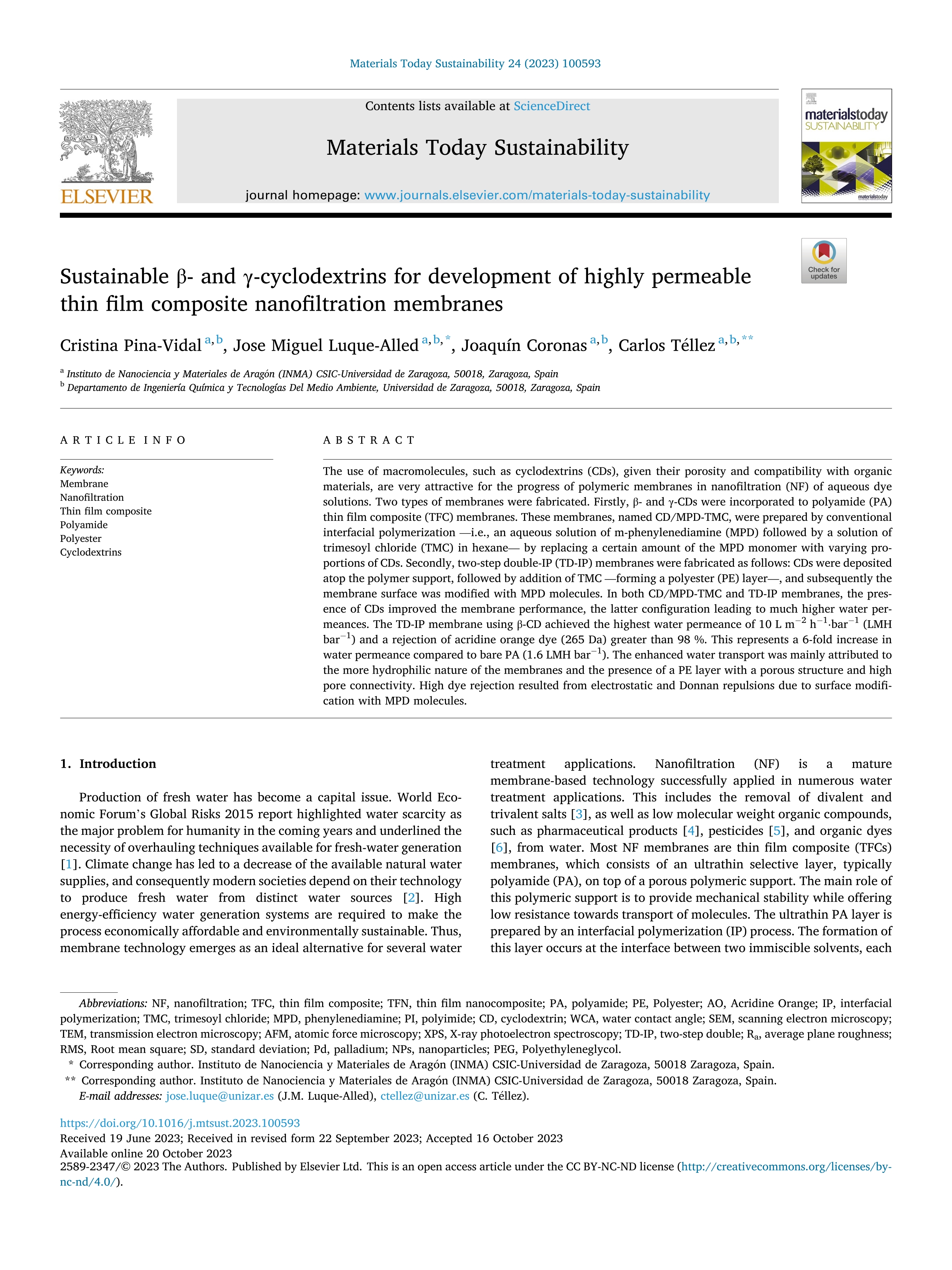
Resumen: The use of macromolecules, such as cyclodextrins (CDs), given their porosity and compatibility with organic materials, are very attractive for the progress of polymeric membranes in nanofiltration (NF) of aqueous dye solutions. Two types of membranes were fabricated. Firstly, β- and γ-CDs were incorporated to polyamide (PA) thin film composite (TFC) membranes. These membranes, named CD/MPD-TMC, were prepared by conventional interfacial polymerization —i.e., an aqueous solution of m-phenylenediamine (MPD) followed by a solution of trimesoyl chloride (TMC) in hexane— by replacing a certain amount of the MPD monomer with varying proportions of CDs. Secondly, two-step double-IP (TD-IP) membranes were fabricated as follows: CDs were deposited atop the polymer support, followed by addition of TMC —forming a polyester (PE) layer—, and subsequently the membrane surface was modified with MPD molecules. In both CD/MPD-TMC and TD-IP membranes, the presence of CDs improved the membrane performance, the latter configuration leading to much higher water permeances. The TD-IP membrane using β-CD achieved the highest water permeance of 10 L m−2 h−1·bar−1 (LMH bar−1) and a rejection of acridine orange dye (265 Da) greater than 98 %. This represents a 6-fold increase in water permeance compared to bare PA (1.6 LMH bar−1). The enhanced water transport was mainly attributed to the more hydrophilic nature of the membranes and the presence of a PE layer with a porous structure and high pore connectivity. High dye rejection resulted from electrostatic and Donnan repulsions due to surface modification with MPD molecules.
Idioma: Inglés
DOI: 10.1016/j.mtsust.2023.100593
Año: 2023
Publicado en: Materials Today Sustainability 24 (2023), 100593 [12 pp.]
ISSN: 2589-2347
Factor impacto JCR: 7.1 (2023)
Categ. JCR: GREEN & SUSTAINABLE SCIENCE & TECHNOLOGY rank: 21 / 91 = 0.231 (2023) - Q1 - T1
Categ. JCR: MATERIALS SCIENCE, MULTIDISCIPLINARY rank: 87 / 439 = 0.198 (2023) - Q1 - T1
Factor impacto CITESCORE: 5.8 - Renewable Energy, Sustainability and the Environment (Q2) - Chemistry (all) (Q2) - Materials Science (all) (Q2)
Factor impacto SCIMAGO: 1.244 - Chemistry (miscellaneous) (Q1) - Renewable Energy, Sustainability and the Environment (Q1) - Materials Science (miscellaneous) (Q1)
Financiación: info:eu-repo/grantAgreement/ES/DGA-FSE/T43-20R
Financiación: info:eu-repo/grantAgreement/ES/DGA/T68-23R
Financiación: info:eu-repo/grantAgreement/ES/FJC-2021-047822-I
Financiación: info:eu-repo/grantAgreement/ES/MCIN-AEI/PID2019-104009RB-I00-AEI-10.13039-501100011033
Tipo y forma: Article (Published version)
Área (Departamento): Área Ingeniería Química (Dpto. Ing.Quím.Tecnol.Med.Amb.)
 You must give appropriate credit, provide a link to the license, and indicate if changes were made. You may do so in any reasonable manner, but not in any way that suggests the licensor endorses you or your use. You may not use the material for commercial purposes. If you remix, transform, or build upon the material, you may not distribute the modified material.
Exportado de SIDERAL (2024-11-22-12:02:31)
Visitas y descargas
Idioma: Inglés
DOI: 10.1016/j.mtsust.2023.100593
Año: 2023
Publicado en: Materials Today Sustainability 24 (2023), 100593 [12 pp.]
ISSN: 2589-2347
Factor impacto JCR: 7.1 (2023)
Categ. JCR: GREEN & SUSTAINABLE SCIENCE & TECHNOLOGY rank: 21 / 91 = 0.231 (2023) - Q1 - T1
Categ. JCR: MATERIALS SCIENCE, MULTIDISCIPLINARY rank: 87 / 439 = 0.198 (2023) - Q1 - T1
Factor impacto CITESCORE: 5.8 - Renewable Energy, Sustainability and the Environment (Q2) - Chemistry (all) (Q2) - Materials Science (all) (Q2)
Factor impacto SCIMAGO: 1.244 - Chemistry (miscellaneous) (Q1) - Renewable Energy, Sustainability and the Environment (Q1) - Materials Science (miscellaneous) (Q1)
Financiación: info:eu-repo/grantAgreement/ES/DGA-FSE/T43-20R
Financiación: info:eu-repo/grantAgreement/ES/DGA/T68-23R
Financiación: info:eu-repo/grantAgreement/ES/FJC-2021-047822-I
Financiación: info:eu-repo/grantAgreement/ES/MCIN-AEI/PID2019-104009RB-I00-AEI-10.13039-501100011033
Tipo y forma: Article (Published version)
Área (Departamento): Área Ingeniería Química (Dpto. Ing.Quím.Tecnol.Med.Amb.)
You must give appropriate credit, provide a link to the license, and indicate if changes were made. You may do so in any reasonable manner, but not in any way that suggests the licensor endorses you or your use. You may not use the material for commercial purposes. If you remix, transform, or build upon the material, you may not distribute the modified material. Exportado de SIDERAL (2024-11-22-12:02:31)
Permalink:
Visitas y descargas
Este artículo se encuentra en las siguientes colecciones:
Articles > Artículos por área > Ingeniería Química
Record created 2024-02-19, last modified 2024-11-25