Understanding the protective effect of social support on depression symptomatology from a longitudinal network perspective
Li, Gen ; Li, Yifan ; Lam, Agnes Iok Fong ; Tang, Weiming ; Seedat, Soraya ; Barbui, Corrado ; Papola, Davide ; Panter-Brick, Catherine ; Waerden, Judith van der ; Bryant, Richard ; Mittendorfer-Rutz, Ellenor ; Gémes, Katalin ; Purba, Fredrick D ; Setyowibowo, Hari ; Pinucci, Irene ; Palantza, Christina ; Acarturk, Ceren ; Kurt, Gülsah ; Tarsitani, Lorenzo ; Morina, Naser ; Burchert, Sebastian ; Patanè, Martina ; Quero, Soledad ; Campos, Daniel (Universidad de Zaragoza) ; Huizink, Anja C ; Fuhr, Daniela C ; Spiller, Tobias ; Sijbrandij, Marit ; Hall, Brian J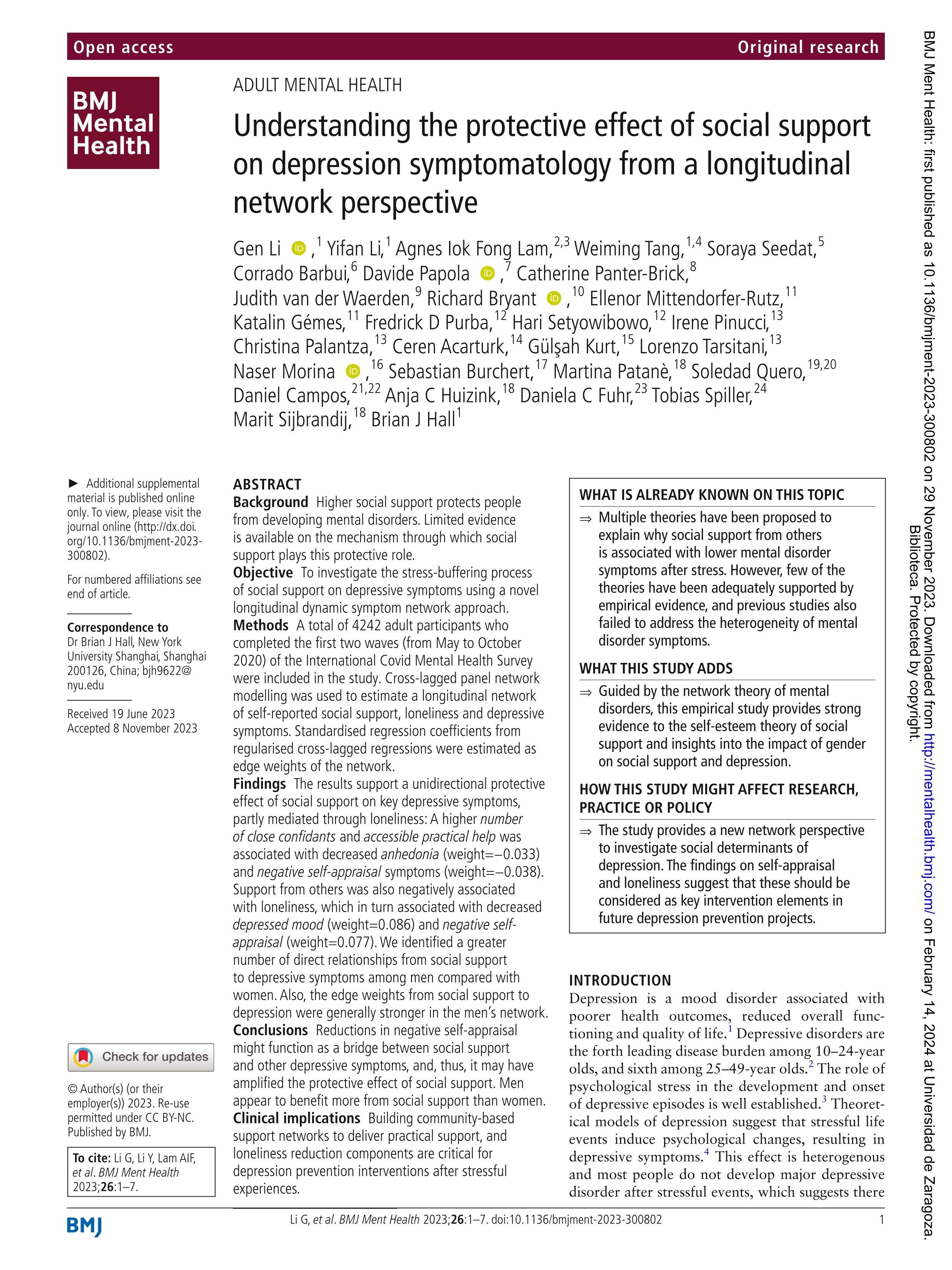
Resumen: Higher social support protects people from developing mental disorders. Limited evidence is available on the mechanism through which social support plays this protective role.ObjectiveTo investigate the stress-buffering process of social support on depressive symptoms using a novel longitudinal dynamic symptom network approach.MethodsA total of 4242 adult participants who completed the first two waves (from May to October 2020) of the International Covid Mental Health Survey were included in the study. Cross-lagged panel network modelling was used to estimate a longitudinal network of self-reported social support, loneliness and depressive symptoms. Standardised regression coefficients from regularised cross-lagged regressions were estimated as edge weights of the network.FindingsThe results support a unidirectional protective effect of social support on key depressive symptoms, partly mediated through loneliness: A highernumber of close confidantsandaccessible practical helpwas associated with decreasedanhedonia(weight=−0.033) andnegative self-appraisalsymptoms (weight=−0.038). Support from others was also negatively associated with loneliness, which in turn associated with decreaseddepressed mood(weight=0.086) andnegative self-appraisal(weight=0.077). We identified a greater number of direct relationships from social support to depressive symptoms among men compared with women. Also, the edge weights from social support to depression were generally stronger in the men’s network.ConclusionsReductions in negative self-appraisal might function as a bridge between social support and other depressive symptoms, and, thus, it may have amplified the protective effect of social support. Men appear to benefit more from social support than women.Clinical implicationsBuilding community-based support networks to deliver practical support, and loneliness reduction components are critical for depression prevention interventions after stressful experiences.
Idioma: Inglés
DOI: 10.1136/bmjment-2023-300802
Año: 2023
Publicado en: BMJ Mental Health 26, 1 (2023), e300802
ISSN: 2755-9734
Factor impacto JCR: 0.0 (2023)
Categ. JCR: PSYCHIATRY
Factor impacto CITESCORE: 6.8 - Psychiatry and Mental Health (Q1)
Factor impacto SCIMAGO: 1.912 - Psychiatry and Mental Health (Q1)
Tipo y forma: Article (Published version)
Área (Departamento): Área Psicolog.Evolut.Educac (Dpto. Psicología y Sociología)
 You must give appropriate credit, provide a link to the license, and indicate if changes were made. You may do so in any reasonable manner, but not in any way that suggests the licensor endorses you or your use. You may not use the material for commercial purposes.
Exportado de SIDERAL (2024-11-22-12:10:46)
Visitas y descargas
Idioma: Inglés
DOI: 10.1136/bmjment-2023-300802
Año: 2023
Publicado en: BMJ Mental Health 26, 1 (2023), e300802
ISSN: 2755-9734
Factor impacto JCR: 0.0 (2023)
Categ. JCR: PSYCHIATRY
Factor impacto CITESCORE: 6.8 - Psychiatry and Mental Health (Q1)
Factor impacto SCIMAGO: 1.912 - Psychiatry and Mental Health (Q1)
Tipo y forma: Article (Published version)
Área (Departamento): Área Psicolog.Evolut.Educac (Dpto. Psicología y Sociología)
You must give appropriate credit, provide a link to the license, and indicate if changes were made. You may do so in any reasonable manner, but not in any way that suggests the licensor endorses you or your use. You may not use the material for commercial purposes. Exportado de SIDERAL (2024-11-22-12:10:46)
Permalink:
Visitas y descargas
Este artículo se encuentra en las siguientes colecciones:
Articles > Artículos por área > Psicología Evolutiva y de la Educación
Record created 2024-02-19, last modified 2024-11-25