Making Aid Work: Institutional Thresholds and FDI
Wang, Dongni ; Fillat Castejón, Carmen (Universidad de Zaragoza)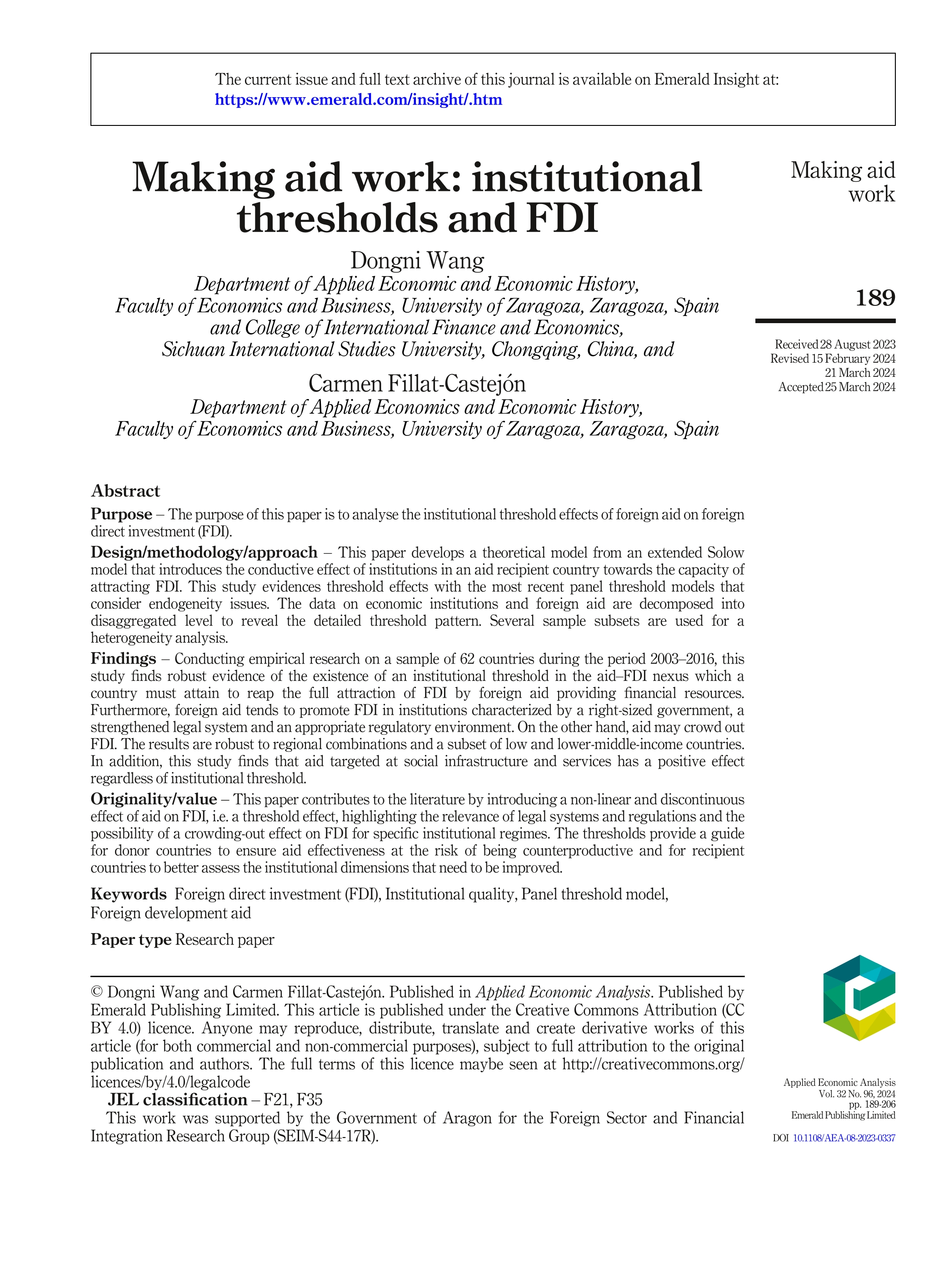
Resumen: Purpose – The purpose of this paper is to analyse the institutional threshold effects of foreign aid on FDI.
Design/methodology/approach – This paper develops a theoretical model from an extended Solow model that introduces the conductive effect of institutions in an aid recipient country towards the capacity of attracting FDI. We evidence threshold effects with the most recent panel threshold models that consider endogeneity issues. The data on economic institutions and foreign aid are decomposed into disaggregated level to reveal the detailed threshold pattern. Several sample subsets are used for a heterogeneity analysis.
Findings – Conducting empirical research on a sample of 62 countries during the period 2003-2016, we find robust evidence of the existence of an institutional threshold in the aid-FDI nexus which a country must attain to reap the full attraction of FDI by foreign aid providing financial resources. Furthermore, foreign aid tends to promote FDI in institutions characterized by a right-sized government, a strengthened legal system, and an appropriate regulatory environment. On the other hand, aid may crowd out FDI. The results are robust to regional combinations and a subset of low and lower-middle income countries. In addition, we find that aid targeted at social infrastructure and services has a positive effect regardless of institutional threshold.
Originality/value –This paper contributes to the literature by introducing a non-linear and discontinuous effect of aid on FDI, i.e., a threshold effect, highlighting the relevance of legal systems and regulations and the possibility of a crowding-out effect on FDI for specific institutional regimes. The thresholds provide a guide for donor countries to ensure aid effectiveness at the risk of being counterproductive, and for recipient countries to better assess the institutional dimensions that need to be improved.
Idioma: Inglés
DOI: 10.1108/AEA-08-2023-0337
Año: 2024
Publicado en: Applied Economic Analysis 32, 96 (2024), 189-206
ISSN: 2632-7627
Originalmente disponible en: Texto completo de la revista
Factor impacto JCR: 2.5 (2024)
Categ. JCR: ECONOMICS rank: 154 / 620 = 0.248 (2024) - Q1 - T1
Factor impacto CITESCORE: 3.7 - Economics, Econometrics and Finance (all) (Q1)
Factor impacto SCIMAGO: 0.433 - Economics, Econometrics and Finance (miscellaneous) (Q2)
Financiación: info:eu-repo/grantAgreement/ES/DGA/S44-17R
Tipo y forma: Article (Published version)
Área (Departamento): Área Economía Aplicada (Dpto. Economía Aplicada)
 You must give appropriate credit, provide a link to the license, and indicate if changes were made. You may do so in any reasonable manner, but not in any way that suggests the licensor endorses you or your use.
Exportado de SIDERAL (2026-02-17-20:20:58)
Visitas y descargas
Design/methodology/approach – This paper develops a theoretical model from an extended Solow model that introduces the conductive effect of institutions in an aid recipient country towards the capacity of attracting FDI. We evidence threshold effects with the most recent panel threshold models that consider endogeneity issues. The data on economic institutions and foreign aid are decomposed into disaggregated level to reveal the detailed threshold pattern. Several sample subsets are used for a heterogeneity analysis.
Findings – Conducting empirical research on a sample of 62 countries during the period 2003-2016, we find robust evidence of the existence of an institutional threshold in the aid-FDI nexus which a country must attain to reap the full attraction of FDI by foreign aid providing financial resources. Furthermore, foreign aid tends to promote FDI in institutions characterized by a right-sized government, a strengthened legal system, and an appropriate regulatory environment. On the other hand, aid may crowd out FDI. The results are robust to regional combinations and a subset of low and lower-middle income countries. In addition, we find that aid targeted at social infrastructure and services has a positive effect regardless of institutional threshold.
Originality/value –This paper contributes to the literature by introducing a non-linear and discontinuous effect of aid on FDI, i.e., a threshold effect, highlighting the relevance of legal systems and regulations and the possibility of a crowding-out effect on FDI for specific institutional regimes. The thresholds provide a guide for donor countries to ensure aid effectiveness at the risk of being counterproductive, and for recipient countries to better assess the institutional dimensions that need to be improved.
Idioma: Inglés
DOI: 10.1108/AEA-08-2023-0337
Año: 2024
Publicado en: Applied Economic Analysis 32, 96 (2024), 189-206
ISSN: 2632-7627
Originalmente disponible en: Texto completo de la revista
Factor impacto JCR: 2.5 (2024)
Categ. JCR: ECONOMICS rank: 154 / 620 = 0.248 (2024) - Q1 - T1
Factor impacto CITESCORE: 3.7 - Economics, Econometrics and Finance (all) (Q1)
Factor impacto SCIMAGO: 0.433 - Economics, Econometrics and Finance (miscellaneous) (Q2)
Financiación: info:eu-repo/grantAgreement/ES/DGA/S44-17R
Tipo y forma: Article (Published version)
Área (Departamento): Área Economía Aplicada (Dpto. Economía Aplicada)
You must give appropriate credit, provide a link to the license, and indicate if changes were made. You may do so in any reasonable manner, but not in any way that suggests the licensor endorses you or your use. Exportado de SIDERAL (2026-02-17-20:20:58)
Permalink:
Visitas y descargas
Este artículo se encuentra en las siguientes colecciones:
Articles > Artículos por área > Economía Aplicada
Record created 2024-04-10, last modified 2026-02-17